
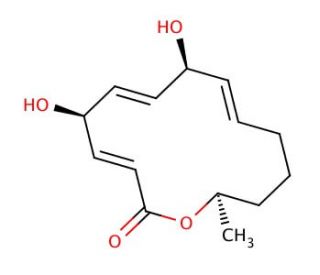

Mutolide (CAS 277749-34-5)
QUICK LINKS
Mutolide is a macrocyclic lactone, a class of chemical compounds that are typically characterized by their large ring structures containing ester functionalities. This compound has been isolated from various natural sources, including soil bacteria, which have been a prolific source of structurally diverse and biologically active macrocyclic lactones. The intriguing chemical structure of Mutolide includes a lactone ring which is crucial for its biological activity, particularly its interactions with other organic molecules. In research, Mutolide has been primarily studied for its role as a signaling molecule in microbial communities. Its mechanism of action is believed to involve the modulation of quorum sensing pathways, which are critical for bacterial communication and coordination of group behaviors such as biofilm formation and virulence factor production. By influencing these pathways, Mutolide serves as a tool for studying microbial ecology and the complex interactions within microbial populations. Additionally, its role in potentially disrupting pathogenic bacterial communications offers a valuable perspective in the study of alternative strategies for controlling microbial growth and preventing bacterial infections, without employing traditional antibiotics. Thus, Mutolide contributes significantly to research in microbial pathogenesis, ecology, and the development of novel anti-infective strategies.
Mutolide (CAS 277749-34-5) References
- Synthesis of (+)-sch 642305 by a biomimetic transannular Michael reaction. | Snider, BB. and Zhou, J. 2006. Org Lett. 8: 1283-6. PMID: 16562872
- Small-molecule elicitation of microbial secondary metabolites. | Pettit, RK. 2011. Microb Biotechnol. 4: 471-8. PMID: 21375710
- Mining the metabiome: identifying novel natural products from microbial communities. | Milshteyn, A., et al. 2014. Chem Biol. 21: 1211-23. PMID: 25237864
- The Sound of Silence: Activating Silent Biosynthetic Gene Clusters in Marine Microorganisms. | Reen, FJ., et al. 2015. Mar Drugs. 13: 4754-83. PMID: 26264003
- Anti-inflammatory properties of mutolide isolated from the fungus Lepidosphaeria species (PM0651419). | Shah, M., et al. 2015. Springerplus. 4: 706. PMID: 26618095
- Sesterterpenes and macrolide derivatives from the endophytic fungus Aplosporella javeedii. | Gao, Y., et al. 2020. Fitoterapia. 146: 104652. PMID: 32512149
- Putative Anticancer Compounds from Plant-Derived Endophytic Fungi: A Review. | Hridoy, M., et al. 2022. Molecules. 27: PMID: 35011527
- Fungal Endophytes: A Potential Source of Antibacterial Compounds. | Deshmukh, SK., et al. 2022. J Fungi (Basel). 8: PMID: 35205918
- Investigating the biosynthesis of Sch-642305 in the fungus Phomopsis sp. CMU-LMA. | Trenti, F., et al. 2020. RSC Adv. 10: 27369-27376. PMID: 35516937
- Total Synthesis and Biological Evaluation of Mutolide and Analogues. | Thiraporn, A., et al. 2022. Chem Asian J. 17: e202200329. PMID: 35727893
Ordering Information
| Product Name | Catalog # | UNIT | Price | Qty | FAVORITES | |
Mutolide, 1 mg | sc-364121 | 1 mg | $160.00 | |||
Mutolide, 5 mg | sc-364121A | 5 mg | $510.00 |