
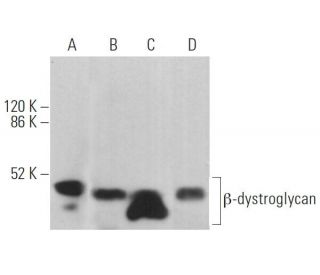
β-dystroglycan Anticuerpo (4F7): sc-33702
- beta-dystroglycan Anticuerpo 4F7 es un monoclonal de ratón IgG2b κ β-dystroglycan Anticuerpo, ver las 20 publicaciones, proporcionado como 200 µg/ml
- levantado contra el C-terminus de human β-dystroglycan
- beta-dystroglycan Anticuerpo (4F7) es recomendado para detectar β-dystroglycan de mouse, rat y human origen, mediante WB, IP, IF y IHC(P)
- beta-dystroglycan Anticuerpo (4F7) es disponible conjugado a agarosa para IP; HRP para WB, IHC(P) y ELISA; y tanto a phycoerythrin como a FITC para IF, IHC(P) y FCM
- también disponible conjugado a Alexa Fluor® 488, Alexa Fluor® 546, Alexa Fluor® 594 o Alexa Fluor® 647 para WB (RGB), IF, IHC (P) y FCM
- también disponible conjugado a Alexa Fluor® 680 o Alexa Fluor® 790 para WB (NIR), IF y FCM
- m-IgG Fc BP-HRP, 2b BP-HRP">m-IgG2b BP-HRP y m-IgGκ BP-HRP son los reactivos de detección secundarios preferidos para β-dystroglycan Anticuerpo (4F7) para aplicaciones WB e IHC(P). Estos reactivos se ofrecen ahora en paquetes con β-dystroglycan Anticuerpo (4F7)(véase la información de pedido más abajo).

ENLACES RÁPIDOS
El anticuerpo β-distroglicano (4F7) es un anticuerpo monoclonal IgG2b de ratón de cadena ligera kappa que detecta β-distroglicano de origen de ratón, rata y humano mediante western blotting (WB), inmunoprecipitación (IP), inmunofluorescencia (IF) e inmunohistoquímica. El anticuerpo β-distroglicano (4F7) está disponible tanto en forma no conjugada como en varias formas conjugadas, incluyendo agarosa, peroxidasa de rábano picante (HRP), ficoeritrina (PE), isotiocianato de fluoresceína (FITC) y múltiples conjugados Alexa Fluor®. El β-distroglicano desempeña un papel crucial como receptor de la superficie celular para varios componentes de la matriz extracelular, como las lamininas, la agrina y el perlecano, que son esenciales para la formación de la membrana basal durante el desarrollo temprano y la correcta organización de la laminina en la superficie celular. Esta función mantiene la integridad de los tejidos y facilita la señalización celular. El β-distroglicano forma un complejo con el α-distroglicano, anclando el α-distroglicano a la membrana celular, y participa en un complejo multimolecular mayor que incluye la distrofina en el sarcolema y la utrofina en la unión neuromuscular. Estas interacciones son críticas para la agrupación de los receptores nicotínicos de acetilcolina, necesarios para una transmisión neuromuscular eficaz. El anticuerpo anti-β-distroglicano (4F7) es una herramienta inestimable para los investigadores que estudian la biología muscular y las patologías relacionadas.
Alexa Fluor® es una marca registrada de Molecular Probes Inc., OR., USA
REIVEW LI-COR® y Odyssey® son marcas registradas de LI-COR Biosciences.
β-dystroglycan Anticuerpo (4F7) Referencias:
- Los ratones quiméricos deficientes en distroglicanos desarrollan distrofia muscular y tienen alteradas las sinapsis mioneurales. | Côté, PD., et al. 1999. Nat Genet. 23: 338-42. PMID: 10610181
- Caracterización de la interacción beta-distroglucano-receptor del factor de crecimiento 2 (Grb2). | Russo, K., et al. 2000. Biochem Biophys Res Commun. 274: 93-8. PMID: 10903901
- Orientación diferencial de componentes del complejo de distrofina a la membrana postsináptica. | Marchand, S., et al. 2001. Eur J Neurosci. 13: 221-9. PMID: 11168526
- Funciones distintas del distroglicano, la integrina beta1 y el perlecano en la organización de la laminina de la superficie celular. | Henry, MD., et al. 2001. J Cell Sci. 114: 1137-44. PMID: 11228157
- Expresión del complejo distroglicano en las células satélite de los ganglios de la raíz dorsal. | Masaki, T., et al. 2001. Acta Neuropathol. 101: 174-8. PMID: 11271373
- Síntesis de aminoácidos glucosilados derivados del alfa-distroglicano que llevan un nuevo enlace mannosil serina/treonina. | Seifert, J., et al. 2000. Glycoconj J. 17: 407-23. PMID: 11294507
- Beta-distroglicano como diana para MMP-9, en respuesta a una mayor actividad neuronal. | Michaluk, P., et al. 2007. J Biol Chem. 282: 16036-41. PMID: 17426029
- Tráfico retrógrado de β-distroglicano desde la membrana plasmática al núcleo. | Gracida-Jiménez, V., et al. 2017. Sci Rep. 7: 9906. PMID: 28852008
- La aparición de β-distroglicano precede a la formación de los pies terminales gliovasculares en el cerebro de rata en desarrollo. | Kálmán, M., et al. 2018. Eur J Histochem. 62: 2908. PMID: 29943956
- El gradiente anterior 2 interviene en la regulación post-transcripcional del β-dystroglicano. | Lee, E. and Lee, DH. 2021. Anim Cells Syst (Seoul). 25: 19-27. PMID: 33717413
- El MiR-132 regula a la baja la degradación del β-distroglicano inducida por la glucosa alta a través de la regulación al alza de las metaloproteinasas de la matriz-9 en las neuronas primarias. | Dou, Y., et al. 2021. J Cell Mol Med. 25: 7783-7795. PMID: 34160889
- El complejo alfa-distroglicano-beta-distroglicano. Organización de la membrana y relación con un receptor de agrina. | Deyst, KA., et al. 1995. J Biol Chem. 270: 25956-9. PMID: 7592785
Información sobre pedidos
| Nombre del producto | Número de catálogo | UNIDAD | Precio | CANTIDAD | Favoritos | |
β-dystroglycan Anticuerpo (4F7) | sc-33702 | 200 µg/ml | $322.00 | |||
Paquete de β-dystroglycan (4F7): m-IgG Fc BP-HRP | sc-528488 | 200 µg Ab; 10 µg BP | $361.00 | |||
Paquete de β-dystroglycan (4F7): m-IgGκ BP-HRP | sc-520879 | 200 µg Ab, 40 µg BP | $361.00 | |||
Paquete de β-dystroglycan (4F7): m-IgG2b BP-HRP | sc-550043 | 200 µg Ab; 10 µg BP | $361.00 | |||
β-dystroglycan Anticuerpo (4F7) AC | sc-33702 AC | 500 µg/ml, 25% agarose | $424.00 | |||
β-dystroglycan Anticuerpo (4F7) HRP | sc-33702 HRP | 200 µg/ml | $322.00 | |||
β-dystroglycan Anticuerpo (4F7) FITC | sc-33702 FITC | 200 µg/ml | $336.00 | |||
β-dystroglycan Anticuerpo (4F7) PE | sc-33702 PE | 200 µg/ml | $349.00 | |||
β-dystroglycan Anticuerpo (4F7) Alexa Fluor® 488 | sc-33702 AF488 | 200 µg/ml | $364.00 | |||
β-dystroglycan Anticuerpo (4F7) Alexa Fluor® 546 | sc-33702 AF546 | 200 µg/ml | $364.00 | |||
β-dystroglycan Anticuerpo (4F7) Alexa Fluor® 594 | sc-33702 AF594 | 200 µg/ml | $364.00 | |||
β-dystroglycan Anticuerpo (4F7) Alexa Fluor® 647 | sc-33702 AF647 | 200 µg/ml | $364.00 | |||
β-dystroglycan Anticuerpo (4F7) Alexa Fluor® 680 | sc-33702 AF680 | 200 µg/ml | $364.00 | |||
β-dystroglycan Anticuerpo (4F7) Alexa Fluor® 790 | sc-33702 AF790 | 200 µg/ml | $364.00 |