
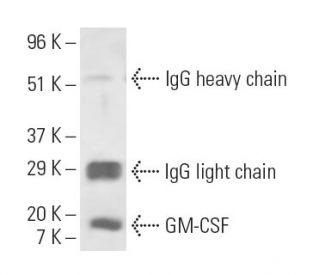

GM-CSF Anticuerpo (1D11): sc-32805
- GM-CSF Anticuerpo 1D11 es un monoclonal de ratón IgG1 proporcionado como 200 µg/ml
- producido contra una proteina recombinante GM-CSF de origen human
- recomendado para detectar GM-CSF de human origen, mediante WBIP
- también sin azida para neutralización, sc-32805 L, 200 µg/0.1 ml L, 200 µg/0.1 ml
- Actualmente, aún no hemos completado la identificación de los reactivos de detección secundaria preferidos para GM-CSF Anticuerpo (1D11). Este trabajo está en progreso.

ENLACES RÁPIDOS
VER TAMBIÉN ....
Los factores estimulantes de colonias (CSFs) fueron inicialmente caracterizados por su capacidad para estimular la formación de colonias in vitro por células progenitoras hematopoyéticas en medios semisólidos. Varios de estos CSFs han sido asignados a un número de interleucina, mientras que tres (GM-CSF, G-CSF y M-CSF) han mantenido sus designaciones de CSF. El factor estimulante de colonias granulocito-macrófago humano (GM-CSF) es una citocina pleiotrópica con un péptido señal de 17 aminoácidos que se escinde para producir la forma madura de 127 aminoácidos. La proteína madura de GM-CSF murino tiene 124 aminoácidos y comparte un 60% de homología con la proteína humana de GM-CSF. GM-CSF es una glicoproteína que puede estimular la proliferación de células hematopoyéticas, incluyendo granulocitos y macrófagos. Se ha demostrado que promueve la fosforilación de cPLA2 en neutrófilos humanos. La fosforilación de cPLA2 puede ir acompañada de un aumento en la actividad enzimática.
Alexa Fluor® es una marca registrada de Molecular Probes Inc., OR., USA
REIVEW LI-COR® y Odyssey® son marcas registradas de LI-COR Biosciences.
GM-CSF Anticuerpo (1D11) Referencias:
- Papel del G-CSF y el GM-CSF en los cánceres no mieloides. | Aliper, AM., et al. 2014. Cancer Med. 3: 737-46. PMID: 24692240
- Autoinmunidad más allá de los Th17: células T productoras de GM-CSF. | Zielinski, CE. 2014. Cell Cycle. 13: 2489-90. PMID: 25486188
- GM-CSF: Citocina moduladora inmunitaria que puede suprimir la autoinmunidad. | Bhattacharya, P., et al. 2015. Cytokine. 75: 261-71. PMID: 26113402
- Focalización de GM-CSF en la artritis reumatoide. | Avci, AB., et al. 2016. Clin Exp Rheumatol. 34: 39-44. PMID: 27586802
- El GM-CSF promueve un microambiente adiposo y pulmonar de apoyo en el cáncer de mama metastásico. | Reggiani, F. and Bertolini, F. 2017. Oncoscience. 4: 126-127. PMID: 29142902
- Papel del GM-CSF en la patogénesis de las enfermedades autoinmunes: An Update. | Lotfi, N., et al. 2019. Front Immunol. 10: 1265. PMID: 31275302
- El G-CSF y el GM-CSF son diferentes. ¿Cuál es mejor para COVID-19? | Lazarus, HM. and Gale, RP. 2021. Acta Haematol. 144: 355-359. PMID: 32791509
- Actualización sobre el GM-CSF y su posible papel en el tratamiento del melanoma. | O Dillman, R. 2020. Melanoma Manag. 7: MMT49. PMID: 32922731
- Ataque al GM-CSF en enfermedades inflamatorias y autoinmunes. | Achuthan, AA., et al. 2021. Semin Immunol. 54: 101523. PMID: 34776300
- La señalización del receptor GM-CSF/SYK/JNK/FOXO1/CD11c promueve la aterosclerosis. | Tsukui, D., et al. 2023. iScience. 26: 107293. PMID: 37520709
Información sobre pedidos
| Nombre del producto | Número de catálogo | UNIDAD | Precio | CANTIDAD | Favoritos | |
GM-CSF Anticuerpo (1D11) | sc-32805 | 200 µg/ml | $322.00 | |||
GM-CSF Anticuerpo (1D11) L | sc-32805 L | 200 µg/0.1 ml | $322.00 |