
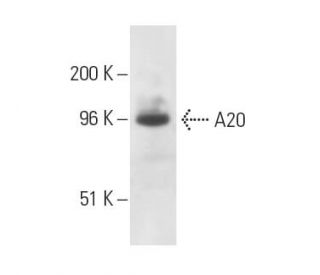

A20 抗体 (8E8. 38): sc-32797. Western 印迹分析 Jurkat 全细胞裂解液中 A20 的表达.
A20/TNFAIP3 抗体 (8E8.38): sc-32797
- A20/TNFAIP3 抗体 8E8.38 是小鼠单克隆 IgG1, 在1篇文献中引用,提供 200 µg/ml
- 与human A20的锌指结构域(对应于氨基酸375-537)结合
- 推荐用于 human 来源的A20 WB 和 IP检测
- 可用于凝胶迁移和ChIP的TransCruz试剂(sc-32797 X, 200 µg/0.1 ml)
- 看 A20/TNFAIP3 (A-12): sc-166692,可查看有标记的 A20/TNFAIP3 抗体,包括AC, HRP, FITC, PE, Alexa Fluor® 488, 594, 647, 680 和 790
- 目前,我们还没有完成A20/TNFAIP3 抗体 (8E8.38)的首选二抗检测试剂的鉴定。这项工作正在进行中。

快捷链接
相关产品
描述
基因信息
说明书与实验方案
研究信息
関連項目
A20抗体(8E8.38)是一种小鼠单克隆IgG1抗体,可通过蛋白质印迹(WB)和免疫沉淀(IP)等方法检测人类样本中的A20。A20是一种重要的Cys2/Cys2锌指蛋白,在肿瘤坏死因子(TNF)和白细胞介素1(IL-1)等多种炎症刺激下会上调,并作为核因子κB(NFκB)基因表达的负调控因子。通过抑制NFκB的激活,A20在炎症反应的消退中发挥着重要作用,从而防止细胞过度受损并促进组织稳态。A20的结构尤为重要,因为A20的C端区域包含七个锌指结构域,其中只有四个结构域对体外抑制TNF诱导的NFκB激活是必需的。这种结构特征使A20能够有效地与TRAF2、TRAF6和IkB激酶(IKK)γ等关键信号蛋白相互作用,这些蛋白对于调节细胞存活和凋亡至关重要。此外,A20与一种新型A20结合蛋白TXBP151的相互作用表明,A20通过某种机制发挥抗凋亡作用。鉴于A20在信号转导通路负反馈调节中的作用,A20和相关蛋白有望成为一系列炎症性疾病的潜在治疗靶点。
仅限研究使用。不适用于诊断和治疗用途。
订购信息
| 产品名称 | 产品编号 | 规格 | 价格 | 数量 | 收藏夹 | |
A20/TNFAIP3 抗体 (8E8.38) | sc-32797 | 200 µg/ml | $322.00 | |||
A20/TNFAIP3 抗体 (8E8.38) X | sc-32797 X | 200 µg/0.1 ml | $322.00 |