
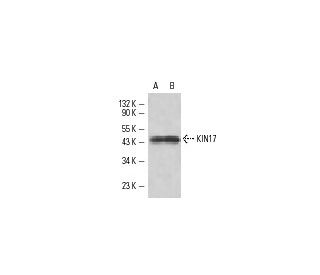
KIN17 Antibody (K36): sc-32768
- KIN17 Antibody (K36) is a mouse monoclonal IgG1 κ, cited in 1 publications, provided at 200 µg/ml
- recommended for detection of KIN17 of mouse, rat and human origin by WB, IP, IF, IHC(P) and FCM
- available conjugated to either phycoerythrin or FITC for IF, IHC(P) and FCM
- TransCruz reagent for Gel Supershift and ChIP applications (sc-32768 X, 200 µg/0.1 ml)
- m-IgG Fc BP-HRP and m-IgG1 BP-HRP are the preferred secondary detection reagents for KIN17 Antibody (K36) for WB and IHC(P) applications. These reagents are now offered in bundles with KIN17 Antibody (K36) (see ordering information below).

QUICK LINKS
SEE ALSO...
KIN17 Antibody (K36) is a mouse monoclonal IgG1 antibody that detects KIN17 protein of mouse, rat, and human origin by applications such as western blotting (WB), immunoprecipitation (IP), immunofluorescence (IF), immunohistochemistry, and flow cytometry (FCM). KIN17 is a crucial protein that plays a significant role in the cellular response to DNA damage, particularly by binding to bent or curved double-stranded DNA fragments found at illegitimate recombination sites, which is essential for maintaining genomic stability. KIN17 is ubiquitously expressed, with the highest levels found in muscle, heart, and testis tissues, highlighting KIN17′s importance in various physiological processes. Notably, KIN17 expression is upregulated in response to low doses of ionizing radiation and during hyperproliferative states in keratinocytes, indicating KIN17′s involvement in cellular stress responses and proliferation regulation. Furthermore, studies have shown that a decrease in KIN17 correlates with reduced cell proliferation and an accumulation of cells in early and mid-S phase, emphasizing KIN17′s role in cell cycle progression. KIN17′s interaction with SV40 Large T antigen, which reduces T-antigen-dependent DNA replication, further illustrates KIN17′s significance in viral replication and cellular transformation. The gene encoding human KIN17 is located on chromosome 10p14, making KIN17 a target of interest for studies related to cancer and other diseases associated with DNA damage and repair mechanisms.
Ordering Information
| Product Name | Catalog # | UNIT | Price | Qty | FAVORITES | |
KIN17 Antibody (K36) | sc-32768 | 200 µg/ml | $322.00 | |||
KIN17 Antibody (K36): m-IgG Fc BP-HRP Bundle | sc-538923 | 200 µg Ab; 10 µg BP | $361.00 | |||
KIN17 Antibody (K36): m-IgG1 BP-HRP Bundle | sc-541153 | 200 µg Ab; 20 µg BP | $361.00 | |||
KIN17 Antibody (K36) FITC | sc-32768 FITC | 200 µg/ml | $336.00 | |||
KIN17 Antibody (K36) PE | sc-32768 PE | 200 µg/ml | $349.00 | |||
KIN17 Antibody (K36) X | sc-32768 X | 200 µg/0.1 ml | $322.00 |