
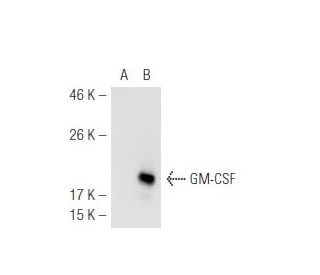
GM-CSF Anticuerpo (B6-2-hGMCSF): sc-32753
- GM-CSF Anticuerpo B6-2-hGMCSF es un monoclonal de ratón IgG1 κ GM-CSF Anticuerpo, ver las 4 publicaciones, proporcionado como 200 µg/ml
- producido contra una proteina recombinante GM-CSF de origen human
- GM-CSF Anticuerpo (B6-2-hGMCSF) es recomendado para detectar GM-CSF de mouse, rat y human origen, mediante WB, IP, IF y IHC(P)
- GM-CSF Anticuerpo (B6-2-hGMCSF) es disponible conjugado a agarosa para IP; HRP para WB, IHC(P) y ELISA; y tanto a phycoerythrin como a FITC para IF, IHC(P) y FCM
- también disponible conjugado a Alexa Fluor® 488, Alexa Fluor® 546, Alexa Fluor® 594 o Alexa Fluor® 647 para WB (RGB), IF, IHC (P) y FCM
- también disponible conjugado a Alexa Fluor® 680 o Alexa Fluor® 790 para WB (NIR), IF y FCM
- Actualmente, aún no hemos completado la identificación de los reactivos de detección secundaria preferidos para GM-CSF Anticuerpo (B6-2-hGMCSF). Este trabajo está en progreso.

ENLACES RÁPIDOS
VER TAMBIÉN ....
El anticuerpo anti-GM-CSF (B6-2-hGMCSF) es un anticuerpo monoclonal IgG1 de ratón de cadena ligera kappa que detecta la proteína GM-CSF de origen humano, de ratón y de rata mediante western blotting (WB), inmunoprecipitación (IP), inmunofluorescencia (IF) e inmunohistoquímica. El anticuerpo anti-GM-CSF (B6-2-hGMCSF) está disponible tanto en forma no conjugada como en varias formas conjugadas, incluyendo agarosa, peroxidasa de rábano picante (HRP), ficoeritrina (PE), isotiocianato de fluoresceína (FITC) y múltiples conjugados Alexa Fluor®. El factor estimulante de colonias de granulocitos-macrófagos (GM-CSF) es una citocina pleiotrópica crucial que desempeña un papel importante en la respuesta inmunitaria al estimular la proliferación y diferenciación de las células progenitoras hematopoyéticas en granulocitos y macrófagos. La forma madura del GM-CSF humano consta de 127 aminoácidos, mientras que la homóloga murina tiene 124 aminoácidos y comparte aproximadamente un 60% de homología con la versión humana. El GM-CSF es una glicoproteína que promueve el crecimiento de las células inmunitarias y mejora las capacidades funcionales, como la fosforilación de la fosfolipasa A2 citosólica (cPLA2) en los neutrófilos humanos, esencial para la producción de mediadores inflamatorios. La fosforilación de la cPLA2 conduce a un aumento de la actividad enzimática, amplificando así la respuesta inflamatoria. El GM-CSF constituye una diana vital para la investigación en inmunología y las intervenciones terapéuticas, especialmente en condiciones en las que el sistema inmunitario está comprometido o desregulado.
Alexa Fluor® es una marca registrada de Molecular Probes Inc., OR., USA
REIVEW LI-COR® y Odyssey® son marcas registradas de LI-COR Biosciences.
GM-CSF Anticuerpo (B6-2-hGMCSF) Referencias:
- Estrategias de desarrollo de anticuerpos monoclonales anticitoquinas: inmunoensayo de IL-10 e IL-5 en muestras clínicas. | Abrams, JS., et al. 1992. Immunol Rev. 127: 5-24. PMID: 1387110
- Uso clínico de los factores estimulantes de colonias. | Moore, MA. 1991. Annu Rev Immunol. 9: 159-91. PMID: 1910675
- El aumento de la expresión del factor estimulante de colonias de granulocitos/macrófagos por la irradiación ultravioleta está mediado por la interleucina 1 en los queratinocitos Pam 212. | Nozaki, S., et al. 1991. J Invest Dermatol. 97: 10-4. PMID: 2056179
- Identificación de un nuevo factor promotor del crecimiento de timocitos derivado de linfomas de células B. | Suda, T., et al. 1990. Cell Immunol. 129: 228-40. PMID: 2194678
- GM-CSF: de factor de crecimiento a mediador central de la inflamación tisular. | Becher, B., et al. 2016. Immunity. 45: 963-973. PMID: 27851925
- GM-CSF inhalado para la proteinosis alveolar pulmonar. | Tazawa, R., et al. 2019. N Engl J Med. 381: 923-932. PMID: 31483963
- Vías inflamatorias dependientes del GM-CSF. | Hamilton, JA. 2019. Front Immunol. 10: 2055. PMID: 31552022
- IFNγ y GM-CSF controlan programas de diferenciación complementarios en la transición de monocitos a fagocitos durante la neuroinflamación. | Amorim, A., et al. 2022. Nat Immunol. 23: 217-228. PMID: 35102344
- Uso terapéutico del factor estimulante de colonias de granulocitos-macrófagos (GM-CSF). Una revisión de la experiencia reciente. | Costello, RT. 1993. Acta Oncol. 32: 403-8. PMID: 8369127
- El factor estimulante de colonias de granulocitos-macrófagos (GM-CSF) promueve la fosforilación y el aumento de la actividad de la fosfolipasa A2 citosólica en neutrófilos humanos. | Nahas, N., et al. 1996. Biochem J. 313 (Pt 2): 503-8. PMID: 8573084
- El papel del GM-CSF en la infección. | Freund, M. and Kleine, HD. 1992. Infection. 20 Suppl 2: S84-92. PMID: 1493940
- Frecuencias y cinética similares de las células productoras de citoquinas en la sangre periférica y el bazo murinos. Detección de citocinas mediante inmunoensayo e inmunotinción intracelular. | Sander, B., et al. 1993. J Immunol Methods. 166: 201-14. PMID: 8288874
Información sobre pedidos
| Nombre del producto | Número de catálogo | UNIDAD | Precio | CANTIDAD | Favoritos | |
GM-CSF Anticuerpo (B6-2-hGMCSF) | sc-32753 | 200 µg/ml | $322.00 | |||
GM-CSF Anticuerpo (B6-2-hGMCSF) AC | sc-32753 AC | 500 µg/ml, 25% agarose | $424.00 | |||
GM-CSF Anticuerpo (B6-2-hGMCSF) HRP | sc-32753 HRP | 200 µg/ml | $322.00 | |||
GM-CSF Anticuerpo (B6-2-hGMCSF) FITC | sc-32753 FITC | 200 µg/ml | $336.00 | |||
GM-CSF Anticuerpo (B6-2-hGMCSF) PE | sc-32753 PE | 200 µg/ml | $349.00 | |||
GM-CSF Anticuerpo (B6-2-hGMCSF) Alexa Fluor® 488 | sc-32753 AF488 | 200 µg/ml | $364.00 | |||
GM-CSF Anticuerpo (B6-2-hGMCSF) Alexa Fluor® 546 | sc-32753 AF546 | 200 µg/ml | $364.00 | |||
GM-CSF Anticuerpo (B6-2-hGMCSF) Alexa Fluor® 594 | sc-32753 AF594 | 200 µg/ml | $364.00 | |||
GM-CSF Anticuerpo (B6-2-hGMCSF) Alexa Fluor® 647 | sc-32753 AF647 | 200 µg/ml | $364.00 | |||
GM-CSF Anticuerpo (B6-2-hGMCSF) Alexa Fluor® 680 | sc-32753 AF680 | 200 µg/ml | $364.00 | |||
GM-CSF Anticuerpo (B6-2-hGMCSF) Alexa Fluor® 790 | sc-32753 AF790 | 200 µg/ml | $364.00 |