
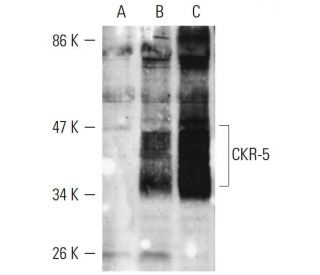

p-CKR-5 Anticuerpo (V14/2): sc-32303
- p-CKR-5 Anticuerpo (V14/2) es un monoclonal de ratón IgG2b (kappa light chain) proporcionado como 200 µg/ml
- criado frente a un péptido sintético cercano al C-terminus del CKR-5 de human origen
- recomendado para detectar Ser 337 phosphorylated CKR-5 de human origen, mediante WB y IP
- m-IgG Fc BP-HRP y m-IgGκ BP-HRP son los reactivos de detección secundarios preferidos para p-CKR-5 Anticuerpo (V14/2) para aplicaciones WB. Estos reactivos se ofrecen ahora en paquetes con p-CKR-5 Anticuerpo (V14/2)(véase la información de pedido más abajo).

ENLACES RÁPIDOS
VER TAMBIÉN ....
Los miembros de la familia de quimiocinas C-C o β se caracterizan por un par de residuos de cisteína adyacentes y sirven como potentes quimioatrayentes y activadores de monocitos y células T. Los miembros de la familia de receptores de quimiocinas C-C incluyen CKR-1, CKR-2A, CKR-2B, CKR-3, CKR-4, CKR-5, CKR-6, CKR-7 y el antígeno del grupo sanguíneo Duffy. Cada uno de estos receptores son proteínas acopladas a proteínas G, con un dominio transmembrana de siete pasos, cuyo papel fisiológico principal es funcionar en la quimiotaxis de células T y células fagocíticas hacia áreas de inflamación. Sin embargo, esta familia de receptores también ha demostrado facilitar la infección viral. Denominado "coreceptor", CKR-5, junto con CD4, ha demostrado ser un receptor importante para el VIH. CKR-5 tiende a asociarse con virus de tropismo macrofágico, como el VIH-1 de tropismo macrofágico, mientras que CKR-2B y CKR-3 se unen a una minoría de virus. La unión de agonistas al CKR-5 induce la fosforilación de cuatro residuos de serina distintos que se encuentran en el extremo carboxilo del CKR-5. Este extremo está involucrado en el acoplamiento a proteínas G y también contiene un sitio de cisteína junto con los sitios de fosforilación, y todos están involucrados en la desensibilización del receptor.
Alexa Fluor® es una marca registrada de Molecular Probes Inc., OR., USA
REIVEW LI-COR® y Odyssey® son marcas registradas de LI-COR Biosciences.
p-CKR-5 Anticuerpo (V14/2) Referencias:
- Efectos diferenciales de las quimiocinas CC sobre la fosforilación del receptor de quimiocinas CC 5 (CCR5) e identificación de los sitios de fosforilación en el extremo carboxilo del CCR5. | Oppermann, M., et al. 1999. J Biol Chem. 274: 8875-85. PMID: 10085131
- Una nueva visión de la función de los 'antiguos' receptores de péptidos quimiotácticos FPR y FPRL1: regulación a la baja de los receptores de quimiocinas CCR5 y CXCR4. | Le, Y., et al. 1999. Forum (Genova). 9: 299-314. PMID: 10611407
- Regulación a la baja del receptor de quimioquinas CCR5 por activación del receptor quimiotáctico del formilpéptido en monocitos humanos. | Shen, W., et al. 2000. Blood. 96: 2887-94. PMID: 11023526
- Caracterización farmacológica del receptor de quimiocinas CCR5. | Mueller, A., et al. 2002. Br J Pharmacol. 135: 1033-43. PMID: 11861332
- Análisis de la fosforilación del receptor 5 de la quimiocina CC (CCR5) estimulada por ligando en células intactas utilizando anticuerpos específicos para fosfitos. | Pollok-Kopp, B., et al. 2003. J Biol Chem. 278: 2190-8. PMID: 12403770
- CCL3, actuando a través del receptor de quimioquinas CCR5, conduce a la activación independiente de la Janus quinasa 2 (JAK2) y de las proteínas Gi. | Mueller, A. and Strange, PG. 2004. FEBS Lett. 570: 126-32. PMID: 15251452
- La activación de CCR5 por el virus vaccinia provoca eventos de señalización de fosforilación de tirosina que favorecen la replicación del virus. | Rahbar, R., et al. 2006. J Virol. 80: 7245-59. PMID: 16809330
- La modulación del canal Kv2.1 dependiente del co-receptor de quimioquinas CCR5/CXCR4 confiere neuroprotección aguda a la exposición a la glicoproteína gp120 del VIH-1. | Shepherd, AJ., et al. 2013. PLoS One. 8: e76698. PMID: 24086760
- La Anulación de la Fosforilación Juega un Papel Relevante en la Formación del Signalosoma CCR5 con Anticuerpos Naturales contra CCR5. | Venuti, A., et al. 2017. Viruses. 10: PMID: 29283386
- Importancia de la señalización PI3K/AKT y AMPK dependiente de PLC en la quimiotaxis de macrófagos mediada por RANTES/CCR5. | Chien, HC., et al. 2018. Chin J Physiol. 61: 266-279. PMID: 30384400
Información sobre pedidos
| Nombre del producto | Número de catálogo | UNIDAD | Precio | CANTIDAD | Favoritos | |
p-CKR-5 Anticuerpo (V14/2) | sc-32303 | 200 µg/ml | $322.00 | |||
Paquete de p-CKR-5 (V14/2): m-IgG Fc BP-HRP | sc-536736 | 200 µg Ab; 10 µg BP | $361.00 | |||
Paquete de p-CKR-5 (V14/2): m-IgGκ BP-HRP | sc-533897 | 200 µg Ab; 40 µg BP | $361.00 |