
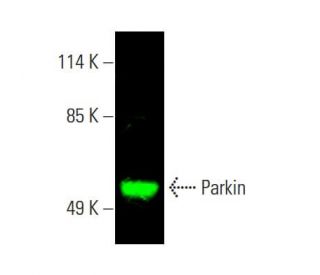
Parkin Anticuerpo (PRK8): sc-32282
- Parkin Anticuerpo PRK8 es un monoclonal de ratón IgG2b κ Parkin Anticuerpo, ver las 319 publicaciones, proporcionado como 200 µg/ml
- criado frente a human recombinante Parkin
- Parkin Anticuerpo (PRK8) es recomendado para detectar Parkin de mouse, rat y human origen, mediante WB, IP, IF, IHC(P) y FCM
- Parkin Anticuerpo (PRK8) es disponible conjugado a agarosa para IP; HRP para WB, IHC(P) y ELISA; y tanto a phycoerythrin como a FITC para IF, IHC(P) y FCM
- también disponible conjugado a Alexa Fluor® 488, Alexa Fluor® 546, Alexa Fluor® 594 o Alexa Fluor® 647 para WB (RGB), IF, IHC (P) y FCM
- también disponible conjugado a Alexa Fluor® 680 o Alexa Fluor® 790 para WB (NIR), IF y FCM
- m-IgG Fc BP-HRP, 2b BP-HRP">m-IgG2b BP-HRP y m-IgGκ BP-HRP son los reactivos de detección secundarios preferidos para Parkin Anticuerpo (PRK8) para aplicaciones WB e IHC(P). Estos reactivos se ofrecen ahora en paquetes con Parkin Anticuerpo (PRK8)(véase la información de pedido más abajo).

ENLACES RÁPIDOS
VER TAMBIÉN ....
El anticuerpo contra la parkina (PRK8) es un anticuerpo monoclonal IgG2b de ratón de cadena ligera kappa dirigido contra la parkina, también conocida como PRKN, PARK2 o parkina RBR E3 ubiquitina proteína ligasa, con reactividad confirmada en muestras humanas, de ratón y de rata. Parkin es una ubiquitina ligasa E3 de 465 aminoácidos codificada por el gen PARK2, esencial para el proceso de ubiquitinación, que marca las proteínas para su degradación, manteniendo la homeostasis celular al eliminar las proteínas dañadas o mal plegadas. Parkin es especialmente importante en la mitofagia, la eliminación autofágica selectiva de las mitocondrias disfuncionales, que es crucial para preservar la calidad y la función mitocondriales. Las mutaciones en el gen PARK2 están asociadas a la enfermedad de Parkinson juvenil autosómica recesiva, lo que pone de relieve la importancia de la Parkina en la salud neuronal. El anticuerpo anti-Parkina (PRK8) se cría contra la Parkina humana recombinante, dirigiéndose a un epítopo dentro de la región C-terminal de la proteína. El anticuerpo monoclonal Parkin (PRK8) está validado para diversas aplicaciones, como la inmunotransferencia (WB), la inmunoprecipitación (IP), la inmunofluorescencia (IF), la inmunohistoquímica con secciones incluidas en parafina (IHCP) y la citometría de flujo (FCM). La expresión de parkina se observa en neuronas de varias regiones cerebrales, incluidos los ganglios basales, el mesencéfalo, el cerebelo y la corteza cerebral, con funciones que se conservan evolutivamente en todas las especies. El anticuerpo anti-Parkina (PRK8) es una herramienta fundamental para estudiar las funciones de la Parkina y su implicación en los procesos celulares y en la investigación neurodegenerativa.
Alexa Fluor® es una marca registrada de Molecular Probes Inc., OR., USA
REIVEW LI-COR® y Odyssey® son marcas registradas de LI-COR Biosciences.
Parkin Anticuerpo (PRK8) Referencias:
- Expresión diferencial del gen parkin en el cerebro humano y en los leucocitos periféricos. | Sunada, Y., et al. 1998. Neurosci Lett. 254: 180-2. PMID: 10214987
- La parkina suprime la muerte celular inducida por el estrés de proteínas no plegadas a través de su actividad E3 ubiquitina-proteína ligasa. | Imai, Y., et al. 2000. J Biol Chem. 275: 35661-4. PMID: 10973942
- La parkina se asocia a filamentos de actina en células neuronales y no neuronales. | Huynh, DP., et al. 2000. Ann Neurol. 48: 737-44. PMID: 11079537
- Expresión de parkina en el cerebro de ratón adulto. | Stichel, CC., et al. 2000. Eur J Neurosci. 12: 4181-94. PMID: 11122330
- Inmunodetección de la proteína Parkina en cerebros de vertebrados e invertebrados: estudio comparativo mediante anticuerpos específicos. | Horowitz, JM., et al. 2001. J Chem Neuroanat. 21: 75-93. PMID: 11173222
- Parkin y enfermedad de Parkinson. | Mizuno, Y., et al. 2001. Curr Opin Neurol. 14: 477-82. PMID: 11470964
- La actividad E3 ubiquitina-proteína ligasa de Parkin depende de la interacción cooperativa de elementos RING finger (TRIAD). | Rankin, CA., et al. 2001. J Biomed Sci. 8: 421-9. PMID: 11549885
Información sobre pedidos
| Nombre del producto | Número de catálogo | UNIDAD | Precio | CANTIDAD | Favoritos | |
Parkin Anticuerpo (PRK8) | sc-32282 | 200 µg/ml | $322.00 | |||
Paquete de Parkin (PRK8): m-IgG Fc BP-HRP | sc-528453 | 200 µg Ab; 10 µg BP | $361.00 | |||
Paquete de Parkin (PRK8): m-IgGκ BP-HRP | sc-520834 | 200 µg Ab, 40 µg BP | $361.00 | |||
Paquete de Parkin (PRK8): m-IgG2b BP-HRP | sc-550038 | 200 µg Ab; 10 µg BP | $361.00 | |||
Parkin Anticuerpo (PRK8) AC | sc-32282 AC | 500 µg/ml, 25% agarose | $424.00 | |||
Parkin Anticuerpo (PRK8) HRP | sc-32282 HRP | 200 µg/ml | $322.00 | |||
Parkin Anticuerpo (PRK8) FITC | sc-32282 FITC | 200 µg/ml | $336.00 | |||
Parkin Anticuerpo (PRK8) PE | sc-32282 PE | 200 µg/ml | $349.00 | |||
Parkin Anticuerpo (PRK8) Alexa Fluor® 488 | sc-32282 AF488 | 200 µg/ml | $364.00 | |||
Parkin Anticuerpo (PRK8) Alexa Fluor® 546 | sc-32282 AF546 | 200 µg/ml | $364.00 | |||
Parkin Anticuerpo (PRK8) Alexa Fluor® 594 | sc-32282 AF594 | 200 µg/ml | $364.00 | |||
Parkin Anticuerpo (PRK8) Alexa Fluor® 647 | sc-32282 AF647 | 200 µg/ml | $364.00 | |||
Parkin Anticuerpo (PRK8) Alexa Fluor® 680 | sc-32282 AF680 | 200 µg/ml | $364.00 | |||
Parkin Anticuerpo (PRK8) Alexa Fluor® 790 | sc-32282 AF790 | 200 µg/ml | $364.00 |