
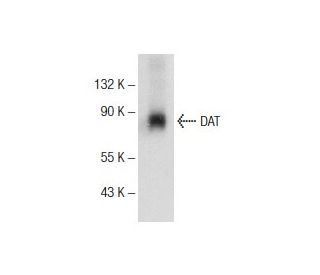
DAT Antibody (6-5G10): sc-32258. ヒト尾状突起脳組織抽出液中の DAT 発現をウエスタンブロットで解析.
DAT/Dopamine Transporter/SLC6A3抗体(6-5G10): sc-32258
- DAT/Dopamine Transporter/SLC6A3抗体 6-5G10はラットモノクローナルIgGです。200 µg/mlで提供
- DATアミノ酸1-66の融合組み換え体に対して
- 反-DAT/Dopamine Transporter/SLC6A3抗体 (6-5G10) mouse, rat と human 由来のDAT WB, IP, IF と IHC(P)での検出にはお勧めします
- 抗 DAT/Dopamine Transporter/SLC6A3 抗体 (6-5G10) は、IP 用には アガロース、WB、IHC(P)、ELISA 用には HRP、IF、IHC(P)、FCM 用には フィコエリスリン または FITC にそれぞれ結合したものが利用可能
- WB (RGB)、IF、IHC(P)、FCM、iBright™ FL1000、FluorChem™、Typhoon、Azureと他の同等システムでRGB蛍光イメージングシステム用のAlexa Fluor® 488、Alexa Fluor® 546、Alexa Fluor® 594 または Alexa Fluor® 647、に共役での利用可能です。
- WB (NIR)、IF、FCMとLI-COR®/Odyssey®、iBright™ FL1000、FluorChem™、Typhoon、Azureと他の同等システムで近赤外(NIR)検出法用のAlexa Fluor® 680 または Alexa Fluor® 790、に共役での利用可能です。
- 現在、DAT/Dopamine Transporter/SLC6A3 Antibody (6-5G10)に適した二次検出試薬の同定はまだ完了していません。この研究は進めています。

クイックリンク
サポート品
説明
Gene情報
データシートとプロトコル
研究情報
関連項目
DAT 抗体 (6-5G10) は、マウス、ラット、ヒトのサンプルから、ウェスタンブロッティング (WB)、免疫沈降 (IP)、免疫蛍光 (IF)、免疫組織化学によって DAT (ドーパミン輸送体) を検出するラットモノクローナルIgG抗体です。抗-DAT 抗体(6-5G10)は非結合型と、アガロース、西洋ワサビペルオキシダーゼ(HRP)、フィコエリスリン(PE)、フルオレセインイソチオシアネート(FITC)、および複数のAlexa Fluor® 蛍光色素に結合したタイプが利用可能です。ドーパミン輸送体(DAT)は、ソルートキャリアファミリー6のメンバーであり、細胞外空間からシナプス前ニューロンへのドーパミンの再取り込みを促進することで、シナプス間隙のドーパミンレベルを調節します。この機能は、気分調節、報酬、運動制御に不可欠なドーパミン作動性シグナル伝達を維持します。DATの機能不全は、うつ病、統合失調症、注意欠陥多動性障害(ADHD)など、さまざまな神経精神疾患と関連しており、健康と疾患におけるDATの重要性を浮き彫りにしています。さらに、神経毒素を輸送するDATの能力は、パーキンソン病のような状態におけるドーパミン作動性神経細胞の脆弱性に寄与しています。 DATの動態とタンパク質の相互作用を研究することで、これらの疾患に対する新たな治療アプローチが明らかになる可能性があります。
試験・研究用以外には使用しないでください。 臨床及び体外診断には使用できません。
Alexa Fluor® はMolecular Probes Inc., OR., USAの商標です。
LI-COR® and Odyssey® はLI-COR Biosciencesの登録商標です。
DAT/Dopamine Transporter/SLC6A3抗体(6-5G10) 参考文献:
- 真核細胞に発現するαアドレナリン受容体サブタイプの複数のセカンドメッセンジャー経路。 | Cotecchia, S., et al. 1990. J Biol Chem. 265: 63-9. PMID: 2152928
- 運動障害センターにおけるドーパミン輸送体(DaT)スキャンの利用。 | Oravivattanakul, S., et al. 2016. Mov Disord Clin Pract. 3: 31-35. PMID: 30363515
- 多様性ドーパミン輸送体(DAT)イメージングと磁気共鳴画像法(MRI)による早期パーキンソン病の特性評価。 | Porter, E., et al. 2020. Parkinsonism Relat Disord. 79: 26-33. PMID: 32861103
- パーキンソン病および関連疾患におけるドーパミン輸送体(DAT)イメージング。 | Brücke, T. and Brücke, C. 2022. J Neural Transm (Vienna). 129: 581-594. PMID: 34910248
- CRISPR-Cas9ゲノム編集によるドーパミン輸送体(DAT)-mCherryノックインラットの生成。 | Matsumoto, N., et al. 2024. Biol Pharm Bull. 47: 394-398. PMID: 38325828
- リスペリドンは、統合失調症患者の末梢血単核細胞におけるセロトニン受容体2A(5-HT2A)およびセロトニントランスポーター(SERT)の発現を減少させるが、ドーパミン受容体およびドーパミン輸送体(DAT)の発現は減少させない。 | Alvarez-Herrera, S., et al. 2024. Pharmaceuticals (Basel). 17: PMID: 38399382
- ドーパミン輸送体(DAT)-Creレポーターマウスの腸内神経細胞の特性評価により、2種類の伝達物質を持つドーパミン作動性亜種が明らかになりました。 | Recinto, SJ., et al. 2024. Eur J Neurosci. 59: 2465-2482. PMID: 38487941
- アゴニストによるドーパミンD1受容体刺激アデニルシクラーゼ活性の脱感作は, D1受容体の内在化とは時間的・生化学的に分離している。 | Ng, GY., et al. 1995. Proc Natl Acad Sci U S A. 92: 10157-61. PMID: 7479745
- Gタンパク質共役型受容体スーパーファミリーの保存された7つの膜貫通配列NP(X)2,3Yは, β2アドレナリン受容体の複数の特性を制御している。 | Barak, LS., et al. 1995. Biochemistry. 34: 15407-14. PMID: 7492540
- ドーパミン受容体サブタイプの分子および化学的神経薬理学。 | Ogawa, N. 1995. Acta Med Okayama. 49: 1-11. PMID: 7762403
- D2ドーパミン受容体アイソフォームは, 異なるGiαタンパク質を介してシグナルを伝達し, アデニルシクラーゼを阻害する。部位特異的変異Giαタンパク質を用いた研究。 | Senogles, SE. 1994. J Biol Chem. 269: 23120-7. PMID: 7916015
- ドーパミントランスポーターは, 黒質ドーパミン作動性ニューロンの樹状突起および軸索の細胞膜に局在している。 | Nirenberg, MJ., et al. 1996. J Neurosci. 16: 436-47. PMID: 8551328
注文情報
| 製品名 | カタログ # | 単位 | 価格 | 数量 | お気に入り | |
DAT/Dopamine Transporter/SLC6A3 抗体 (6-5G10) | sc-32258 | 200 µg/ml | $322.00 | |||
DAT/Dopamine Transporter/SLC6A3 抗体 (6-5G10) AC | sc-32258 AC | 500 µg/ml, 25% agarose | $424.00 | |||
DAT/Dopamine Transporter/SLC6A3 抗体 (6-5G10) HRP | sc-32258 HRP | 200 µg/ml | $322.00 | |||
DAT/Dopamine Transporter/SLC6A3 抗体 (6-5G10) FITC | sc-32258 FITC | 200 µg/ml | $336.00 | |||
DAT/Dopamine Transporter/SLC6A3 抗体 (6-5G10) PE | sc-32258 PE | 200 µg/ml | $349.00 | |||
DAT/Dopamine Transporter/SLC6A3 抗体 (6-5G10) Alexa Fluor® 488 | sc-32258 AF488 | 200 µg/ml | $364.00 | |||
DAT/Dopamine Transporter/SLC6A3 抗体 (6-5G10) Alexa Fluor® 546 | sc-32258 AF546 | 200 µg/ml | $364.00 | |||
DAT/Dopamine Transporter/SLC6A3 抗体 (6-5G10) Alexa Fluor® 594 | sc-32258 AF594 | 200 µg/ml | $364.00 | |||
DAT/Dopamine Transporter/SLC6A3 抗体 (6-5G10) Alexa Fluor® 647 | sc-32258 AF647 | 200 µg/ml | $364.00 | |||
DAT/Dopamine Transporter/SLC6A3 抗体 (6-5G10) Alexa Fluor® 680 | sc-32258 AF680 | 200 µg/ml | $364.00 | |||
DAT/Dopamine Transporter/SLC6A3 抗体 (6-5G10) Alexa Fluor® 790 | sc-32258 AF790 | 200 µg/ml | $364.00 |