
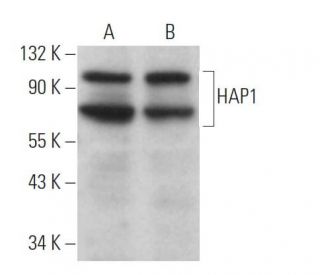
HAP1 Anticuerpo (1B6): sc-32257
- HAP1 Anticuerpo (1B6) es un monoclonal de ratón IgG1 κ, ver las 3 publicaciones, proporcionado como 200 µg/ml
- criado contra ADNc residuos 290-426 de HAP-1 de rata
- recomendado para detectar HAP1 of mouse and human origin and HAP1A and HAP1B of rat origin medainte WB y IP
- m-IgG Fc BP-HRP, 1 BP-HRP">m-IgG1 BP-HRP y m-IgGκ BP-HRP son los reactivos de detección secundarios preferidos para HAP1 Anticuerpo (1B6) para aplicaciones WB. Estos reactivos se ofrecen ahora en paquetes con HAP1 Anticuerpo (1B6)(véase la información de pedido más abajo).

ENLACES RÁPIDOS
El anticuerpo HAP1 (1B6) es un anticuerpo monoclonal de ratón IgG1 κ que detecta la proteína HAP1 de origen humano y de ratón, así como HAP1A y HAP1B de origen de rata mediante WB e IP. HAP1 (proteína asociada a huntingtina 1) se une a huntingtina. La huntingtina es una proteína que contiene una región de poliglutamina y cuando el número de repeticiones de glutamina excede 35, el gen codifica una versión de huntingtina que conduce a la enfermedad de Huntington (HD). La capacidad de HAP1 para unirse a huntingtina se ve potenciada por una región expandida de repeticiones de poliglutamina. HAP1 muestra localización neuronal y se mueve con huntingtina en las fibras nerviosas. HAP1 se expresa principalmente en tejido cerebral, con una mayor expresión en el bulbo olfatorio y el tronco cerebral. Se ha demostrado que HAP1 en rata se asocia con varios orgánulos intracelulares. HAP1 de ratón se localiza en orgánulos de membrana, incluyendo endosomas grandes, estructuras tubulovesiculares y vesículas en desarrollo en neuronas.
Información sobre pedidos
| Nombre del producto | Número de catálogo | UNIDAD | Precio | CANTIDAD | Favoritos | |
HAP1 Anticuerpo (1B6) | sc-32257 | 200 µg/ml | $322.00 | |||
Paquete de HAP1 (1B6): m-IgG Fc BP-HRP | sc-536725 | 200 µg Ab; 10 µg BP | $361.00 | |||
Paquete de HAP1 (1B6): m-IgGκ BP-HRP | sc-533886 | 200 µg Ab; 40 µg BP | $361.00 | |||
Paquete de HAP1 (1B6): m-IgG1 BP-HRP | sc-544784 | 200 µg Ab; 20 µg BP | $361.00 |