
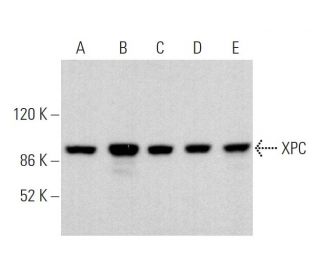

이 다클론 항체는 생산이 중단되었습니다. 권장 XPC (D-10) 단클론 항체(샘플 데이터 표시)를 참조하세요.
XPC 항체 (H-300): sc-30156
- XPC 항체 H-300 는 토끼 polyclonal IgG 이며 200 µg/ml으로 제공합니다.
- 항원결정부는 human origin의 XPC의 extracellular domain 위치입니다.
- 단종된 다클론항체

더보기
주문정보
XPC (D-10): sc-74410 [ XPC (H-300)의 권장하는 대체 단클론항체입니다. ]
| 제품명 | 카탈로그 번호 | 단위 | 가격 | 수량 | 관심품목 | |
XPC 항체 (D-10) | sc-74410 | 200 µg/ml | $322.00 | |||
XPC (D-10): m-IgG Fc BP-HRP 번들 | sc-528662 | 200 µg Ab; 10 µg BP | $361.00 | |||
XPC (D-10): m-IgGκ BP-HRP 번들 | sc-521107 | 200 µg Ab, 40 µg BP | $361.00 | |||
XPC (D-10): m-IgG2a BP-HRP 번들 | sc-547136 | 200 µg Ab; 10 µg BP | $361.00 | |||
XPC 항체 (D-10) AC | sc-74410 AC | 500 µg/ml, 25% agarose | $424.00 | |||
XPC 항체 (D-10) HRP | sc-74410 HRP | 200 µg/ml | $322.00 | |||
XPC 항체 (D-10) FITC | sc-74410 FITC | 200 µg/ml | $336.00 | |||
XPC 항체 (D-10) PE | sc-74410 PE | 200 µg/ml | $349.00 | |||
XPC 항체 (D-10) Alexa Fluor® 488 | sc-74410 AF488 | 200 µg/ml | $364.00 | |||
XPC 항체 (D-10) Alexa Fluor® 546 | sc-74410 AF546 | 200 µg/ml | $364.00 | |||
XPC 항체 (D-10) Alexa Fluor® 594 | sc-74410 AF594 | 200 µg/ml | $364.00 | |||
XPC 항체 (D-10) Alexa Fluor® 647 | sc-74410 AF647 | 200 µg/ml | $364.00 | |||
XPC 항체 (D-10) Alexa Fluor® 680 | sc-74410 AF680 | 200 µg/ml | $364.00 | |||
XPC 항체 (D-10) Alexa Fluor® 790 | sc-74410 AF790 | 200 µg/ml | $364.00 |