
 |
- rabbit polyclonal IgG, 200 µg/ml
- epitope corresponding to amino acids 1-45 mapping at the N-terminus of HDAC9 of human origin
- recommended for detection of HDAC9 isoforms 1-4 of mouse, rat and human origin by WB, IP, IF and ELISA; also reactive with additional species, including equine, canine and porcine
|
|
| |
Ordering InformationProduct Citations
Recommended Support Products:
(click button of application of choice)
HDAC9 Background Information In the intact cell, DNA closely associates with histones and other nuclear proteins to form chromatin. The remodeling of chromatin is a critical component of transcriptional regulation and the acetylation of nucleosomal histones is a major source of this remodeling. Acetylation of lysine residues in the amino terminal tail domain of histone results in an allosteric change in the nucleosomal conformation and an increased accessibility to transcription factors by DNA. Several mammalian proteins function as nuclear histone acetylases, including GCN5, PCAF (p300/CBP-associated factor), p300/CBP, HAT1 and the TFIID subunit TAF II p250. Conversely, the deacetylation of histones is associated with transcriptional silencing. The histone deacetylases (HDAC) include HDAC1–9. HDAC9 and HDAC9a are two alternatively spliced isoforms of HDAC9. HDAC9a is 132 amino acids shorter than HDAC9, but both isoforms contain the HDAC catalytic domain, remain capable of deacetylase activity and repress myoctye enhancer-binding factor 2-mediated transcription. HDAC9 and HDAC9a are expressed in brain, skeletal muscle, kidney, placenta and pancreas.
| HDAC9 (H-45) Product Citations |
See how others have used HDAC9 (H-45): sc-28732 antibody and or HDAC9 (H-45) antibody conjugates.
3 total citations Loading citations.
|
| |
|
 |
|
HDAC9 (H-45)
Click on image to enlarge
|
|
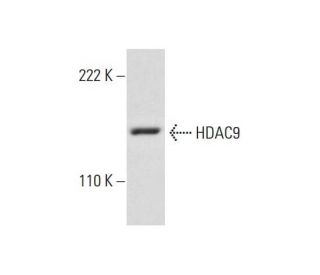
HDAC9 (H-45): sc-28732. Western blot analysis of HDAC9 expression in Ramos nuclear extract.
|
|
Download
|
|
