
epitope corresponding to amino acids 142-441 mapping at the C-terminus of EED of human origin
recommended for detection of EED of mouse, rat and human origin by WB, IP, IF and ELISA; also reactive with additional species, including equine, canine, bovine, porcine and avian
EED Background Information The transcriptional repressing Polycomb-group (PcG) and transcriptional activating trithorax-group (trxG) genes of Drosophila are part of a cellular memory system responsible for the stable inheritance of gene activity. PcG proteins assemble into multimeric protein complexes, which are involved in maintaining the transcriptional repressive state of genes over successive cell generations. EED (embryonic ectoderm development) is the human homolog of Eed, a murine PcG gene homologous to the Drosophila homeotic gene, extra sex combs. The human EED protein is 99. 5% identical to the mouse EED protein and contains seven WD repeats, which are involved in protein-protein interactions. There are two human EED transcripts that contain a putative 407-nucleotide-long intron and give rise to two HEED protein isoforms, 535 and 494 amino acids in length. EED interacts in a highly specific manner, both in vitro and in vivo, with histone deacetylase (HDAC) proteins.
EED (H-300) Product Citations
See how others have used EED (H-300): sc-28701 antibody and or EED (H-300) antibody conjugates.
2 total citations
Loading citations.
EED (H-300)
Click on image to enlarge
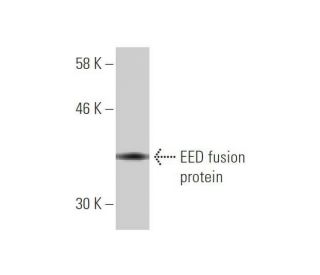
EED (H-300): sc-28701. Western blot analysis of EED expression in K-562 whole cell lysate.
