
Subscrever / Inscrever-se Conta
Corrinho de compra (0)
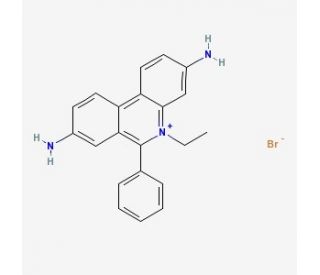

Estrutura molecular do Ethidium Bromide Solution, Número CAS: 1239-45-8
Ethidium Bromide Solution (CAS 1239-45-8)
Veja citações de produtos (3)
Nomes alternativos:
Ethidium Bromide Solution is also known as ETBR.
Aplicacao:
Ethidium Bromide Solution é um corante de ácido nucleico para PAGE ou eletroforese em gel de agarose, e um inibidor da polimerase do ADN.
Numero VAT:
1239-45-8
Peso Molecular:
394.31
Separar por Funcao:
C21H20N3•Br
Para uso em exclusivo em pesquisa. Não se destina a uso em diagnostico e tratamento.
* Refere-se a Certificado de Análise para data especifica de lotes (incluindo-se o conteúdo de agua).
LINKS RÁPIDOS
Informacoes sobre ordens
Citacoes dos Produtos
Descricao
Informações Técnicas
Informações de Segurança
SDS & Certificado de Análise
Ethidium Bromide Solution (CAS 1239-45-8) Referencias
- Determinação fluorométrica de ácidos nucleicos em sementes de ervilha através da utilização de complexos de brometo de etídio. | El Hamalawi, AR., et al. 1975. Anal Biochem. 67: 384-91. PMID: 1163763
- Efeitos dos agentes antimicrobianos na polimerase do ácido desoxirribonucleico. | Elliott, WH. 1963. Biochem J. 86: 562-7. PMID: 16748992
- Método expresso para a deteção de toxinas amanitinas de Amanita phalloides. | Vlaskin, DN., et al. 2006. Bull Exp Biol Med. 141: 110-1. PMID: 16929979
- Ligação do brometo de etídio a uma tripla hélice de ADN. Evidência de intercalação. | Scaria, PV. and Shafer, RH. 1991. J Biol Chem. 266: 5417-23. PMID: 2005088
- Um microensaio densitométrico não destrutivo para quantificação de DNA. | Moore, SP. and Sutherland, BM. 1985. Anal Biochem. 144: 15-9. PMID: 2858989
- Ligação do brometo de etídio ao ácido ribonucleico de cadeia dupla. | Douthart, RJ., et al. 1973. Biochemistry. 12: 214-20. PMID: 4630220
- Um complexo fluorescente entre o brometo de etídio e os ácidos nucleicos. Caracterização físico-química. | LePecq, JB. and Paoletti, C. 1967. J Mol Biol. 27: 87-106. PMID: 6033613
- Isolamento de uma proteína de ligação ao ADN de E. coli, caraterização e sua relação com as proteínas H1 e B1. | Laine, B., et al. 1984. Biochem Biophys Res Commun. 119: 1147-53. PMID: 6370250
- Melhorias no método do brometo de etídio para a estimativa fluorométrica direta de ADN e ARN em homogenatos de células e tecidos. | Karsten, U. and Wollenberger, A. 1977. Anal Biochem. 77: 464-70. PMID: 842829
- Uma reação em cadeia da polimerase com transcrição reversa simples para a identificação do vírus da dengue tipo 2. | Figueiredo, LT., et al. 1997. Mem Inst Oswaldo Cruz. 92: 395-8. PMID: 9332607
Informacoes sobre ordens
| Nome do Produto | Numero de Catalogo | UNID | Preco | Qde | FAVORITOS | |
Ethidium Bromide Solution, 10 ml | sc-286960 | 10 ml | $79.00 | |||
Ethidium Bromide Solution, 230 ml | sc-286960A | 230 ml | $1550.00 |