
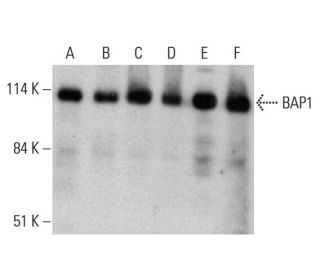
BAP1 Antibody (C-4): sc-28383
- BAP1 Antibody (C-4) is a mouse monoclonal IgG1 κ BAP1 antibody, cited in 337 publications, provided at 200 µg/ml
- Anti-BAP1 Antibody (C-4) is recommended for detection of BAP 1 of mouse, rat and human origin by WB, IP, IF, IHC(P) and ELISA
- BAP1 Antibody (C-4) is available conjugated to agarose for IP; HRP for WB, IHC(P) and ELISA; and to either phycoerythrin or FITC for IF, IHC(P) and FCM
- also available conjugated to Alexa Fluor® 488, Alexa Fluor® 546, Alexa Fluor® 594 or Alexa Fluor® 647 for WB (RGB), IF, IHC(P) and FCM, and for use with RGB fluorescent imaging systems, such as iBright™ FL1000, FluorChem™, Typhoon, Azure and other comparable systems
- also available conjugated to Alexa Fluor® 680 or Alexa Fluor® 790 for WB (NIR), IF and FCM; for use with Near-Infrared (NIR) detection systems, such as LI-COR®Odyssey®, iBright™ FL1000, FluorChem™, Typhoon, Azure and other comparable systems
- m-IgG Fc BP-HRP, m-IgG1 BP-HRP and m-IgGκ BP-HRP are the preferred secondary detection reagents for BAP1 Antibody (C-4) for WB and IHC(P) applications. These reagents are now offered in bundles with BAP1 Antibody (C-4) (see ordering information below).

QUICK LINKS
SEE ALSO...
BAP1 Antibody (C-4) is a mouse monoclonal IgG1 kappa light chain antibody that detects BAP1 protein of mouse, rat, and human origin by western blotting (WB), immunoprecipitation (IP), immunofluorescence (IF), immunohistochemistry, and enzyme-linked immunosorbent assay (ELISA). BAP1 Antibody (C-4) is available in non-conjugated and various conjugated forms, including agarose, horseradish peroxidase (HRP), phycoerythrin (PE), fluorescein isothiocyanate (FITC), and multiple Alexa Fluor® conjugates. BAP1, also known as BRCA1-associated protein 1, functions as a ubiquitin hydrolase essential for regulating protein degradation and maintaining cellular homeostasis. Anti-BAP1 antibody (C-4) enhances BRCA1-mediated cell growth suppression, contributing to cancer prevention. Mutations in BRCA1 gene, located on chromosome 17q, are implicated in approximately 45% of families with higher incidence of early-onset breast and ovarian cancers. BAP1 consists of 729 amino acids and interacts with other proteins, such as BARD1, which also plays a role in tumor suppression. BAP1 (C-4) antibody binding to BRCA1 and involvement in critical cellular pathways makes this product valuable for cancer research and therapeutic development.
Alexa Fluor® is a trademark of Molecular Probes Inc., OR., USA
LI-COR® and Odyssey® are registered trademarks of LI-COR Biosciences
BAP1 Antibody (C-4) References:
- Familial breast-ovarian cancer locus on chromosome 17q12-q23. | Narod, SA., et al. 1991. Lancet. 338: 82-3. PMID: 1676470
- Linkage of early-onset familial breast cancer to chromosome 17q21. | Hall, JM., et al. 1990. Science. 250: 1684-9. PMID: 2270482
- Pharmacological inhibition of BAP1 recruits HERC2 to competitively dissociate BRCA1-BARD1, suppresses DNA repair and sensitizes CRC to radiotherapy. | Yue, X., et al. 2023. Acta Pharm Sin B. 13: 3382-3399. PMID: 37655321
- Beyond typical histology of BAP1-inactivated melanocytoma. | Donati, M. and Kazakov, DV. 2024. Pathol Res Pract. 259: 155162. PMID: 38326181
- ATF2/BAP1 Axis Mediates Neuronal Apoptosis After Subarachnoid Hemorrhage via P53 Pathway. | Tian, Q., et al. 2024. Stroke. 55: 2113-2125. PMID: 38965653
- Tumor suppressor BAP1 suppresses disulfidptosis through the regulation of SLC7A11 and NADPH levels. | Wang, J., et al. 2024. Oncogenesis. 13: 31. PMID: 39266549
- BRCA1 mutations in primary breast and ovarian carcinomas. | Futreal, PA., et al. 1994. Science. 266: 120-2. PMID: 7939630
- Breast cancer gene offers surprises. | Nowak, R. 1994. Science. 265: 1796-9. PMID: 8091205
- Identification of a RING protein that can interact in vivo with the BRCA1 gene product. | Wu, LC., et al. 1996. Nat Genet. 14: 430-40. PMID: 8944023
- Cell cycle-dependent colocalization of BARD1 and BRCA1 proteins in discrete nuclear domains. | Jin, Y., et al. 1997. Proc Natl Acad Sci U S A. 94: 12075-80. PMID: 9342365
- Mutations in the BRCA1-associated RING domain (BARD1) gene in primary breast, ovarian and uterine cancers. | Thai, TH., et al. 1998. Hum Mol Genet. 7: 195-202. PMID: 9425226
- BAP1: a novel ubiquitin hydrolase which binds to the BRCA1 RING finger and enhances BRCA1-mediated cell growth suppression. | Jensen, DE., et al. 1998. Oncogene. 16: 1097-112. PMID: 9528852
Ordering Information
| Product Name | Catalog # | UNIT | Price | Qty | FAVORITES | |
BAP1 Antibody (C-4) | sc-28383 | 200 µg/ml | $322.00 | |||
BAP1 Antibody (C-4): m-IgG Fc BP-HRP Bundle | sc-528441 | 200 µg Ab; 10 µg BP | $361.00 | |||
BAP1 Antibody (C-4): m-IgGκ BP-HRP Bundle | sc-520819 | 200 µg Ab, 40 µg BP | $361.00 | |||
BAP1 Antibody (C-4): m-IgG1 BP-HRP Bundle | sc-542933 | 200 µg Ab; 20 µg BP | $361.00 | |||
BAP1 Antibody (C-4) AC | sc-28383 AC | 500 µg/ml, 25% agarose | $424.00 | |||
BAP1 Antibody (C-4) HRP | sc-28383 HRP | 200 µg/ml | $322.00 | |||
BAP1 Antibody (C-4) FITC | sc-28383 FITC | 200 µg/ml | $336.00 | |||
BAP1 Antibody (C-4) PE | sc-28383 PE | 200 µg/ml | $349.00 | |||
BAP1 Antibody (C-4) Alexa Fluor® 488 | sc-28383 AF488 | 200 µg/ml | $364.00 | |||
BAP1 Antibody (C-4) Alexa Fluor® 546 | sc-28383 AF546 | 200 µg/ml | $364.00 | |||
BAP1 Antibody (C-4) Alexa Fluor® 594 | sc-28383 AF594 | 200 µg/ml | $364.00 | |||
BAP1 Antibody (C-4) Alexa Fluor® 647 | sc-28383 AF647 | 200 µg/ml | $364.00 | |||
BAP1 Antibody (C-4) Alexa Fluor® 680 | sc-28383 AF680 | 200 µg/ml | $364.00 | |||
BAP1 Antibody (C-4) Alexa Fluor® 790 | sc-28383 AF790 | 200 µg/ml | $364.00 |