
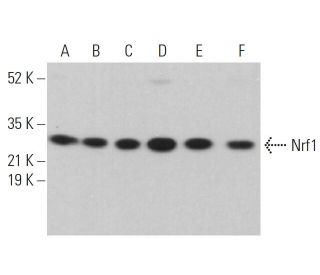
Nrf1 Anticorpo (H-4): sc-28379
- Nrf1 Anticorpo H-4é um anticorpo monoclonal produzido em camundongo IgG2a κ Nrf1 anticorpo, citado em 25 publicações, fornecido em 200 µg/ml
- Produzido contra aminoácidos 191-475 de Nrf1 de human origem
- recomendado para a detecção de Nrf1 de mouse, rat e human origem em
- disponível como reagente TransCruz para ensaios de Gel Supershift e uso em ChIP (sc-28379 X, 200 µg/0.1 ml)
- O m-IgGκ BP-HRP é o reagente de deteção secundário preferido para o anticorpo Nrf1 (H-4) para aplicações WB e IHC(P). Este reagente é agora oferecido num pacote com o anticorpo Nrf1 (H-4)(ver informações de encomenda abaixo). Para mais conjugados m-IgGκ BP, ver a nossa lista completa de Proteínas de Ligação IgG de Rato.

LINKS RÁPIDOS
O Anticorpo Nrf1 (H-4) é um anticorpo monoclonal Nrf1 IgG2a κ de camundongo (também designado anticorpo Nrf1 (fator nuclear eritroide 2 relacionado ao fator 1), anticorpo NFE2L1 (fator nuclear eritroide 2 semelhante ao fator 1), anticorpo LCR-F1, anticorpo NRF1 ou anticorpo TCF11) que detecta a proteína Nrf1 de origem de camundongo, rato e humana por WB, IP, IF, IHC(P) e ELISA. O anticorpo Nrf1 (H-4) está disponível como anticorpo anti-Nrf1 não conjugado. A proteína de ligação protéica ao DNA NF-E2 é composta por duas subunidades, p45 e MafK, e regula a expressão dos genes da globina nas células eritróides em desenvolvimento por meio da interação com os elementos de reconhecimento Maf (MAREs). Uma família de proteínas relacionadas ao NF-E2, conhecidas coletivamente como família Cap 'n' collar (CNC) e que incluem Nrf1 (também designada TCF11), Nrf2 e Nrf3, são fatores de transcrição bZIP que se heterodimerizam com as proteínas Maf para se ligarem às sequências MARE. As proteínas Nrf também ligam o elemento de resposta antioxidante (ARE) e estão envolvidas na regulação das enzimas de desintoxicação e na resposta ao estresse oxidativo. Elas fazem isso por meio da heterodimerização com os membros da família Jun (c-Jun, JunB e JunD) para ativar a expressão gênica, especificamente a enzima de desintoxicação, NQO1. O Nrf2 é amplamente expresso e acredita-se que se transloca para o núcleo após o tratamento com xenobióticos e antioxidantes, que estimulam sua liberação de uma proteína repressora Keap1. O Nrf3 é altamente expresso na placenta, nas células B e nos monócitos.
Alexa Fluor® é uma marca comercial da Molecular Probes Inc., OR., EUA
LI-COR® e Odyssey® são marcas registadas da LI-COR Biosciences
Referencias do Nrf1 Anticorpo (H-4):
- Clonagem molecular e caraterização funcional de um novo fator de transcrição da família Cap'n' collar Nrf3. | Kobayashi, A., et al. 1999. J Biol Chem. 274: 6443-52. PMID: 10037736
- As pequenas proteínas maf (MafG e MafK) regulam negativamente a expressão mediada pelo elemento de resposta antioxidante e a indução antioxidante do gene NAD(P)H:Quinona oxidoredutase1. | Dhakshinamoorthy, S. and Jaiswal, AK. 2000. J Biol Chem. 275: 40134-41. PMID: 11013233
- Regulação dos genes que codificam as NAD(P)H:quinona oxidorredutases. | Jaiswal, AK. 2000. Free Radic Biol Med. 29: 254-62. PMID: 11035254
- Expressão deficiente dos genes das enzimas sintéticas da glutationa em ratinhos com deleção específica da proteína Nrf2 com fecho de correr de leucina básica. | Chan, JY. and Kwong, M. 2000. Biochim Biophys Acta. 1517: 19-26. PMID: 11118612
- A sobreexpressão de TCF11/Nrf1 aumenta o nível intracelular de glutatião e pode transactivar o promotor da subunidade pesada da gama-glutamilcisteína sintetase (GCS). | Myhrstad, MC., et al. 2001. Biochim Biophys Acta. 1517: 212-9. PMID: 11342101
- A regulação negativa do fator de transcrição Nrf1 pelo seu domínio N-terminal é independente de Keap1: Nrf1, mas não Nrf2, é direcionado para o retículo endoplasmático. | Zhang, Y., et al. 2006. Biochem J. 399: 373-85. PMID: 16872277
- O recetor nuclear órfão alfa relacionado com o estrogénio é essencial para a termogénese adaptativa. | Villena, JA., et al. 2007. Proc Natl Acad Sci U S A. 104: 1418-23. PMID: 17229846
- Localização cromossómica da família NF-E2 humana de factores de transcrição bZIP por hibridação in situ fluorescente. | Chan, JY., et al. 1995. Hum Genet. 95: 265-9. PMID: 7868116
- NRF2, um membro da família NFE2 de factores de transcrição, não é essencial para a eritropoiese, crescimento e desenvolvimento murinos. | Chan, K., et al. 1996. Proc Natl Acad Sci U S A. 93: 13943-8. PMID: 8943040
Informacoes sobre ordens
| Nome do Produto | Numero de Catalogo | UNID | Preco | Qde | FAVORITOS | |
Nrf1 Anticorpo (H-4) | sc-28379 | 200 µg/ml | $322.00 | |||
Pacote do Nrf1 (H-4): m-IgGκ BP-HRP | sc-520815 | 200 µg Ab, 40 µg BP | $361.00 | |||
Nrf1 Anticorpo (H-4) X | sc-28379 X | 200 µg/0.1 ml | $322.00 |