
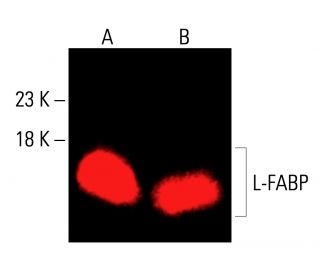
L-FABP Antibody (F-9): sc-271591
- L-FABP Antibody (F-9) is a mouse monoclonal IgG1 κ L-FABP antibody, cited in 5 publications, provided at 200 µg/ml
- specific for an epitope mapping between amino acids 4-37 near the N-terminus of L-FABP of human origin
- L-FABP Antibody (F-9) is recommended for detection of L-FABP of human origin by WB, IP, IF, IHC(P) and ELISA
- Anti-L-FABP Antibody (F-9) is available conjugated to agarose for IP; HRP for WB, IHC(P) and ELISA; and to either phycoerythrin or FITC for IF, IHC(P) and FCM
- also available conjugated to Alexa Fluor® 488, Alexa Fluor® 546, Alexa Fluor® 594 or Alexa Fluor® 647 for WB (RGB), IF, IHC(P) and FCM, and for use with RGB fluorescent imaging systems, such as iBright™ FL1000, FluorChem™, Typhoon, Azure and other comparable systems
- also available conjugated to Alexa Fluor® 680 or Alexa Fluor® 790 for WB (NIR), IF and FCM; for use with Near-Infrared (NIR) detection systems, such as LI-COR®Odyssey®, iBright™ FL1000, FluorChem™, Typhoon, Azure and other comparable systems
- m-IgG1 BP-HRP and m-IgGκ BP-HRP are the preferred secondary detection reagents for L-FABP Antibody (F-9) for WB and IHC(P) applications. These reagents are now offered in bundles with L-FABP Antibody (F-9) (see ordering information below).

QUICK LINKS
SEE ALSO...
L-FABP Antibody (F-9) is a mouse monoclonal IgG1 kappa light chain antibody that detects L-FABP of human origin by western blotting (WB), immunoprecipitation (IP), immunofluorescence (IF), immunohistochemistry, and enzyme-linked immunosorbent assay (ELISA). L-FABP (F-9) antibody is available in both non-conjugated and various conjugated forms, including agarose, horseradish peroxidase (HRP), phycoerythrin (PE), fluorescein isothiocyanate (FITC), and multiple Alexa Fluor® conjugates. The liver-type fatty acid-binding protein (L-FABP) plays a crucial role in lipid metabolism, specifically in the uptake, transport, and targeting of fatty acids within liver cells. L-FABP is primarily located in the cytoplasm of hepatocytes, where L-FABP facilitates the intracellular transport of long-chain fatty acids and their derivatives, thereby influencing lipid homeostasis and energy metabolism. Proper functioning of L-FABP is essential for maintaining cellular lipid levels and preventing lipid-related disorders, such as fatty liver disease. Additionally, L-FABP expression is regulated by various factors, including hormonal changes and dietary intake, highlighting L-FABP′s importance in metabolic adaptation. Using anti-L-FABP antibody (F-9) in research can provide valuable insights into the mechanisms of lipid metabolism and the physiological roles of fatty acid-binding proteins in human health.
Alexa Fluor® is a trademark of Molecular Probes Inc., OR., USA
LI-COR® and Odyssey® are registered trademarks of LI-COR Biosciences
L-FABP Antibody (F-9) References:
- L-FABP directly interacts with PPARalpha in cultured primary hepatocytes. | Hostetler, HA., et al. 2009. J Lipid Res. 50: 1663-75. PMID: 19289416
- L-FABP can be an early marker of acute kidney injury in children. | Ivanišević, I., et al. 2013. Pediatr Nephrol. 28: 963-9. PMID: 23407997
- NGAL, L-FABP, and KIM-1 in comparison to established markers of renal dysfunction. | Holzscheiter, L., et al. 2014. Clin Chem Lab Med. 52: 537-46. PMID: 24243749
- Evaluation of serum L-FABP levels in patients with acute pancreatitis. | Koçak, E., et al. 2015. Ulus Travma Acil Cerrahi Derg. 21: 39-43. PMID: 25779711
- Loss of L-FABP, SCP-2/SCP-x, or both induces hepatic lipid accumulation in female mice. | Martin, GG., et al. 2015. Arch Biochem Biophys. 580: 41-9. PMID: 26116377
- Phenotypic divergence in two lines of L-Fabp-/- mice reflects substrain differences and environmental modifiers. | Newberry, EP., et al. 2015. Am J Physiol Gastrointest Liver Physiol. 309: G648-61. PMID: 26251469
- Rapid and sensitive detection of L-FABP for prediction and diagnosis of acute kidney injury in critically ill patients by chemiluminescent immunoassay. | Sun, T., et al. 2021. J Clin Lab Anal. 35: e24051. PMID: 34651352
- Hepatotoxicity assessment investigations on PFASs targeting L-FABP using binding affinity data and machine learning-based QSAR model. | Zhao, J., et al. 2023. Ecotoxicol Environ Saf. 262: 115310. PMID: 37523843
- Urinary L-FABP as an Early Biomarker for Pediatric Acute Kidney Injury Following Cardiac Surgery with Cardiopulmonary Bypass: A Systematic Review and Meta-Analysis. | Wilnes, B., et al. 2024. Int J Mol Sci. 25: PMID: 38732152
- L-FABP and I-FABP expression increase NBD-stearate uptake and cytoplasmic diffusion in L cells. | Murphy, EJ. 1998. Am J Physiol. 275: G244-9. PMID: 9688651
Ordering Information
| Product Name | Catalog # | UNIT | Price | Qty | FAVORITES | |
L-FABP Antibody (F-9) | sc-271591 | 200 µg/ml | $322.00 | |||
L-FABP Antibody (F-9): m-IgGκ BP-HRP Bundle | sc-521990 | 200 µg Ab, 40 µg BP | $361.00 | |||
L-FABP Antibody (F-9): m-IgG1 BP-HRP Bundle | sc-533513 | 200 µg Ab; 20 µg BP | $361.00 | |||
L-FABP Antibody (F-9) AC | sc-271591 AC | 500 µg/ml, 25% agarose | $424.00 | |||
L-FABP Antibody (F-9) HRP | sc-271591 HRP | 200 µg/ml | $322.00 | |||
L-FABP Antibody (F-9) FITC | sc-271591 FITC | 200 µg/ml | $336.00 | |||
L-FABP Antibody (F-9) PE | sc-271591 PE | 200 µg/ml | $349.00 | |||
L-FABP Antibody (F-9) Alexa Fluor® 488 | sc-271591 AF488 | 200 µg/ml | $364.00 | |||
L-FABP Antibody (F-9) Alexa Fluor® 546 | sc-271591 AF546 | 200 µg/ml | $364.00 | |||
L-FABP Antibody (F-9) Alexa Fluor® 594 | sc-271591 AF594 | 200 µg/ml | $364.00 | |||
L-FABP Antibody (F-9) Alexa Fluor® 647 | sc-271591 AF647 | 200 µg/ml | $364.00 | |||
L-FABP Antibody (F-9) Alexa Fluor® 680 | sc-271591 AF680 | 200 µg/ml | $364.00 | |||
L-FABP Antibody (F-9) Alexa Fluor® 790 | sc-271591 AF790 | 200 µg/ml | $364.00 | |||
L-FABP (F-9) Neutralizing Peptide | sc-271591 P | 100 µg/0.5 ml | $69.00 |