
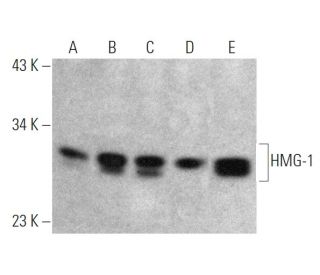

Cet anticorps polyclonal n'est plus commercialisé. Voir l'anticorps monoclonal HMG-1/HMGB1 (HAP46.5) que nous recommandons (données d'échantillonnage indiquées).
Anticorps HMG-1 (K-12): sc-26351
- L'anticorps HMG-1 K-12 est un polyclonal IgG de chèvre fourni en 100 µg/ml
- épitope situé dans une région interne de HMG-1 d'origine human
- Anticorps polyclonal arrêté

Informations pour la commande
HMG-1/HMGB1 (HAP46.5): sc-56698 [ Monoclonal recommandé en remplacement de HMG-1 (K-12) ]
| Nom du produit | Ref. Catalogue | COND. | Prix HT | QTÉ | Favoris | |
Anticorps HMG-1/HMGB1 (HAP46.5) | sc-56698 | 50 µg/0.5 ml | $322.00 | |||
HMG-1/HMGB1 (HAP46.5): m-IgG Fc BP-HRP Kit | sc-539036 | 50 µg Ab; 10 µg BP | $361.00 | |||
HMG-1/HMGB1 (HAP46.5): m-IgG1 BP-HRP Kit | sc-541219 | 50 µg Ab; 20 µg BP | $361.00 |