
 |
- rabbit polyclonal IgG, 200 µg/ml; also available as goat IgG, 200 µg/ml, sc-260-G
- epitope mapping at the C-terminus of Cdk4 of mouse origin
- recommended for detection of Cdk4 p34 of mouse, rat and human origin by WB, IP, KA, IF, IHC(P) and ELISA; also reactive with additional species, including bovine
- blocking peptide, sc-260 P
- agarose conjugate for IP studies, sc-260 AC, 500 µg/0.25 ml agarose
- fluorescein (sc-260 FITC) and rhodamine (sc-260 TRITC) conjugates for immunofluorescence, 200 µg/ml
- HRP conjugate, sc-260 HRP, 200 µg/ml
|
|
| |
Ordering InformationProduct Citations
Recommended Support Products:
(click button of application of choice)
| |
| Species |
Gene Name |
Gene ID |
Chromosome Location |
Isoform (mRNA) Accession # |
Protein Accession # |
OMIM™ Number |
| Human |
CDK4 |
1019 |
12q14.1 |
NM_000075 |
P11802
|
609048 |
| Mouse |
Cdk4 |
12567 |
10 D3 |
|
P30285
|
N/A |
| |
Cdk4 Background Information Cell cycle progression is controlled in part by a family of cyclin proteins and cyclin dependent kinases (Cdks). Cdk proteins work in concert with the cyclins to phosphorylate key substrates involved in each phase of cell cycle progression. Another family of proteins, Cdk inhibitors, also plays a role in regulating the cell cycle by binding to cyclin-Cdk complexes and modulating their activity. Several Cdk proteins have been identified, including Cdk2–Cdk8, PCTAIRE-1–3, PITALRE and PITSLRE. Cdk4, in complex with D-type cyclins, is thought to regulate cell growth during the G1 phase of the cell cycle. This association with a D-type cyclin upregulates Cdk4 activity, whereas binding to the Cdk inhibitor p16 downregulates Cdk4 activity. Activation of the Cdk4-cyclin complexes requires phosphorylation on a single threonyl residue of Cdk4, catalyzed by a Cdk-activating protein (CAK).
| Cdk4 (C-22) Product Citations |
See how others have used Cdk4 (C-22): sc-260 antibody and or Cdk4 (C-22) antibody conjugates.
425 total citations Loading citations.
|
| |
|
 |
|
Cdk4 (C-22)
Click on image to enlarge
|
|
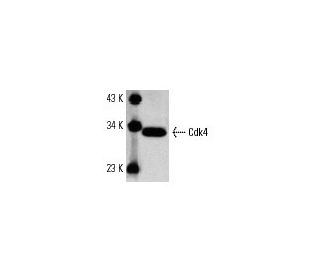
Cdk4 (C-22): sc-260. Western blot analysis of Cdk4 expression in NIH/3T3 nuclear extract.
Cdk4 (C-22): sc-260. Immunofluorescence staining of methanol-fixed NIH/3T3 cells showing nuclear localization (A). Immunoperoxidase staining of formalin-fixed, paraffin-embedded normal human skin. Note nuclear staining of epidermal cells (B).
Cdk4 (C-22): sc-260. Western blot analysis of Cdk4 p34 expression in HeLa whole cell lysate.
MHC (G-4): sc-6956. Immunofluorescence staining of methanol-fixed NIH/3T3 cells showing cytoskeletal rhodamine immunostaining of myosin heavy chain. Note also nuclear rhodamine immunostaining with Cdk4 (C-22): sc-260.
Cdk4 siRNA (h): sc-29261. Western blot analysis of Cdk4 expression in non-transfected control (A) and Cdk4 siRNA transfected (B) HeLa cells. Blot probed with Cdk4 (C-22): sc-260. Actin (I-19): sc-1616 used as specificity and loading control.
Cdk4 (C-22): sc-260. Western blot analysis of Cdk4 expression in non-transfected 293T: sc-117752 (A), mouse Cdk4 transfected 293T: sc-119150 (B) and HeLa (C) whole cell lysates.
Cdk4 (C-22)-G: sc-260-G. Western blot analysis of Cdk4 expression in non-transfected 293T: sc-117752 (A), mouse Cdk4 transfected 293T: sc-119150 (B) and HeLa (C) whole cell lysates.
Immunoprecipitation of Cdk4 from HeLa whole cell lysate using Cdk4 (DCS-35): sc-23896 (mouse monoclonal antibody) followed by Western blot analysis using Cdk4 (C-22)-G: sc-260-G (goat polyclonal antibody). Note presence of Protein A/G band using Protein A/G PLUS-Agarose: sc-2003 conventional IP matrix (A) as compared to their absence using ExactaCruz A: sc-45038 (B).
Cdk4 (C-22)-G: sc-260-G. Western blot analysis of Cdk4 expression in Ramos whole cell lysate.
|
|
Download
|
|
