
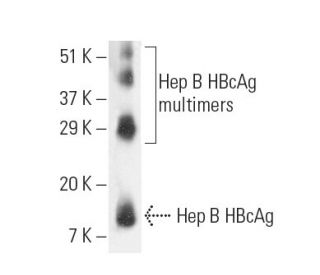

Hep B cAg Antibody (C1-5): sc-23945
- Hep B cAg Antibody (C1-5) is a mouse monoclonal IgG2a κ Hep B cAg antibody, cited in 17 publications, provided at 200 µg/ml
- raised against Hep B cAg
- Hep B cAg Antibody (C1-5) is recommended for detection of an epitope corresponding to amino acids 74-80 of the core antigen of Hep B origin by WB, IP, IF, FCM and ELISA; may cross-react with denatured Hep B cAg
- Anti-Hep B cAg Antibody (C1-5) is available conjugated to agarose for IP; HRP for WB, IHC(P) and ELISA; and to either phycoerythrin or FITC for IF, IHC(P) and FCM
- also available conjugated to Alexa Fluor® 488, Alexa Fluor® 546, Alexa Fluor® 594 or Alexa Fluor® 647 for WB (RGB), IF, IHC(P) and FCM, and for use with RGB fluorescent imaging systems, such as iBright™ FL1000, FluorChem™, Typhoon, Azure and other comparable systems
- also available conjugated to Alexa Fluor® 680 or Alexa Fluor® 790 for WB (NIR), IF and FCM; for use with Near-Infrared (NIR) detection systems, such as LI-COR®Odyssey®, iBright™ FL1000, FluorChem™, Typhoon, Azure and other comparable systems
- m-IgG Fc BP-HRP and m-IgG2a BP-HRP are the preferred secondary detection reagents for Hep B cAg Antibody (C1-5) for WB applications. These reagents are now offered in bundles with Hep B cAg Antibody (C1-5) (see ordering information below).

QUICK LINKS
SEE ALSO...
Hep B cAg Antibody (C1-5) is a mouse monoclonal IgG2a kappa light chain antibody that detects the Hep B cAg protein of Hep B origin by western blotting (WB), immunoprecipitation (IP), immunofluorescence (IF), flow cytometry (FCM), and enzyme-linked immunosorbent assay (ELISA). Hep B cAg (C1-5) antibody is available in both non-conjugated and various conjugated forms, including agarose, horseradish peroxidase (HRP), phycoerythrin (PE), fluorescein isothiocyanate (FITC), and multiple Alexa Fluor® conjugates. The Hepatitis B virus (HBV), a member of the Hepadnavirus family, is known for causing serious liver inflammation, which can lead to symptoms such as vomiting, jaundice, and in severe cases, death. The core antigen (Hep B cAg) plays a crucial role in the viral life cycle as Hep B cAg encapsulates the viral genome, forming the capsid that protects the genetic material during transmission and infection. Understanding the structure and function of Hep B cAg is vital, as Hep B cAg not only aids in the diagnosis of HBV infections but also serves as a target for therapeutic interventions. The presence of Hep B cAg, along with other viral antigens like Hep B surface antigen (Hep B sAg) and e-antigen (Hep B eAg), is essential for monitoring viral replication and assessing the effectiveness of antiviral treatments. Hep B cAg and Hep B eAg are primarily utilized in clinical diagnostics, while Hep B sAg is critical for vaccine development and prevention strategies. The expression of these antigens predominantly occurs in the liver, highlighting the organ′s central role in HBV pathogenesis and the importance of targeted therapies in managing liver-related complications.
Alexa Fluor® is a trademark of Molecular Probes Inc., OR., USA
LI-COR® and Odyssey® are registered trademarks of LI-COR Biosciences
Hep B cAg Antibody (C1-5) References:
- In vivo inhibition of anti-hepatitis B virus core antigen (HBcAg) immunoglobulin G production by HBcAg-specific CD4(+) Th1-type T-cell clones in a hu-PBL-NOD/SCID mouse model. | Cao, T., et al. 2001. J Virol. 75: 11449-56. PMID: 11689626
- HBcAg-specific cytokine production by CD4 T lymphocytes of children with acute and chronic hepatitis B. | Szkaradkiewicz, A., et al. 2003. Virus Res. 97: 127-33. PMID: 14602204
- Exposure of RNA templates and encapsidation of spliced viral RNA are influenced by the arginine-rich domain of human hepatitis B virus core antigen (HBcAg 165-173). | Le Pogam, S., et al. 2005. J Virol. 79: 1871-87. PMID: 15650211
- Hepatitis C virus core antigen testing: role in diagnosis, disease monitoring and treatment. | Tillmann, HL. 2014. World J Gastroenterol. 20: 6701-6. PMID: 24944462
- Quantification of Antibody to Hepatitis B Core Antigen to Predict Outcomes of Patients With HBV Infection. | Lim, YS. 2019. Clin Gastroenterol Hepatol. 17: 39-40. PMID: 30099105
- Virion Secretion of Hepatitis B Virus Naturally Occurring Core Antigen Variants. | Shih, C., et al. 2020. Cells. 10: PMID: 33396864
- Absolute Quantification of Hepatitis B Core Antigen (HBcAg) Virus-like Particles and Bound Nucleic Acids. | Valentic, A., et al. 2023. Viruses. 16: PMID: 38275948
- Introducing adjuvant-loaded particulate hepatitis B core antigen as an alternative therapeutic hepatitis B vaccine component. | Su, J., et al. 2024. JHEP Rep. 6: 100997. PMID: 38425450
- Epitopes recognized by antibodies to denatured core protein of hepatitis B virus. | Bichko, V., et al. 1993. Mol Immunol. 30: 221-31. PMID: 7679466
- Identification of hepatitis B virus core protein regions exposed or internalized at the surface of HBcAg particles by scanning with monoclonal antibodies. | Pushko, P., et al. 1994. Virology. 202: 912-20. PMID: 8030252
- The structure of the variable regions of mouse monoclonal antibodies to hepatitis B virus core antigen. | Skrivelis, V., et al. 1993. Scand J Immunol. 37: 637-43. PMID: 8316761
- Differentiation of core gene products of the hepatitis B virus in infected liver tissue using monoclonal antibodies. | Naoumov, NV., et al. 1997. J Med Virol. 53: 127-38. PMID: 9334923
Ordering Information
| Product Name | Catalog # | UNIT | Price | Qty | FAVORITES | |
Hep B cAg Antibody (C1-5) | sc-23945 | 200 µg/ml | $322.00 | |||
Hep B cAg Antibody (C1-5): m-IgG Fc BP-HRP Bundle | sc-525508 | 200 µg Ab; 10 µg BP | $361.00 | |||
Hep B cAg Antibody (C1-5): m-IgG2a BP-HRP Bundle | sc-546295 | 200 µg Ab; 10 µg BP | $361.00 | |||
Hep B cAg Antibody (C1-5) AC | sc-23945 AC | 500 µg/ml, 25% agarose | $424.00 | |||
Hep B cAg Antibody (C1-5) HRP | sc-23945 HRP | 200 µg/ml | $322.00 | |||
Hep B cAg Antibody (C1-5) FITC | sc-23945 FITC | 200 µg/ml | $336.00 | |||
Hep B cAg Antibody (C1-5) PE | sc-23945 PE | 200 µg/ml | $349.00 | |||
Hep B cAg Antibody (C1-5) Alexa Fluor® 488 | sc-23945 AF488 | 200 µg/ml | $364.00 | |||
Hep B cAg Antibody (C1-5) Alexa Fluor® 546 | sc-23945 AF546 | 200 µg/ml | $364.00 | |||
Hep B cAg Antibody (C1-5) Alexa Fluor® 594 | sc-23945 AF594 | 200 µg/ml | $364.00 | |||
Hep B cAg Antibody (C1-5) Alexa Fluor® 647 | sc-23945 AF647 | 200 µg/ml | $364.00 | |||
Hep B cAg Antibody (C1-5) Alexa Fluor® 680 | sc-23945 AF680 | 200 µg/ml | $364.00 | |||
Hep B cAg Antibody (C1-5) Alexa Fluor® 790 | sc-23945 AF790 | 200 µg/ml | $364.00 |