
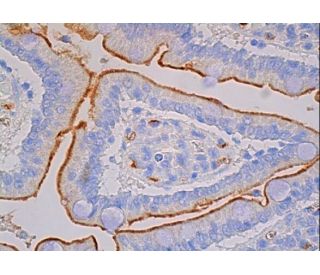
ACE Antibody (2E2): sc-23908
- ACE Antibody (2E2) is a mouse monoclonal IgG1 κ ACE antibody, cited in 37 publications, provided at 200 µg/ml
- raised against angiotensin-converting enzyme from human kidney
- ACE Antibody (2E2) is recommended for detection of ACE of mouse, rat and human origin by WB, IP, IF and IHC(P)
- Anti-ACE Antibody (2E2) is available conjugated to agarose for IP; HRP for WB, IHC(P) and ELISA; and to either phycoerythrin or FITC for IF, IHC(P) and FCM
- also available conjugated to Alexa Fluor® 488, Alexa Fluor® 546, Alexa Fluor® 594 or Alexa Fluor® 647 for WB (RGB), IF, IHC(P) and FCM, and for use with RGB fluorescent imaging systems, such as iBright™ FL1000, FluorChem™, Typhoon, Azure and other comparable systems
- also available conjugated to Alexa Fluor® 680 or Alexa Fluor® 790 for WB (NIR), IF and FCM; for use with Near-Infrared (NIR) detection systems, such as LI-COR®Odyssey®, iBright™ FL1000, FluorChem™, Typhoon, Azure and other comparable systems
- m-IgG1 BP-HRP is the preferred secondary detection reagent for ACE Antibody (2E2) for WB and IHC(P) applications. This reagent is now offered in a bundle with ACE Antibody (2E2) (see ordering information below).

QUICK LINKS
ACE Antibody (2E2) is a mouse monoclonal IgG1 kappa light chain antibody designed to target angiotensin-converting enzyme (ACE), also known as CD143, DCP1, or Angiotensin Converting Enzyme 1. ACE monoclonal antibody (2E2) effectively detects ACE proteins from mouse, rat, and human origins through various applications including western blotting (WB), immunoprecipitation (IP), immunofluorescence (IF), and immunohistochemistry with paraffin-embedded sections (IHCP). Available in both non-conjugated and multiple conjugated forms such as agarose, horseradish peroxidase (HRP), phycoerythrin (PE), fluorescein isothiocyanate (FITC), and various Alexa Fluor® conjugates, anti-ACE antibody (2E2) provides versatile options for diverse research needs. Angiotensin-converting enzyme (ACE) is a crucial carboxy-terminal dipeptidyl exo-peptidase involved in the renin-angiotensin system, where ACE converts Angiotensin I into the potent vasopressor hormone Angiotensin II, playing a vital role in regulating blood pressure and electrolyte balance. Additionally, ACE inactivates bradykinin, a vasodepressor peptide, thereby contributing to fluid and electrolyte homeostasis. There are two primary isoforms of ACE: pulmonary ACE (ACEP), a glycoprotein expressed in vascular endothelial cells of the lung, liver, adrenal cortex, pancreas, kidney, and spleen, and testicular ACE (ACET), which is exclusively expressed in adult testis by developing sperm cells, specifically late pachytene spermatocytes. Understanding ACE function is essential for researching cardiovascular diseases, hypertension, and related disorders, making anti-ACE antibody (2E2) an indispensable tool in biomedical research. Furthermore, while ACE is ubiquitously expressed throughout the vasculature, ACE2 has a more restricted expression pattern, being limited to cardiac, renal, and testicular cells, highlighting the importance of precise detection provided by ACE (2E2) antibody.
Alexa Fluor® is a trademark of Molecular Probes Inc., OR., USA
LI-COR® and Odyssey® are registered trademarks of LI-COR Biosciences
ACE Antibody (2E2) References:
- A novel angiotensin-converting enzyme-related carboxypeptidase (ACE2) converts angiotensin I to angiotensin 1-9. | Donoghue, M., et al. 2000. Circ Res. 87: E1-9. PMID: 10969042
- Use of alternative polyadenylation sites for tissue-specific transcription of two angiotensin-converting enzyme mRNAs. | Thekkumkara, TJ., et al. 1992. Nucleic Acids Res. 20: 683-7. PMID: 1311831
- Angiotensin-converting enzyme: vascular endothelial localization. | Caldwell, PR., et al. 1976. Science. 191: 1050-1. PMID: 175444
- Angiotensin-converting enzyme and the regulation of vasoactive peptides. | Soffer, RL. 1976. Annu Rev Biochem. 45: 73-94. PMID: 183603
- The mRNAs encoding the two angiotensin-converting isozymes are transcribed from the same gene by a tissue-specific choice of alternative transcription initiation sites. | Kumar, RS., et al. 1991. J Biol Chem. 266: 3854-62. PMID: 1847388
- An enzyme in microsomal fraction of kidney that inactivates bradykinin. | Erdos, EG. and Yang, HY. 1967. Life Sci. 6: 569-74. PMID: 4962200
- Molecular and catalytic properties of rabbit testicular dipeptidyl carboxypeptidase. | El-Dorry, HA., et al. 1982. J Biol Chem. 257: 14128-33. PMID: 6754723
- Regulated expression of testis angiotensin-converting enzyme during spermatogenesis in mice. | Langford, KG., et al. 1993. Biol Reprod. 48: 1210-8. PMID: 8391328
Ordering Information
| Product Name | Catalog # | UNIT | Price | Qty | FAVORITES | |
ACE Antibody (2E2) | sc-23908 | 200 µg/ml | $322.00 | |||
ACE Antibody (2E2): m-IgG1 BP-HRP Bundle | sc-531641 | 200 µg Ab; 20 µg BP | $361.00 | |||
ACE Antibody (2E2) AC | sc-23908 AC | 500 µg/ml, 25% agarose | $424.00 | |||
ACE Antibody (2E2) HRP | sc-23908 HRP | 200 µg/ml | $322.00 | |||
ACE Antibody (2E2) FITC | sc-23908 FITC | 200 µg/ml | $336.00 | |||
ACE Antibody (2E2) PE | sc-23908 PE | 200 µg/ml | $349.00 | |||
ACE Antibody (2E2) Alexa Fluor® 488 | sc-23908 AF488 | 200 µg/ml | $364.00 | |||
ACE Antibody (2E2) Alexa Fluor® 546 | sc-23908 AF546 | 200 µg/ml | $364.00 | |||
ACE Antibody (2E2) Alexa Fluor® 594 | sc-23908 AF594 | 200 µg/ml | $364.00 | |||
ACE Antibody (2E2) Alexa Fluor® 647 | sc-23908 AF647 | 200 µg/ml | $364.00 | |||
ACE Antibody (2E2) Alexa Fluor® 680 | sc-23908 AF680 | 200 µg/ml | $364.00 | |||
ACE Antibody (2E2) Alexa Fluor® 790 | sc-23908 AF790 | 200 µg/ml | $364.00 |