
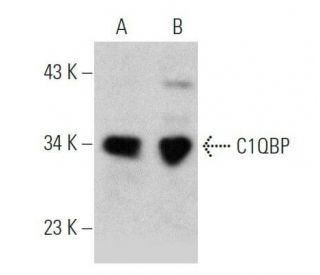


C1QBP Antibody (60.11): sc-23884
- C1QBP Antibody (60.11) is a mouse monoclonal IgG1, cited in 6 publications, provided at 200 µg/ml
- raised against recombinant C1QBP corresponding to mature C1QBP (amino acids 74-282)
- recommended for detection of mature form of C1QBP of mouse, rat and human origin by WB, IP and FCM; blocks C1q/C1QBP interaction
- available conjugated to either phycoerythrin or FITC for IF, IHC(P) and FCM
- also provided azide-free for biological studies, sc-23884 L, 200 µg/0.1 ml
- At present, we have not yet completed the identification of the preferred secondary detection reagent(s) for C1QBP Antibody (60.11). This work is in progress.

QUICK LINKS
SEE ALSO...
C1QBP Antibody (60.11) is a mouse monoclonal IgG1 antibody that detects C1QBP in mouse, rat, and human samples through western blotting (WB), immunoprecipitation (IP), and flow cytometry (FCM). C1QBP, also known as gC1q-R, p32 (p33), or hyaluronan-binding protein 1 (HABP1), plays a crucial role in the immune response by binding to the globular heads of C1q molecules, thereby inhibiting C1 activation and modulating the complement system. C1QBP is primarily located in vascular endothelial cells, where C1QBP is involved in various physiological processes, including inflammation and immune regulation. C1QBP presence in these cells facilitates the interaction between the complement and coagulation systems, which is essential for maintaining homeostasis and responding to pathogens. Additionally, C1QBP has been identified as a subunit of the pre-mRNA splicing factor SF2/ASF, highlighting C1QBP′s multifunctional nature and importance in cellular processes beyond the immune response. Anti-C1QBP antibody (60.11) is an invaluable tool for researchers studying the complement system and its interactions in various biological contexts.
Ordering Information
| Product Name | Catalog # | UNIT | Price | Qty | FAVORITES | |
C1QBP Antibody (60.11) | sc-23884 | 200 µg/ml | $322.00 | |||
C1QBP Antibody (60.11) FITC | sc-23884 FITC | 200 µg/ml | $336.00 | |||
C1QBP Antibody (60.11) L | sc-23884 L | 200 µg/0.1 ml | $322.00 | |||
C1QBP Antibody (60.11) PE | sc-23884 PE | 200 µg/ml | $349.00 |