
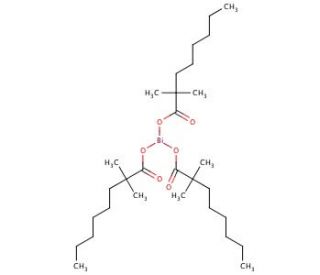

Bismuth neodecanoate (CAS 34364-26-6)
Available in US only.
ENLACES RÁPIDOS
El neodecanoato de bismuto es un compuesto que acapara la atención en el ámbito de la investigación química, principalmente en el estudio de su uso como catalizador para la síntesis de diversos polímeros, incluidos los poliésteres y las resinas alquídicas. Su eficacia como catalizador se atribuye a las propiedades del ácido de Lewis del bismuto, que puede acelerar las reacciones de esterificación y transesterificación. Además de sus aplicaciones catalíticas, el neodecanoato de bismuto también se investiga por su papel en la producción de materiales ignífugos, aprovechando la baja toxicidad del bismuto en comparación con otros metales pesados. El compuesto también se estudia en el campo de la ciencia de los materiales, donde se utiliza para mejorar las propiedades de los revestimientos, aumentando su adherencia y durabilidad. También se investigan los aspectos medioambientales del neodecanoato de bismuto, estudiando sus productos de descomposición y su posible impacto ambiental, sobre todo en comparación con catalizadores más tradicionales basados en metales.
Bismuth neodecanoate (CAS 34364-26-6) Referencias
- Estudio ecotoxicológico de revestimientos a base de PDMS catalizados por estaño y bismuto que contienen un polímero tensioactivo. | Pretti, C., et al. 2013. Ecotoxicol Environ Saf. 98: 250-6. PMID: 24125869
- Visualización de la coalescencia de nanopartículas de bismuto. | Niu, KY., et al. 2014. Microsc Microanal. 20: 416-24. PMID: 24636580
- Poliuretano fluorescente con derivados de rodamina covalentemente reticulados. | Tian, S., et al. 2020. Polymers (Basel). 12: PMID: 32882833
- Ingeniería de nanomateriales bioactivos de sulfuro metálico para la terapia del cáncer. | Fei, W., et al. 2021. J Nanobiotechnology. 19: 93. PMID: 33789653
- PU de base biológica al agua para revestimientos textiles duraderos. | De Smet, D., et al. 2021. Polymers (Basel). 13: PMID: 34883730
- Diseño de un constructo tubular electrospun que combina un enfoque mecánico y biológico para mejorar la reparación de tendones. | Pien, N., et al. 2022. J Mater Sci Mater Med. 33: 51. PMID: 35639212
- Preparación del Polvo Compuesto Fotocatalítico g-C3N4/TNTs/CNTs y su Mejora del Rendimiento Antifouling de los Revestimientos de Polidimetilsiloxano. | Xiong, G., et al. 2022. Nanomaterials (Basel). 12: PMID: 35889666
- Superficies con eficacia antimicrobiana instantánea y persistente contra bacterias y SARS-CoV-2. | Dhyani, A., et al. 2022. Matter. 5: 4076-4091. PMID: 36034972
- Recubrimiento textil PU 2K cicatrizable de base biológica para aplicaciones duraderas. | De Smet, D. and Vanneste, M. 2022. Polymers (Basel). 14: PMID: 36235962
- Nanocompuestos de puntos cuánticos de bismuto (Bi QD)/polidimetilsiloxano (PDMS) con actividad autolimpiante y antibacteriana para aplicaciones dentales. | Hu, Y., et al. 2022. Nanomaterials (Basel). 12: PMID: 36364687
- Solvólisis selectiva de tejido recubierto de PU de base biológica. | De Smet, D., et al. 2022. Polymers (Basel). 14: PMID: 36559819
- Crecimiento anisótropo selectivo de nanopartículas de Bi2S3 con propiedades ópticas ajustables. | Escoda-Torroella, M., et al. 2023. Phys Chem Chem Phys. 25: 3900-3911. PMID: 36648114
- Copolímero de poliéter-tiourea-siloxano basado en la interacción de enlace H para antiincrustantes marinos. | Li, M., et al. 2023. Molecules. 28: PMID: 37110807
Información sobre pedidos
| Nombre del producto | Número de catálogo | UNIDAD | Precio | CANTIDAD | Favoritos | |
Bismuth neodecanoate, 250 g | sc-234094 | 250 g | $67.00 | |||
| EE.UU: Sólo disponible en EE. | ||||||