
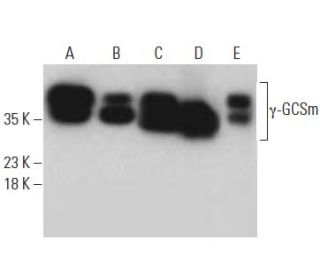

Cet anticorps polyclonal n'est plus commercialisé. Voir l'anticorps monoclonal γ-GCSm (E-4) que nous recommandons (données d'échantillonnage indiquées).
Anticorps γ-GCSm (FL-274): sc-22754
- L'anticorps gamma-GCSm FL-274 est un polyclonal IgG de lapin fourni en 200 µg/ml
- Anticorps polyclonal arrêté

Informations pour la commande
γ-GCSm (E-4): sc-55586 [ Monoclonal recommandé en remplacement de γ-GCSm (FL-274) ]
| Nom du produit | Ref. Catalogue | COND. | Prix HT | QTÉ | Favoris | |
Anticorps γ-GCSm (E-4) | sc-55586 | 200 µg/ml | $322.00 | |||
Anticorps γ-GCSm (E-4) AC | sc-55586 AC | 500 µg/ml, 25% agarose | $424.00 | |||
Anticorps γ-GCSm (E-4) HRP | sc-55586 HRP | 200 µg/ml | $322.00 | |||
Anticorps γ-GCSm (E-4) FITC | sc-55586 FITC | 200 µg/ml | $336.00 | |||
Anticorps γ-GCSm (E-4) PE | sc-55586 PE | 200 µg/ml | $349.00 | |||
Anticorps γ-GCSm (E-4) Alexa Fluor® 488 | sc-55586 AF488 | 200 µg/ml | $364.00 | |||
Anticorps γ-GCSm (E-4) Alexa Fluor® 546 | sc-55586 AF546 | 200 µg/ml | $364.00 | |||
Anticorps γ-GCSm (E-4) Alexa Fluor® 594 | sc-55586 AF594 | 200 µg/ml | $364.00 | |||
Anticorps γ-GCSm (E-4) Alexa Fluor® 647 | sc-55586 AF647 | 200 µg/ml | $364.00 | |||
Anticorps γ-GCSm (E-4) Alexa Fluor® 680 | sc-55586 AF680 | 200 µg/ml | $364.00 | |||
Anticorps γ-GCSm (E-4) Alexa Fluor® 790 | sc-55586 AF790 | 200 µg/ml | $364.00 |