
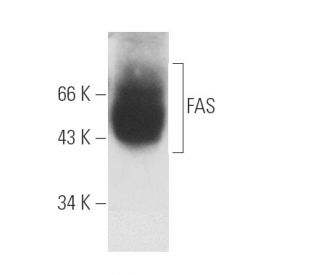


FAS Antibody (C236): sc-21730
- FAS Antibody (C236) is a mouse monoclonal IgG1 κ, cited in 13 publications, provided at 200 µg/ml
- raised against the human B lymphoblast cell line SKW6.4
- Anti-FAS Antibody (C236) is recommended for detection of FAS of mouse, rat and human origin by WB, IP, IF, IHC(P) and FCM
- Anti-FAS Antibody (C236) is available conjugated to agarose for IP; HRP for WB, IHC(P) and ELISA; and to either phycoerythrin or FITC for IF, IHC(P) and FCM
- also available conjugated to Alexa Fluor® 488, Alexa Fluor® 546, Alexa Fluor® 594 or Alexa Fluor® 647 for WB (RGB), IF, IHC(P) and FCM, and for use with RGB fluorescent imaging systems, such as iBright™ FL1000, FluorChem™, Typhoon, Azure and other comparable systems
- also available conjugated to Alexa Fluor® 680 or Alexa Fluor® 790 for WB (NIR), IF and FCM; for use with Near-Infrared (NIR) detection systems, such as LI-COR®Odyssey®, iBright™ FL1000, FluorChem™, Typhoon, Azure and other comparable systems
- m-IgG Fc BP-HRP and m-IgG1 BP-HRP are the preferred secondary detection reagents for FAS Antibody (C236) for WB and IHC(P) applications. These reagents are now offered in bundles with FAS Antibody (C236) (see ordering information below).

QUICK LINKS
SEE ALSO...
FAS Antibody (C236) is a mouse monoclonal IgG1 kappa light chain antibody raised against the human B lymphoblast cell line SKW6.4, reactive with mouse, rat, and human species, and validated for applications including western blotting (WB), immunoprecipitation (IP), immunofluorescence (IF), flow cytometry (FCM), and immunohistochemistry. FAS, also known as CD95 or APO-1, is a cell surface glycoprotein and a member of the tumor necrosis factor (TNF) receptor superfamily. FAS plays a pivotal role in mediating apoptosis, a fundamental process in immune regulation and cellular homeostasis. As part of the FAS/FAS ligand (FASL) signaling pathway, FAS transduces apoptotic signals upon binding to FASL, leading to the recruitment of adaptor proteins and the activation of caspases that orchestrate programmed cell death. This mechanism is critical for cytotoxic T lymphocyte (CTL)-mediated cytotoxicity, an essential component of immune surveillance against virus-infected and transformed cells. FAS is widely expressed on lymphoid cells and other tissues, and FAS function is tightly regulated to prevent excessive apoptosis, which can lead to immune deficiencies, or insufficient apoptosis, associated with autoimmune disorders and cancer. The targeted induction of apoptosis through FAS interactions is also implicated in potential therapeutic strategies for eliminating malignant or infected cells. FAS Antibody (C236) provides a versatile and reliable tool for exploring the function and regulation of this essential apoptotic receptor in both physiological and pathological contexts. FAS Antibody (C236) is available in non-conjugated form and various conjugated options, including agarose, horseradish peroxidase (HRP), phycoerythrin (PE), fluorescein isothiocyanate (FITC), and Alexa Fluor® conjugates, to support a wide range of experimental needs.
Alexa Fluor® is a trademark of Molecular Probes Inc., OR., USA
LI-COR® and Odyssey® are registered trademarks of LI-COR Biosciences
FAS Antibody (C236) References:
- Fas-induced caspase denitrosylation. | Mannick, JB., et al. 1999. Science. 284: 651-4. PMID: 10213689
- Structure and function of Fas/Fas ligand. | Orlinick, JR., et al. 1999. Int Rev Immunol. 18: 293-308. PMID: 10626245
- Fas regulates liver regeneration. | Hayashi, N. 2000. J Gastroenterol. 35: 73-4. PMID: 10632548
- Fas and Fas ligand interactions in malignant disease. | Owen-Schaub, L., et al. 2000. Int J Oncol. 17: 5-12. PMID: 10853011
- Fas and fas ligand in human hepatocellular carcinoma. | Takehara, T. and Hayashi, N. 2001. J Gastroenterol. 36: 727-8. PMID: 11686487
- Targeting Fas in osteoresorptive disorders. | Kovacic, N., et al. 2010. Expert Opin Ther Targets. 14: 1121-34. PMID: 20854180
- Fas-Fas Ligand: Checkpoint of T Cell Functions in Multiple Sclerosis. | Volpe, E., et al. 2016. Front Immunol. 7: 382. PMID: 27729910
- Lipid Nanoparticle Delivery of Fas Plasmid Restores Fas Expression to Suppress Melanoma Growth In Vivo. | Al Subeh, ZY., et al. 2022. ACS Nano. 16: 12695-12710. PMID: 35939651
- CD95 (Fas) and CD95L (FasL)-mediated non-canonical signaling pathways. | Haymour, L., et al. 2023. Biochim Biophys Acta Rev Cancer. 1878: 189004. PMID: 37865305
- CAR-engineered lymphocyte persistence is governed by a FAS ligand/FAS auto-regulatory circuit. | Yi, F., et al. 2024. bioRxiv.. PMID: 38464085
Ordering Information
| Product Name | Catalog # | UNIT | Price | Qty | FAVORITES | |
FAS Antibody (C236) | sc-21730 | 200 µg/ml | $322.00 | |||
FAS Antibody (C236): m-IgG Fc BP-HRP Bundle | sc-526601 | 200 µg Ab; 10 µg BP | $361.00 | |||
FAS Antibody (C236): m-IgG1 BP-HRP Bundle | sc-531974 | 200 µg Ab; 20 µg BP | $361.00 | |||
FAS Antibody (C236) AC | sc-21730 AC | 500 µg/ml, 25% agarose | $424.00 | |||
FAS Antibody (C236) HRP | sc-21730 HRP | 200 µg/ml | $322.00 | |||
FAS Antibody (C236) FITC | sc-21730 FITC | 200 µg/ml | $336.00 | |||
FAS Antibody (C236) PE | sc-21730 PE | 200 µg/ml | $349.00 | |||
FAS Antibody (C236) Alexa Fluor® 488 | sc-21730 AF488 | 200 µg/ml | $364.00 | |||
FAS Antibody (C236) Alexa Fluor® 546 | sc-21730 AF546 | 200 µg/ml | $364.00 | |||
FAS Antibody (C236) Alexa Fluor® 594 | sc-21730 AF594 | 200 µg/ml | $364.00 | |||
FAS Antibody (C236) Alexa Fluor® 647 | sc-21730 AF647 | 200 µg/ml | $364.00 | |||
FAS Antibody (C236) Alexa Fluor® 680 | sc-21730 AF680 | 200 µg/ml | $364.00 | |||
FAS Antibody (C236) Alexa Fluor® 790 | sc-21730 AF790 | 200 µg/ml | $364.00 |