
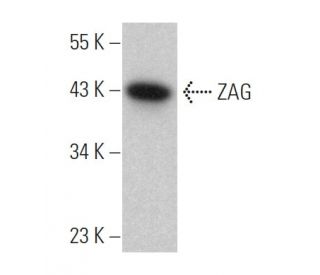
ZAG Antibody (6G2): sc-21721
- ZAG Antibody (6G2) is a mouse monoclonal IgG1 κ, cited in 2 publications, provided at 200 µg/ml
- raised against purified Zn-α2-glycoprotein (ZAG) of human origin
- recommended for detection of ZAG of mouse, rat and human origin by WB, IP and IF
- m-IgG Fc BP-HRP, m-IgG1 BP-HRP and m-IgGκ BP-HRP are the preferred secondary detection reagents for ZAG Antibody (6G2) for WB applications. These reagents are now offered in bundles with ZAG Antibody (6G2) (see ordering information below).

QUICK LINKS
SEE ALSO...
ZAG Antibody (6G2) is a mouse monoclonal IgG1 antibody that detects ZAG (Zn-α2-glycoprotein) in mouse, rat, and human samples through applications such as western blotting (WB), immunoprecipitation (IP), and immunofluorescence (IF). ZAG is a soluble, secreted protein predominantly found in serum and various body fluids, including cerebrospinal fluid, blood plasma, urine, and sweat. ZAG (6G2) antibody helps researchers study a protein that plays a crucial role in lipid metabolism by stimulating lipid degradation in adipocytes, which is significant for maintaining energy homeostasis in the body. ZAG overexpression has been linked to extensive fat losses observed in advanced cancers, highlighting ZAG′s potential as a biomarker for cachexia and metabolic disorders. The structure of ZAG features a large groove similar to the peptide binding grooves of class I major histocompatibility complex (MHC) proteins, although ZAG does not bind the class I light chain β-2-Microglobulin. This unique structural characteristic may influence ZAG′s interactions and functions within the immune system and metabolic pathways. Anti-ZAG antibody (6G2) serves as an essential tool for researchers investigating ZAG′s roles in various physiological and pathological contexts.
Ordering Information
| Product Name | Catalog # | UNIT | Price | Qty | FAVORITES | |
ZAG Antibody (6G2) | sc-21721 | 200 µg/ml | $322.00 | |||
ZAG Antibody (6G2): m-IgG Fc BP-HRP Bundle | sc-536657 | 200 µg Ab; 10 µg BP | $361.00 | |||
ZAG Antibody (6G2): m-IgGκ BP-HRP Bundle | sc-533816 | 200 µg Ab; 40 µg BP | $361.00 | |||
ZAG Antibody (6G2): m-IgG1 BP-HRP Bundle | sc-544741 | 200 µg Ab; 20 µg BP | $361.00 |