
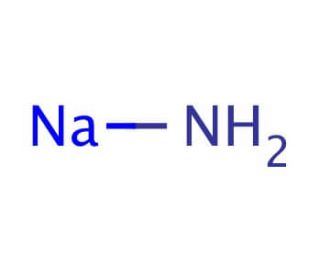

Sodium amide (CAS 7782-92-5)
Available in US only.
QUICK LINKS
Sodium amide is a strong base that is organic synthesis as a reagent for deprotonation reactions. It functions by abstracting a proton from various organic compounds, forming an alkali metal salt and an alkene or alkyne. Sodium amide′s mechanism of action involves the generation of an alkali metal salt, which can then undergo further reactions to produce a variety of organic compounds. In the presence of ammonia, sodium amide can also act as a source of amide anions, which can be used in the synthesis of amines and other nitrogen-containing compounds. Sodium amide can participate in metalation reactions, where it deprotonates aromatic compounds to form metalated intermediates that can undergo further functionalization. Sodium amide plays a role in organic synthesis by facilitating deprotonation and metalation reactions, leading to the formation of diverse organic compounds.
Sodium amide (CAS 7782-92-5) References
- Microdetection of carbon in organic and inorganic compounds by ignition with sodium amide. | MOMOSE, T., et al. 1958. Chem Pharm Bull (Tokyo). 6: 322. PMID: 13573496
- Rearrangement in the Reaction of 3-Bromopyridine with Sodium Amide and Sodioacetophenone. | Levine, R. and Leake, WW. 1955. Science. 121: 780. PMID: 17773207
- [Not Available]. | Miocque, M., et al. 1970. Talanta. 17: 423-30. PMID: 18960754
- The use of the fused eutectic of sodium amide and potassium amide in organic syntheses. | BERGSTROM, FW., et al. 1946. J Org Chem. 11: 239-46. PMID: 20983300
- Proportion of ester anion and amide from esters and sodium amide; carbonation of esters; synthesis of malonic acid derivatives. | HAUSER, CR., et al. 1946. J Am Chem Soc. 68: 26-9. PMID: 21008319
- In situ high-pressure study of sodium amide by Raman and infrared spectroscopies. | Liu, A. and Song, Y. 2011. J Phys Chem B. 115: 7-13. PMID: 21141952
- Hydrogen production from ammonia using sodium amide. | David, WI., et al. 2014. J Am Chem Soc. 136: 13082-5. PMID: 24972299
- Isotopic studies of the ammonia decomposition reaction mediated by sodium amide. | Wood, TJ., et al. 2015. Phys Chem Chem Phys. 17: 22999-3006. PMID: 26271016
- An efficient low-temperature route to nitrogen-doping and activation of mesoporous carbons for CO2 capture. | Huang, K., et al. 2015. Chem Commun (Camb). 51: 17261-4. PMID: 26460737
- Thermal decomposition of sodium amide, NaNH2, and sodium amide hydroxide composites, NaNH2-NaOH. | Jepsen, LH., et al. 2016. Phys Chem Chem Phys. 18: 25257-25264. PMID: 27722371
- Formal Allylic C(sp3)-H Bond Activation of Alkenes Triggered by a Sodium Amide. | Bao, W., et al. 2017. J Am Chem Soc. 139: 4362-4365. PMID: 28294612
- Analysis of the Effect of Conditions of Preparation of Nitrogen-Doped Activated Carbons Derived from Lotus Leaves by Activation with Sodium Amide on the Formation of Their Porous Structure. | Kwiatkowski, M. and Hu, X. 2021. Materials (Basel). 14: PMID: 33801121
- Combustion Reactions between Transition-Metal Chlorides and Sodium Amide and Their Ignition Temperature. | Noguchi, S., et al. 2021. Inorg Chem. 60: 12753-12758. PMID: 34428370
- Synthetic Route of Layered Titanium Nitride Chloride TiNCl Using Sodium Amide. | Tanaka, M., et al. 2022. ACS Omega. 7: 6375-6380. PMID: 35224398
- Perdeuteration of Arenes via Hydrogen Isotope Exchange Catalyzed by the Superbasic Sodium Amide Donor Species NaTMP·PMDETA. | Tortajada, A. and Hevia, E. 2022. J Am Chem Soc. 144: 20237-20242. PMID: 36302147
Ordering Information
| Product Name | Catalog # | UNIT | Price | Qty | FAVORITES | |
Sodium amide, 100 g | sc-215863 | 100 g | $77.00 | |||
| US: Only available in the US | ||||||