
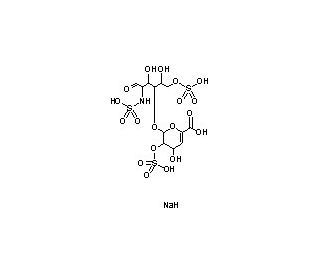

Heparin disaccharide I-S sodium salt (CAS 136098-10-7)
QUICK LINKS
Heparin disaccharide I-S sodium salt is a specific fraction of heparin, a highly sulfated glycosaminoglycan, which is composed of repeating disaccharide units. This particular disaccharide is used extensively in biochemical research to investigate the structure-activity relationships of heparin. Due to its uniform structure, it serves as a model compound for studying the interactions between heparin and various proteins, including growth factors, enzymes, and heparin-binding proteins. In the study of anticoagulation mechanisms, Heparin disaccharide I-S sodium salt provides insights into the minimal structural requirements necessary for the inhibition of blood coagulation factors. Additionally, it is utilized in the investigation of the biosynthesis and enzymatic degradation of heparin and heparan sulfate, as understanding these processes is essential for elucidating the roles of these biopolymers in physiological and pathological conditions. The sodium salt form of this compound ensures enhanced solubility, making it suitable for a range of experimental conditions.
Heparin disaccharide I-S sodium salt (CAS 136098-10-7) References
- Heparin reacts with and inactivates nitric oxide. | Upchurch, GR., et al. 2001. J Cardiovasc Pharmacol Ther. 6: 163-73. PMID: 11509923
- Binding of sucrose octasulphate to the C-type lectin-like domain of the recombinant natural killer cell receptor NKR-P1A observed by NMR spectroscopy. | Kogelberg, H., et al. 2002. Chembiochem. 3: 1072-7. PMID: 12404632
- The X-ray structure of RANTES: heparin-derived disaccharides allows the rational design of chemokine inhibitors. | Shaw, JP., et al. 2004. Structure. 12: 2081-93. PMID: 15530372
- Analysis of acidic carbohydrates as their quaternary ammonium or phosphonium salts by matrix-assisted laser desorption/ionization mass spectrometry. | Ueki, M. and Yamaguchi, M. 2005. Carbohydr Res. 340: 1722-31. PMID: 15936739
- Separation and analysis of nanomole quantities of heparin oligosaccharides using on-line capillary isotachophoresis coupled with NMR detection. | Korir, AK., et al. 2005. Anal Chem. 77: 5998-6003. PMID: 16159133
- Eosinophil-granule major basic protein, a C-type lectin, binds heparin. | Swaminathan, GJ., et al. 2005. Biochemistry. 44: 14152-8. PMID: 16245931
- Size-exclusion chromatography of heparin oligosaccharides at high and low pressure. | Ziegler, A. and Zaia, J. 2006. J Chromatogr B Analyt Technol Biomed Life Sci. 837: 76-86. PMID: 16704936
- Structural and functional basis of CXCL12 (stromal cell-derived factor-1 alpha) binding to heparin. | Murphy, JW., et al. 2007. J Biol Chem. 282: 10018-10027. PMID: 17264079
- Sulfated oligosaccharides (heparin and fucoidan) binding and dimerization of stromal cell-derived factor-1 (SDF-1/CXCL 12) are coupled as evidenced by affinity CE-MS analysis. | Fermas, S., et al. 2008. Glycobiology. 18: 1054-64. PMID: 18796646
- Heterogeneity of depolymerized heparin SEC fractions: to pool or not to pool? | Eldridge, SL., et al. 2008. Carbohydr Res. 343: 2963-70. PMID: 18804200
- Identification of a heparin binding peptide from the Japanese encephalitis virus envelope protein. | Chen, HL., et al. 2010. Biopolymers. 94: 331-8. PMID: 20069543
- NMR structural determinants of eosinophil cationic protein binding to membrane and heparin mimetics. | García-Mayoral, MF., et al. 2010. Biophys J. 98: 2702-11. PMID: 20513415
- Divergent heparin-induced fibrillation pathways of a prion amyloidogenic determinant. | Bazar, E. and Jelinek, R. 2010. Chembiochem. 11: 1997-2002. PMID: 20799315
- Transferring the C-terminus of the chemokine CCL21 to CCL19 confers enhanced heparin binding. | Barmore, AJ., et al. 2016. Biochem Biophys Res Commun. 477: 602-606. PMID: 27338641
- Soft Matrix-Assisted Laser Desorption/Ionization for Labile Glycoconjugates. | Lee, C. and Ni, CK. 2019. J Am Soc Mass Spectrom. 30: 1455-1463. PMID: 30993639
Ordering Information
| Product Name | Catalog # | UNIT | Price | Qty | FAVORITES | |
Heparin disaccharide I-S sodium salt, 1 mg | sc-215132 | 1 mg | $249.00 | |||
Heparin disaccharide I-S sodium salt, 25 mg | sc-215132B | 25 mg | $2879.00 |