
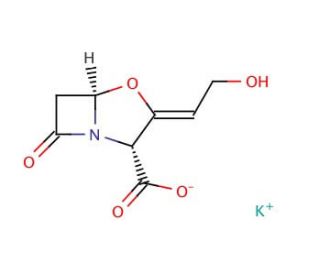

Clavulanic acid potassium salt (CAS 61177-45-5)
See product citations (2)
QUICK LINKS
Clavulanic acid potassium salt is a widely researched beta-lactamase inhibitor that has been a focal point in studies aiming to combat antibiotic resistance. In research environments, this compound is of particular interest due to its ability to inhibit a broad spectrum of beta-lactamases, enzymes produced by bacteria that render many antibiotics ineffective. Investigations involving clavulanic acid potassium salt delve into the structural and functional aspects of beta-lactamase inhibition, providing insights into how these enzymes interact with beta-lactam antibiotics and how inhibitors can enhance antibiotic efficacy. Additionally, it is employed in enzymology studies to understand the mechanism by which beta-lactamase inhibitors bind to their targets and protect antibiotics from degradation. This knowledge is for the design of new inhibitors that can be used in conjunction with antibiotics to overcome resistance. Moreover, the potassium salt form of clavulanic acid is particularly suited for such studies as it increases the compound′s solubility, making it more manageable in various experimental setups.
Clavulanic acid potassium salt (CAS 61177-45-5) References
- Amoxicillin-clavulanic acid and trimethoprim- sulfamethoxazole in rodent feed and water: effects of compounding on antibiotic stability. | McIntyre, AR. and Lipman, NS. 2007. J Am Assoc Lab Anim Sci. 46: 26-32. PMID: 17877324
- Inhibition mechanism of carbapenem antibiotics on acylpeptide hydrolase, a key enzyme in the interaction with valproic acid. | Suzuki, E., et al. 2011. Xenobiotica. 41: 958-63. PMID: 21770850
- Stability, compatibility and microbiological activity studies of meropenem-clavulanate potassium. | Cielecka-Piontek, J., et al. 2015. J Antibiot (Tokyo). 68: 35-9. PMID: 25074659
- Amoxicillin and Clavulanate Form Chemically and Immunologically Distinct Multiple Haptenic Structures in Patients. | Meng, X., et al. 2016. Chem Res Toxicol. 29: 1762-1772. PMID: 27603302
- Applying ecological resistance and resilience to dissect bacterial antibiotic responses. | Meredith, HR., et al. 2018. Sci Adv. 4: eaau1873. PMID: 30525104
- A 2D HPLC-MS/MS method for several antibiotics in blood plasma, plasma water, and diverse tissue samples. | Rehm, S. and Rentsch, KM. 2020. Anal Bioanal Chem. 412: 715-725. PMID: 31900530
- Extracellular and membrane-bound beta lactamase of Staphylococcus aureus: their importance for the expression of penicillin resistance. | Bruns, W. and Keppeler, H. 1987. J Med Microbiol. 23: 133-9. PMID: 3494127
- The antibacterial activity of ticarcillin/clavulanic acid (BRL28500) against ticarcillin-resistant bacteria. | Kasai, T., et al. 1986. J Antibiot (Tokyo). 39: 1450-60. PMID: 3536827
- The pharmacokinetics of ticarcillin, clavulanic acid and their combination. | Höffken, G., et al. 1986. J Antimicrob Chemother. 17 Suppl C: 47-55. PMID: 3722046
- Pharmacokinetics and serum bactericidal activity of ticarcillin and clavulanic acid. | Höffken, G., et al. 1985. J Antimicrob Chemother. 16: 763-71. PMID: 4093345
Ordering Information
| Product Name | Catalog # | UNIT | Price | Qty | FAVORITES | |
Clavulanic acid potassium salt, 100 mg | sc-207446 | 100 mg | $224.00 |