
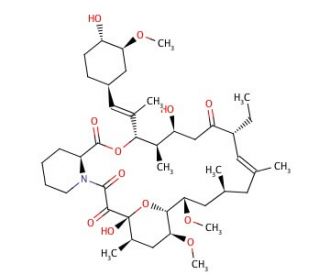

Molecular structure of Ascomycin, CAS Number: 104987-12-4
Ascomycin (CAS 104987-12-4)
Application:
Ascomycin is a potent immunosuppressive agent
CAS Number:
104987-12-4
Molecular Weight:
792.01
Molecular Formula:
C43H69NO12
For Research Use Only. Not Intended for Diagnostic or Therapeutic Use.
* Refer to Certificate of Analysis for lot specific data.
QUICK LINKS
Ordering Information
Description
Technical Information
Safety Information
SDS & Certificate of Analysis
Ascomycin, a polyketide antibiotic, is naturally produced by certain Streptomyces species. The mode of action employed by ascomycin involves inhibiting the synthesis of peptidoglycan, a component of bacterial cell walls. By binding to the peptidoglycan precursor, UDP-N-acetylmuramoyl-L-alanine, it effectively hampers its conversion into the mature form. Ultimately, this mechanism leads to the demise of the targeted bacteria.
Ascomycin (CAS 104987-12-4) References
- Discovery of ascomycin analogs with potent topical but weak systemic activity for treatment of inflammatory skin diseases. | Mollison, KW., et al. 1998. Curr Pharm Des. 4: 367-79. PMID: 10197049
- Ascomycin: an advance in the management of atopic dermatitis. | Griffiths, CE. 2001. Br J Dermatol. 144: 679-81. PMID: 11298524
- Ascomycin, an antifungal antibiotic. | ARAI, T., et al. 1962. J Antibiot (Tokyo). 15: 231-2. PMID: 14040785
- Chemistry of the immunomodulatory macrolide ascomycin and related analogues. | Bulusu, MA., et al. 2011. Prog Chem Org Nat Prod. 94: 59-126. PMID: 21833838
- Enhancement of ascomycin production in Streptomyces hygroscopicus var. ascomyceticus by combining resin HP20 addition and metabolic profiling analysis. | Qi, H., et al. 2014. J Ind Microbiol Biotechnol. 41: 1365-74. PMID: 24965502
- Engineering of the LysR family transcriptional regulator FkbR1 and its target gene to improve ascomycin production. | Song, K., et al. 2017. Appl Microbiol Biotechnol. 101: 4581-4592. PMID: 28349163
- Metabolic network model guided engineering ethylmalonyl-CoA pathway to improve ascomycin production in Streptomyces hygroscopicus var. ascomyceticus. | Wang, J., et al. 2017. Microb Cell Fact. 16: 169. PMID: 28974216
- Enhancement of ascomycin production via a combination of atmospheric and room temperature plasma mutagenesis in Streptomyces hygroscopicus and medium optimization. | Yu, Z., et al. 2019. AMB Express. 9: 25. PMID: 30778695
- Generation of Streptomyces hygroscopicus cell factories with enhanced ascomycin production by combined elicitation and pathway-engineering strategies. | Wang, C., et al. 2019. Biotechnol Bioeng. 116: 3382-3395. PMID: 31478187
- Tacrolimus and ascomycin inhibit melanoma cell growth, migration and invasion via targeting nuclear factor of activated T-cell 3. | Xiao, T., et al. 2020. Melanoma Res. 30: 325-335. PMID: 32301802
- Bioprocess and genetic engineering aspects of ascomycin production: a review. | Sambyal, K. and Singh, RV. 2020. J Genet Eng Biotechnol. 18: 73. PMID: 33215240
- Enhanced ascomycin production in Streptomyces hygroscopicus var. ascomyceticus by employing polyhydroxybutyrate as an intracellular carbon reservoir and optimizing carbon addition. | Wang, P., et al. 2021. Microb Cell Fact. 20: 70. PMID: 33731113
- Increasing the Ascomycin Yield by Relieving the Inhibition of Acetyl/Propionyl-CoA Carboxylase by the Signal Transduction Protein GlnB. | Wang, P., et al. 2021. Front Microbiol. 12: 684193. PMID: 34122395
Inhibitor of:
β-defensin 47, B7h, BTNL2, CD40L, DSCR 1, FKBP15, FKF1, GIMAP5, Gm1337, HLA-HB1, IL-12Rβ1, ILT-3, KIR3DL3, LST1, Myozenin (MYOZ), NFAM1, NFATc2IP, NFATc3, OR4N5, PP2, PPIAL4C, PPIAL4G, Pre-TCRα, protein phosphatase (PPP3R1 PPP3R2), RCAN2, RFX-B, RRP9, RT1-Bα, Skint11, T Cell Marker, and TCR V γ 3.Activator of:
FKBP12, FKBP6, Histone cluster 2 H4A, HSP 56, Slo3, and THIK-2.Ordering Information
| Product Name | Catalog # | UNIT | Price | Qty | FAVORITES | |
Ascomycin, 1 mg | sc-207303B | 1 mg | $36.00 | |||
Ascomycin, 5 mg | sc-207303 | 5 mg | $173.00 | |||
Ascomycin, 25 mg | sc-207303A | 25 mg | $316.00 |