
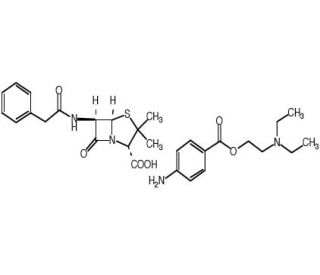

Penicillin G procaine (CAS 6130-64-9)
ENLACES RÁPIDOS
Penicillin G procaine es una combinación de penicilina G y procaina. La penicilina G es un antibiótico hidrofóbico de beta-lactama producido por Penicillium spp. Como antibiótico, se destaca por su efectividad principalmente contra organismos gram-positivos. Algunos organismos gram-negativos como Neiserria gonorrhoeae y Neiserria meningitidis también se reportan como susceptibles a la penicilina G. La penicilina G también es conocida como benzilpenicilina y contiene una cadena lateral de fenilacetilo 6'. En soluciones acuosas ácidas, se reporta que la penicilina se descompone en ácido penílico y ácido penílico. La procaina es un conocido bloqueador de canales de sodio con una variedad de efectos inhibitorios. En el músculo esquelético, se reporta que la procaina inhibe la liberación de calcio inducida por calcio (CICR). También se reporta que la procaina actúa como un inhibidor de metilación del ADN y causa desmetilación y reactivación de genes silenciados por metilación como RARbeta y GSTP1. Se reporta que WIF-1 se reactiva en una línea celular de cáncer y que regula a la baja la vía canónica de Wnt. En estudios utilizando una línea celular de neuroblastoma (SHEP), se reporta que la procaina induce apoptosis neuronal de manera correlacionada con la solubilidad en lípidos del compuesto. En una línea celular de músculo de ratón adulto (HEK293), se reporta que la presencia de procaina inhibe potencialmente los receptores de acetilcolina nicotínica (AChR). Penicilina G también está disponible sola (sc-344973) y en formas de sal como penicilina G sódica (sc-257971) y penicilina G potásica (sc-255411). Procaina está disponible sola (sc-296134) y en su forma de sal, clorhidrato de procaina (sc-250776).
Penicillin G procaine (CAS 6130-64-9) Referencias
- MECANISMO DE DEGRADACIÓN DE LA PENICILINA G EN SOLUCIÓN ÁCIDA. | SCHWARTZ, MA. 1965. J Pharm Sci. 54: 472-3. PMID: 14301592
- Producción de antibióticos betalactámicos y su regulación. | Demain, AL. 1991. Proc Natl Sci Counc Repub China B. 15: 251-65. PMID: 1815263
- Beta-lactamasas: la amenaza se renueva. | Livermore, DM. 2009. Curr Protein Pept Sci. 10: 397-400. PMID: 19538149
- Inducción de apoptosis por diferentes anestésicos locales en una línea celular de neuroblastoma. | Werdehausen, R., et al. 2009. Br J Anaesth. 103: 711-8. PMID: 19700777
- Liberación de calcio inducida por calcio en el músculo esquelético. | Endo, M. 2009. Physiol Rev. 89: 1153-76. PMID: 19789379
- La procaína y la procainamida inhiben la vía canónica Wnt mediante la desmetilación del promotor de WIF-1 en células de cáncer de pulmón. | Gao, Z., et al. 2009. Oncol Rep. 22: 1479-84. PMID: 19885602
- El efecto de los anestésicos locales sobre la inhibición de los receptores de acetilcolina nicotínicos de tipo muscular adultos por relajantes musculares no despolarizantes. | Wang, H., et al. 2010. Eur J Pharmacol. 630: 29-33. PMID: 20045405
- Una avispa manipula la actividad neuronal en el ganglio subesofágico para disminuir el impulso de caminar en su presa cucaracha. | Gal, R. and Libersat, F. 2010. PLoS One. 5: e10019. PMID: 20383324
- Evaluación del impacto de los protocolos de uso de antimicrobianos en cerdos infectados por el virus del síndrome reproductivo y respiratorio porcino sobre los patrones fenotípicos de resistencia a los antimicrobianos. | Odland, CA., et al. 2022. Appl Environ Microbiol. 88: e0097021. PMID: 34644164
- Seguridad de los antimicrobianos para la profilaxis postexposición y el tratamiento del carbunco: Una revisión. | Parker, CM., et al. 2022. Clin Infect Dis. 75: S417-S431. PMID: 36251549
- Comparación de los efectos de la tilosina y la tilmicosina como tratamiento sistémico de vacas Holstein secas. | Abani, S., et al. 2022. Vet Res Forum. 13: 495-499. PMID: 36686881
- La neuritis óptica fue la única manifestación de la neurosífilis. | Roy, T., et al. 2023. Oman J Ophthalmol. 16: 161-164. PMID: 37007240
- Penicilina G procaína: una posible causa de muerte embrionaria en el cerdo. | Nurmio, P. and Schulman, A. 1980. Vet Rec. 106: 97-8. PMID: 7361408
Información sobre pedidos
| Nombre del producto | Número de catálogo | UNIDAD | Precio | CANTIDAD | Favoritos | |
Penicillin G procaine, 10 g | sc-205797 | 10 g | $46.00 | |||
Penicillin G procaine, 25 g | sc-205797A | 25 g | $65.00 |