
 |
- rabbit polyclonal IgG, 200 µg/ml
- epitope corresponding to amino acids 1-105 representing full length Trx of human origin
- recommended for detection of Trx of mouse, rat and human origin by WB, IP, IF, IHC(P) and ELISA; also reactive with additional species, including equine, bovine and porcine
- agarose conjugate for IP studies, sc-20146 AC, 500 µg/0.25 ml agarose
|
|
| |
Ordering InformationProduct Citations
Recommended Support Products:
(click button of application of choice)
| |
| Species |
Gene Name |
Gene ID |
Chromosome Location |
Isoform (mRNA) Accession # |
Protein Accession # |
OMIM™ Number |
| Human |
TXN |
7295 |
9q31.3 |
NM_003329 |
P10599
|
187700 |
| Mouse |
Txn1 |
22166 |
4 B3 |
|
P10639
|
N/A |
| |
Trx Background Information Thioredoxin (Trx) is a redox protein that is found in several species, such as bacteria, plants and mammals, and contains a conserved active site, consisting of Trp-Cys-Gly-Pro-Cys. Trx has several biological functions. It acts as a hydrogen donor for ribonucleotide reductase, which is critical for DNA synthesis, and modulates the DNA-binding activity of several transcription factors, including NF˚B, AP-1, p53, TFIIIC and glucocorticoid receptor. Trx also stimulates cell growth, is an inhibitor of apoptosis and plays a role in the protection against oxidative stress. Drugs that inhibit Trx have antitumor activity, suggesting that Trx is involved in a variety of human diseases, including cancer. Thioredoxin 2 (Trx-2) is a small redox protein that is localized to the mitochondria and is essential for cell viability, playing a crucial role in the scavenging of ROS in mitochondria and regulating the mitochondrial apoptosis signaling pathway. Trx reductases (TrxR1 and TrxR2) are ubiquitously expressed flavoproteins that catalyze the NADPH-dependent reduction of Trx as well as several other oxidized cellular components. Mammalian Trx reductases are a part of a selenium-containing pyridine nucleotide-disulphide oxidoreductase family, which has a conserved catalytic site of Cys-Val-Asn-Val-Gly-Cys. TrxR1 and TrxR2 are also involved in the prevention of oxidative stress. Inhibition of TrxR activity may provide for potential treatments of cancer, AIDS and other autoimmune diseases as well as bacterial infections and parasitic diseases.
| Trx (FL-105) Product Citations |
See how others have used Trx (FL-105): sc-20146 antibody and or Trx (FL-105) antibody conjugates.
22 total citations Loading citations.
|
| |
|
 |
|
Trx (FL-105)
Click on image to enlarge
|
|
Trx (FL-105): sc-20146. Immunofluorescence staining of methanol-fixed BJAB cells showing cytoplasmic localization.
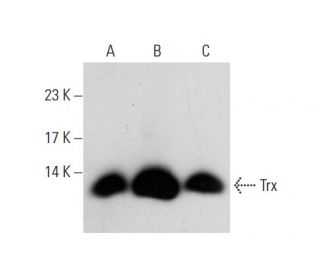
Trx (FL-105): sc-20146. Western blot analysis of Trx expression in THP-1 (A), JEG-3 (B) and HeLa (C) whole cell lysates.
Trx (FL-105): sc-20146. Western blot analysis of Trx expression in non-transfected 293: sc-110760 (A), human Trx transfected 293: sc-110552 (B), THP-1 (C) and AML-193 (D) whole cell lysates.
Trx (FL-105): sc-20146. Western blot analysis of Trx expression in 293T (A) and BJAB (B) whole cell lysates.
Trx (FL-105): sc-20146. Immunoperoxidase staining of formalin fixed, paraffin-embedded human cervix tissue showing cytoplasmic and nuclear staining of squamous epithelial cells.
|
|
Download
|
|
