
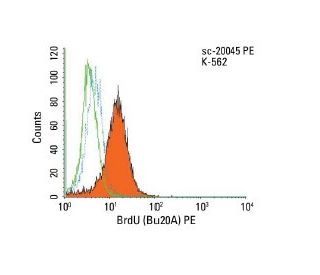

BrdU Anticuerpo (Bu20A): sc-20045
- BrdU Anticuerpo (Bu20A) es un monoclonal de ratón IgG1 κ, ver las 12 publicaciones, proporcionado como 200 µg/ml
- producido contra bromodeoxyuridine (BrdU) conjugado a una proteina transporteadora
- recomendado para la detección de BrdU, a proliferation marker incorporated into newly synthesized DNA during S-phase of a cell cycle, por FCM
- reconoce BrdU en ADN desnaturalizado de células marcadas con BrdU
- Producto complementario recomendado: 5-Bromo-2′ deoxyuridine: sc-290815
- disponible conjugado tanto a ficoeritrina como a FITC para IF, IHC(P) y FCM
- Ver BrdU (IIB5): sc-32323 para BrdU anticuerpos conjugados, incluyendo AC, HRP, FITC, PE, Alexa Fluor® 488, 594, 647, 680 y 790.
- m-IgG Fc BP-HRP y m-IgG1 BP-HRP son los reactivos de detección secundarios preferidos para BrdU Anticuerpo (Bu20A). Estos reactivos se ofrecen ahora en paquetes con BrdU Anticuerpo (Bu20A)(véase la información de pedido más abajo).

ENLACES RÁPIDOS
VER TAMBIÉN ....
El bromodeoxiuridina (BrdU) es un análogo de la timidina pirimidinada halogenada que se incorpora en las hebras de ADN recién sintetizadas de las células en fase S, y es útil para estimar la fracción de células en fase S. Además, el análisis de la incorporación de BrdU es un método confiable para cuantificar el grado de síntesis de ADN. BrdU también es útil para estudiar el intercambio de cromátidas hermanas y para aislar el ADN naciente. La síntesis de reparación por excisión inducida por UV es un método para incorporar BrdU en el ADN celular. Los anticuerpos anti-BrdU se unen al BrdU expuesto en el ADN de cadena sencilla después de un paso de desnaturalización con ácido clorhídrico o digestión con nucleasas. La recuperación del antígeno proteasa es necesaria para la mayoría de los tejidos o células fijados con agentes de entrecruzamiento como el formaldehído, pero puede disminuir la especificidad de la inmunodetección de BrdU.
Información sobre pedidos
| Nombre del producto | Número de catálogo | UNIDAD | Precio | CANTIDAD | Favoritos | |
BrdU Anticuerpo (Bu20A) | sc-20045 | 200 µg/ml | $322.00 | |||
Paquete de BrdU (Bu20A): m-IgG Fc BP-HRP | sc-553082 | 200 µg Ab; 10 µg BP | $361.00 | |||
Paquete de BrdU (Bu20A): m-IgG1 BP-HRP | sc-553083 | 200 µg Ab; 20 µg BP | $361.00 | |||
BrdU Anticuerpo (Bu20A) FITC | sc-20045 FITC | 200 µg/ml | $336.00 | |||
BrdU Anticuerpo (Bu20A) PE | sc-20045 PE | 200 µg/ml | $349.00 |