
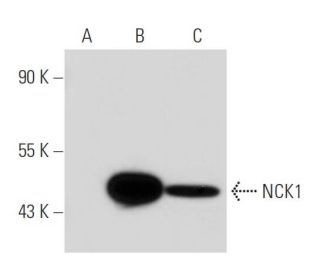
Anticorpo NCK1 (20B.1H9): sc-20026
- NCK1 Antibody 20B.1H9 è un monoclonale di topo IgG1 κ NCK1 antibody, citato in 3 pubblicazioni, fornito in 200 µg/ml
- sollevato contro il ricombinante human Nck
- NCK1 Antibody (20B.1H9) é raccomandato per il rilevamento di NCK1 di origine mouse, rat e human in WB e IP
- NCK1 Antibody (20B.1H9) é disponibile coniugato con agarose per IP; HRP per WB, IHC(P) ed ELISA; sia con phycoerythrin o FITC per IF, IHC(P) e FCM
- disponibile anche coniugato con Alexa Fluor® 488, Alexa Fluor® 546; Alexa Fluor® 594 o Alexa Fluor® 647 per IF, IHC (P) e FCM
- disponibile anche coniugato con Alexa Fluor® 680 o Alexa Fluor® 790 per WB (NIR), IF e FCM
- Al momento non abbiamo ancora completato l'identificazione dei reagenti secondari di rilevazione preferiti per NCK1 l'anticorpo (20B.1H9). Questo lavoro è in corso.

LINK RAPIDI
L'anticorpo NCK1 (20B.1H9) è un anticorpo monoclonale di topo IgG1 a catena leggera kappa che rileva la proteina NCK1 di origine murina, di ratto e umana mediante western blotting (WB) e immunoprecipitazione (IP). L'anticorpo NCK1 (20B.1H9) è disponibile sia in forma non coniugata che in varie forme coniugate, tra cui agarosio, perossidasi di rafano (HRP), ficoeritrina (PE), isotiocianato di fluoresceina (FITC) e molteplici coniugati Alexa Fluor®. NCK1, nota anche come proteina adattatrice NCK 1, svolge un ruolo cruciale nella segnalazione cellulare, agendo come adattatore che collega i recettori tirosin-chinasici, come i recettori del fattore di crescita epidermico (EGF) e del fattore di crescita derivato dalle piastrine (PDGF), alle vie di segnalazione a valle. Questa interazione è fondamentale per regolare processi come la proliferazione cellulare, la migrazione e l'organizzazione citoscheletrica. In particolare, il dominio SH3 di NCK1 si lega a sequenze ricche di prolina in proteine come PAK, che è essenziale per la dinamica del citoscheletro di actina. La disregolazione di NCK1 può portare a risposte cellulari alterate ai fattori di crescita, con un impatto su vari processi fisiologici e patologici, compresa la progressione del cancro. Il gene umano NCK1 si trova sul cromosoma 3q21, evidenziando la sua importanza negli studi genetici relativi alla segnalazione cellulare e alle malattie.
Alexa Fluor® è un marchio registrato di Molecular Probes Inc., OR., USA
LI-COR® e Odyssey® sono marchi registrati di LI-COR Biosciences
Anticorpo NCK1 (20B.1H9) Riferimenti:
- L'adattatore Nckbeta regola la polimerizzazione dell'actina nei fibroblasti NIH 3T3 in risposta al fattore di crescita di derivazione piastrinica bb. | Chen, M., et al. 2000. Mol Cell Biol. 20: 7867-80. PMID: 11027258
- Un peptide p65 PAK dominante-negativo inibisce l'angiogenesi. | Kiosses, WB., et al. 2002. Circ Res. 90: 697-702. PMID: 11934838
- La famiglia di proteine adattatrici Nck: regolatori del citoscheletro di actina. | Buday, L., et al. 2002. Cell Signal. 14: 723-31. PMID: 12034353
- Fosforilazione di Nck in risposta a diversi recettori, al forbolo miristato acetato e all'AMP ciclico. | Park, D. and Rhee, SG. 1992. Mol Cell Biol. 12: 5816-23. PMID: 1333046
- Regolazione al ribasso di Nck1 dopo lesione del midollo spinale in ratti adulti. | Yang, R., et al. 2022. Balkan Med J. 39: 39-47. PMID: 34928232
- La segnalazione complementare di Nck1/2 nei podociti controlla l'organizzazione dell'actina, l'adesione e la composizione della membrana basale mediata da α actina-4. | Martin, CE., et al. 2022. J Am Soc Nephrol. 33: 1546-1567. PMID: 35906089
- Funzioni regolatorie mediate dall'LncRNA NCK1-AS1 nelle malattie umane. | Wang, Y., et al. 2023. Clin Transl Oncol. 25: 323-332. PMID: 36131072
- L'attività di Nck1 nell'amigdala laterale regola la formazione della memoria della paura a lungo termine. | Ilovich, O., et al. 2022. Transl Psychiatry. 12: 475. PMID: 36371406
- NCK1 modula la dinamica dell'actina neuronale e promuove la formazione di spine dendritiche, sinapsi e memoria. | Diab, AM., et al. 2023. J Neurosci. 43: 885-901. PMID: 36535770
- Una revisione sul ruolo dell'RNA antisenso NCK1 1 (NCK1-AS1) in diversi disturbi. | Taheri, M., et al. 2023. Pathol Res Pract. 245: 154451. PMID: 37028107
- Localizzazione cromosomica dei geni che codificano le proteine adattatrici della trasduzione del segnale umano, Nck (NCK), Shc (SHC1) e Grb2 (GRB2). | Huebner, K., et al. 1994. Genomics. 22: 281-7. PMID: 7806213
- Identificazione dei geni della famiglia Nck, localizzazione cromosomica, espressione e specificità di segnalazione. | Chen, M., et al. 1998. J Biol Chem. 273: 25171-8. PMID: 9737977
Informazioni ordini
| Nome del prodotto | Codice del prodotto | UNITÀ | Prezzo | Quantità | Preferiti | |
NCK1 Anticorpo (20B.1H9) | sc-20026 | 200 µg/ml | $322.00 | |||
NCK1 Anticorpo (20B.1H9) AC | sc-20026 AC | 500 µg/ml, 25% agarose | $424.00 | |||
NCK1 Anticorpo (20B.1H9) HRP | sc-20026 HRP | 200 µg/ml | $322.00 | |||
NCK1 Anticorpo (20B.1H9) FITC | sc-20026 FITC | 200 µg/ml | $336.00 | |||
NCK1 Anticorpo (20B.1H9) PE | sc-20026 PE | 200 µg/ml | $349.00 | |||
NCK1 Anticorpo (20B.1H9) Alexa Fluor® 488 | sc-20026 AF488 | 200 µg/ml | $364.00 | |||
NCK1 Anticorpo (20B.1H9) Alexa Fluor® 546 | sc-20026 AF546 | 200 µg/ml | $364.00 | |||
NCK1 Anticorpo (20B.1H9) Alexa Fluor® 594 | sc-20026 AF594 | 200 µg/ml | $364.00 | |||
NCK1 Anticorpo (20B.1H9) Alexa Fluor® 647 | sc-20026 AF647 | 200 µg/ml | $364.00 | |||
NCK1 Anticorpo (20B.1H9) Alexa Fluor® 680 | sc-20026 AF680 | 200 µg/ml | $364.00 | |||
NCK1 Anticorpo (20B.1H9) Alexa Fluor® 790 | sc-20026 AF790 | 200 µg/ml | $364.00 |