
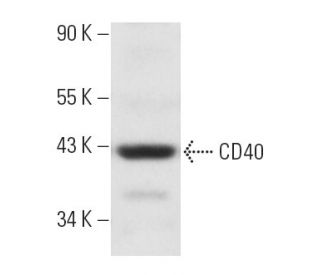
Anticorps CD40 (HM40-3): sc-20010
- L'anticorps CD40 HM40-3 est un monoclonal IgM de hamster d'Arménie, cité dans 4 publications, fourni en 200 µg/ml
- soulevé contre les cellules WEHI-231 du lymphome dérivé de mouse (BALB/c x NZB)F1
- recommandé pour la détection de CD40 d'origine mouse et rat par WB, IP, IF, IHC(P) et FCM
- également fourni sans azide pour le blocage de la liaison du ligand et de la stimulation des lymphocytes B, sc-20010 L, 200 µg/0.1 ml
- Nous testons actuellement encore nos anticorps secondaires pour trouver la meilleure protéine de liaison pour cet anticorps primaire CD40 (HM40-3). Veuillez nous contacter si vous avez des questions concernant les réactifs de détection secondaire appropriés.

ACCÈS RAPIDE AUX LIENS
VOIR ÉGALEMENT...
L'anticorps CD40 (HM40-3) est un anticorps IgM monoclonal de hamster qui détecte la protéine CD40 d'origine souris et rat par western blotting (WB), immunoprécipitation (IP), immunofluorescence (IF), immunohistochimie et cytométrie de flux (FCM). L'anticorps anti-CD40 (HM40-3) est disponible sous une forme non conjuguée, offrant aux chercheurs un outil polyvalent pour étudier la voie de signalisation du CD40. Le CD40 joue un rôle crucial dans la réponse immunitaire, en particulier dans l'activation et la différenciation des cellules B. Le CD40 est principalement localisé à la surface des cellules B. Le CD40 est principalement situé à la surface des cellules B et interagit avec le ligand du CD40 (CD40L) exprimé sur les cellules T activées, facilitant ainsi la communication essentielle de cellule à cellule. Cette interaction est vitale pour l'activation des cellules B, conduisant à l'expansion clonale et à la production d'anticorps. L'importance du CD40 dans la régulation immunitaire est soulignée par son implication dans le changement de classe d'immunoglobuline et la sécrétion d'IgE, qui sont des processus critiques dans la réponse immunitaire adaptative. En outre, la voie de signalisation du CD40 est médiée par des effecteurs en aval tels que le CRAF, qui fait partie d'une famille de protéines comprenant TRAF1 et TRAF2, connues pour leur rôle dans la régulation de la signalisation du récepteur du facteur de nécrose tumorale et dans l'activation des facteurs de transcription NFκB. Il est essentiel de comprendre la fonction et les interactions du CD40 pour élucider les mécanismes des réponses immunitaires et développer des stratégies thérapeutiques pour les maladies liées à l'immunité.
Alexa Fluor® est une marque déposée de Molecular Probes Inc., OR., USA
LI-COR® et Odyssey® sont marques déposées de LI-COR Biosciences
Anticorps CD40 (HM40-3) Références:
- Mécanismes moléculaires de la signalisation du CD40. | Bishop, GA. and Hostager, BS. 2001. Arch Immunol Ther Exp (Warsz). 49: 129-37. PMID: 11348017
- CD40 dans l'épithélium buccal humain. | Villarroel Dorrego, M., et al. 2007. Oral Oncol. 43: 626-33. PMID: 17307023
- Interactions des ligands CD40-CD40 dans le stress oxydatif, l'inflammation et les maladies vasculaires. | Rizvi, M., et al. 2008. Trends Mol Med. 14: 530-8. PMID: 18977174
- La multifonctionnalité du CD40L et de son récepteur CD40 dans l'athérosclérose. | Lievens, D., et al. 2009. Thromb Haemost. 102: 206-14. PMID: 19652870
- Le système CD40-CD40L dans les maladies cardiovasculaires. | Pamukcu, B., et al. 2011. Ann Med. 43: 331-40. PMID: 21244217
- Mise à jour sur le blocage des CD40 et CD154 dans les modèles de transplantation. | Zhang, T., et al. 2015. Immunotherapy. 7: 899-911. PMID: 26268734
- La dyade CD40/Ligand CD40 et sa molécule effectrice en aval ISG54 dans la relation entre la neuroinflammation aiguë et la démyélinisation persistante et progressive. | Hazra, B. and Das Sarma, J. 2024. IUBMB Life. 76: 313-331. PMID: 38116887
- Les cellules de carcinome hépatocellulaire peu différenciées évitent l'apoptose en interagissant avec les cellules T par l'intermédiaire du ligand CD40-CD40. | Vinh Hanh, N., et al. 2024. Am J Pathol. 194: 1230-1247. PMID: 38548267
- Interactions CD40/Ligand CD40 dans les tissus lympho-hématopoïétiques normaux, réactifs et malins. | Gruss, HJ., et al. 1997. Leuk Lymphoma. 24: 393-422. PMID: 9086433
- Interaction CD40-Ligand CD40 dans les maladies auto-immunes. | Datta, SK. and Kalled, SL. 1997. Arthritis Rheum. 40: 1735-45. PMID: 9336404
Informations pour la commande
| Nom du produit | Ref. Catalogue | COND. | Prix HT | QTÉ | Favoris | |
Anticorps CD40 (HM40-3) | sc-20010 | 200 µg/ml | $322.00 | |||
Anticorps CD40 (HM40-3) L | sc-20010 L | 200 µg/0.1 ml | $322.00 |