
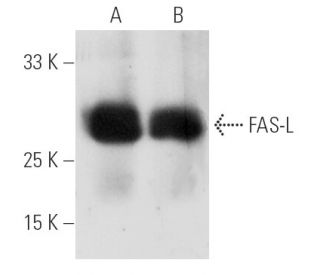
Anticorpo FAS-L (NOK-1): sc-19681
- FAS-L Antibody NOK-1 è un monoclonale di topo IgG1 κ FAS-L antibody, citato in 37 pubblicazioni, fornito in 200 µg/ml
- sollevato contro le cellule di linfoma T di topo L5178Y che esprimono la sostanza ricombinante human FAS-L
- FAS-L Antibody (NOK-1) é raccomandato per il rilevamento di FAS-L di origine mouse, rat e human in WB, IP, IF, IHC(P) e FCM; non raccomandato per WB
- FAS-L Antibody (NOK-1) é disponibile coniugato con agarose per IP; HRP per WB, IHC(P) ed ELISA; sia con phycoerythrin o FITC per IF, IHC(P) e FCM
- disponibile anche coniugato con Alexa Fluor® 488, Alexa Fluor® 546; Alexa Fluor® 594 o Alexa Fluor® 647 per IF, IHC (P) e FCM
- disponibile anche coniugato con Alexa Fluor® 680 o Alexa Fluor® 790 per WB (NIR), IF e FCM
- fornito anche senza azide per neutralizzare gli effetti citotossici di FAS-L, sc-19681 L, 200 µg/0,1 ml
- m-IgG Fc BP-HRP e m-IgG1 BP-HRP sono i reagenti secondari preferiti per l'anticorpo FAS-L (NOK-1) for WB and IHC(P) applications. Questi reagenti sono ora offerti in bundle con l'anticorpo FAS-L (NOK-1)(vedere le informazioni per l'ordine sotto).

LINK RAPIDI
VEDI ANCHE...
L'anticorpo FAS-L (NOK-1) è un anticorpo monoclonale di topo IgG1 a catena leggera kappa che rileva la proteina FAS-L (nota anche come FASLG, CD178, CD95-L, TNFSF6 o Fas ligand) in campioni di topo, ratto e uomo mediante western blotting, immunoprecipitazione, immunofluorescenza, immunoistochimica su sezioni incluse in paraffina e citometria a flusso. L'anticorpo FAS-L (NOK-1) è disponibile in forma non coniugata e in molteplici forme coniugate, tra cui agarosio, perossidasi di rafano, ficoeritrina, isotiocianato di fluoresceina e molteplici coniugati Alexa Fluor®. La citotossicità mediata dai linfociti T citotossici (CTL) costituisce una componente importante dei meccanismi effettori specifici nella sorveglianza immunitaria contro le cellule infettate o trasformate da virus. Due meccanismi spiegano questa attività, uno dei quali è il processo basato sulla perforina. Un meccanismo basato sulla FAS coinvolge la molecola di trasduzione FAS (nota anche come Apo-1) e FAS-L. La proteina FAS umana è una glicoproteina della superficie cellulare appartenente ad una famiglia di recettori, tra cui il CD40, i recettori del fattore di crescita nervosa e i recettori del fattore di necrosi tumorale. L'antigene FAS è espresso su un'ampia gamma di linee cellulari linfoidi, alcune delle quali subiscono l'apoptosi in risposta al trattamento con l'anticorpo anti-FAS. Questi risultati implicano fortemente che la morte cellulare mirata è potenzialmente mediata da interazioni intercellulari di FAS con FAS-L o effettori, e che FAS può essere coinvolto in modo critico nella citotossicità mediata da CTL.
Alexa Fluor® è un marchio registrato di Molecular Probes Inc., OR., USA
LI-COR® e Odyssey® sono marchi registrati di LI-COR Biosciences
Anticorpo FAS-L (NOK-1) Riferimenti:
- Modulazione del fas-ligand (Fas-L) sulle cellule microgliali umane: uno studio in vitro. | Frigerio, S., et al. 2000. J Neuroimmunol. 105: 109-14. PMID: 10742551
- Meccanismo di fuga dal tumore che coinvolge le molecole Fas e Fas-L nei tumori colorettali umani. | Radfar, S., et al. 2000. Gastroenterol Clin Biol. 24: 1191-6. PMID: 11173732
- L'up-regolazione di Fas-L da parte delle plasmacellule del mieloma altamente maligno: ruolo nella patogenesi dell'anemia e nella progressione della malattia. | Silvestris, F., et al. 2001. Blood. 97: 1155-64. PMID: 11222356
- Il ruolo critico della protein chinasi C-theta nell'apoptosi mediata dal ligando Fas/Fas. | Manicassamy, S. and Sun, Z. 2007. J Immunol. 178: 312-9. PMID: 17182568
- FasL e TRAIL inducono apoptosi epidermica e ulcerazione cutanea in seguito all'esposizione a Leishmania major. | Eidsmo, L., et al. 2007. Am J Pathol. 170: 227-39. PMID: 17200196
- [Espressione di gastrina, somatostatina, PCNA e Fas-L nella mucosa dell'antrum gastrico di bambini con gastrite cronica e ulcera duodenale]. | Xie, XZ., et al. 2006. Zhonghua Er Ke Za Zhi. 44: 774-7. PMID: 17229384
- I mediatori dell'apoptosi Fas e FasL predicono la progressione della disabilità nella sclerosi multipla in un periodo di 10 anni. | Lopatinskaya, L., et al. 2006. Mult Scler. 12: 704-9. PMID: 17262997
- La deplezione delle cellule T regolatorie CD4+CD25+ intratumorali attraverso il trasferimento della proteina FasL aumenta l'efficacia terapeutica del trasferimento adottivo di cellule T. | Chen, A., et al. 2007. Cancer Res. 67: 1291-8. PMID: 17283166
- [L'apoptosi dei linfociti alveolari nella sarcoidosi e nel gruppo di controllo è più frequente nei fumatori che nei non fumatori]. | Kopiński, P., et al. 2006. Przegl Lek. 63: 841-7. PMID: 17288168
- Meccanismo della citotossicità mediata dai linfociti. | Henkart, PA. 1985. Annu Rev Immunol. 3: 31-58. PMID: 3904772
- Fas e il suo ligando in un meccanismo generale di citotossicità mediata da cellule T. | Hanabuchi, S., et al. 1994. Proc Natl Acad Sci U S A. 91: 4930-4. PMID: 7515183
- La proteina Fas è espressa ad alti livelli sui timociti CD4+CD8+ e sui linfociti maturi attivati nei topi normali, ma non nel ceppo lupus-prone, MRL lpr/lpr. | Drappa, J., et al. 1993. Proc Natl Acad Sci U S A. 90: 10340-4. PMID: 7694292
Informazioni ordini
| Nome del prodotto | Codice del prodotto | UNITÀ | Prezzo | Quantità | Preferiti | |
FAS-L Anticorpo (NOK-1) | sc-19681 | 200 µg/ml | $322.00 | |||
FAS-L (NOK-1): m-IgG Fc BP-HRP Bundle | sc-526589 | 200 µg Ab; 10 µg BP | $361.00 | |||
FAS-L (NOK-1): m-IgG1 BP-HRP Bundle | sc-531962 | 200 µg Ab; 20 µg BP | $361.00 | |||
FAS-L Anticorpo (NOK-1) L | sc-19681 L | 200 µg/0.1 ml | $322.00 | |||
FAS-L Anticorpo (NOK-1) AC | sc-19681 AC | 500 µg/ml, 25% agarose | $424.00 | |||
FAS-L Anticorpo (NOK-1) HRP | sc-19681 HRP | 200 µg/ml | $322.00 | |||
FAS-L Anticorpo (NOK-1) FITC | sc-19681 FITC | 200 µg/ml | $336.00 | |||
FAS-L Anticorpo (NOK-1) PE | sc-19681 PE | 200 µg/ml | $349.00 | |||
FAS-L Anticorpo (NOK-1) Alexa Fluor® 488 | sc-19681 AF488 | 200 µg/ml | $364.00 | |||
FAS-L Anticorpo (NOK-1) Alexa Fluor® 546 | sc-19681 AF546 | 200 µg/ml | $364.00 | |||
FAS-L Anticorpo (NOK-1) Alexa Fluor® 594 | sc-19681 AF594 | 200 µg/ml | $364.00 | |||
FAS-L Anticorpo (NOK-1) Alexa Fluor® 647 | sc-19681 AF647 | 200 µg/ml | $364.00 | |||
FAS-L Anticorpo (NOK-1) Alexa Fluor® 680 | sc-19681 AF680 | 200 µg/ml | $364.00 | |||
FAS-L Anticorpo (NOK-1) Alexa Fluor® 790 | sc-19681 AF790 | 200 µg/ml | $364.00 |