
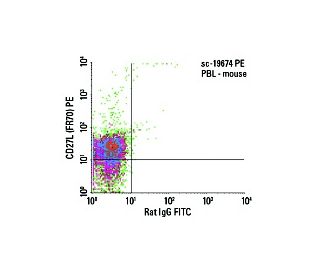

CD27L Antibody (FR70): sc-19674
- CD27L Antibody (FR70) is a rat monoclonal IgG2b CD27L antibody provided at 200 µg/ml
- raised against BALB/c mouse B lymphoma A20.2J
- recommended for detection of CD27L of mouse origin by IP, IF and FCM
- available conjugated to either phycoerythrin or FITC for IF, IHC(P) and FCM
- also provided azide-free for blocking of ligand binding, sc-19674 L, 200 µg/0.1 ml
- At present, we have not yet completed the identification of the preferred secondary detection reagent(s) for CD27L Antibody (FR70). This work is in progress.

QUICK LINKS
SEE ALSO...
CD27L Antibody (FR70) is a rat monoclonal IgG2b antibody that detects mouse CD27L by immunoprecipitation (IP), immunofluorescence (IF), and flow cytometry (FCM). Anti-CD27L antibody (FR70) is available in non-conjugated form and conjugated with phycoerythrin (PE) or fluorescein isothiocyanate (FITC). CD27L serves as a ligand for CD27 receptor, playing a crucial role in T cell activation and survival. CD27L (FR70) monoclonal antibody promotes T cell proliferation and enhances cytokine production, amplifying immune responses. CD27L′s involvement in co-stimulatory signaling pathways is vital for effective immune responses, particularly during infections and cancer development. Understanding CD27L′s function and interactions provides valuable insights for therapeutic strategies in immune enhancement and autoimmune disease treatment.
Alexa Fluor® is a trademark of Molecular Probes Inc., OR., USA
LI-COR® and Odyssey® are registered trademarks of LI-COR Biosciences
CD27L Antibody (FR70) References:
- Anti-tumor immunity elicited by a recombinant vaccinia virus expressing CD70 (CD27L). | Lorenz, MG., et al. 1999. Hum Gene Ther. 10: 1095-103. PMID: 10340542
- Expression of tumour necrosis factor (TNF) receptor/ligand superfamily co-stimulatory molecules CD40, CD30L, CD27L, and OX40L in murine hearts with chronic ongoing myocarditis caused by coxsackie virus B3. | Seko, Y., et al. 1999. J Pathol. 188: 423-30. PMID: 10440754
- Expression of tumour necrosis factor (TNF) ligand superfamily co-stimulatory molecules CD30L, CD27L, OX40L, and 4-1BBL in murine hearts with acute myocarditis caused by Coxsackievirus B3. | Seko, Y., et al. 2001. J Pathol. 195: 593-603. PMID: 11745696
- Expression of tumor necrosis factor ligand superfamily costimulatory molecules CD27L, CD30L, OX40L and 4-1BBL in the heart of patients with acute myocarditis and dilated cardiomyopathy. | Seko, Y., et al. 2002. Cardiovasc Pathol. 11: 166-70. PMID: 12031769
- Trimer stabilization, oligomerization, and antibody-mediated cell surface immobilization improve the activity of soluble trimers of CD27L, CD40L, 41BBL, and glucocorticoid-induced TNF receptor ligand. | Wyzgol, A., et al. 2009. J Immunol. 183: 1851-61. PMID: 19596991
- The CD27L and CTP1L endolysins targeting Clostridia contain a built-in trigger and release factor. | Dunne, M., et al. 2014. PLoS Pathog. 10: e1004228. PMID: 25058163
- Exploring the therapeutic potential of endolysin CD27L_EAD against Clostridioides difficile infection. | Cho, Y., et al. 2024. Int J Antimicrob Agents. 64: 107222. PMID: 38810936
- CD27-CD27 ligand/CD70 interactions enhance alloantigen-induced proliferation and cytolytic activity in CD8+ T lymphocytes. | Brown, GR., et al. 1995. J Immunol. 154: 3686-95. PMID: 7706711
- CD40 and IL-4 regulate murine CD27L expression. | Hartwig, UF., et al. 1997. J Immunol. 159: 6000-8. PMID: 9550398
- Enhancement of antitumor immunity by expression of CD70 (CD27 ligand) or CD154 (CD40 ligand) costimulatory molecules in tumor cells. | Couderc, B., et al. 1998. Cancer Gene Ther. 5: 163-75. PMID: 9622100
Ordering Information
| Product Name | Catalog # | UNIT | Price | Qty | FAVORITES | |
CD27L Antibody (FR70) | sc-19674 | 200 µg/ml | $322.00 | |||
CD27L Antibody (FR70) FITC | sc-19674 FITC | 200 µg/ml | $336.00 | |||
CD27L Antibody (FR70) L | sc-19674 L | 200 µg/0.1 ml | $322.00 | |||
CD27L Antibody (FR70) PE | sc-19674 PE | 200 µg/ml | $349.00 |