
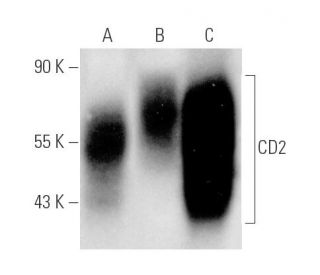


CD2 Antibody (RM2-5): sc-19639
- CD2 Antibody (RM2-5) is a rat monoclonal IgG2b provided at 200 µg/ml
- raised against BALB/c mouse thymocytes
- recommended for detection of CD2 of mouse origin by WB, IP, IF and FCM
- available conjugated to either phycoerythrin or FITC for IF and FCM
- also provided azide-free for blocking cell adhesion, sc-19639 L, 200 µg/0.1 ml
- At present, we have not yet completed the identification of the preferred secondary detection reagent(s) for CD2 Antibody (RM2-5). This work is in progress.

QUICK LINKS
SEE ALSO...
CD2 Antibody (RM2-5) is a rat monoclonal IgG2b antibody that detects CD2 protein of mouse origin by western blotting (WB), immunoprecipitation (IP), immunofluorescence (IF), and flow cytometry (FCM). CD2 (RM2-5) antibody is available in both conjugated and non-conjugated forms, providing flexibility for various experimental needs. CD2, also known as the E-rosette receptor, plays a crucial role in the immune response by mediating cell adhesion through interaction with CD58, also referred to as CD2 ligand. This interaction is vital for enhancing antigen-specific T cell activation, which is essential for effective immune responses. CD2 is a transmembrane glycoprotein predominantly expressed on peripheral blood T lymphocytes, natural killer cells, and thymocytes, as well as on mouse B cells and rat splenic macrophages. The binding of CD2 to counterreceptor CD58, which is heavily glycosylated and widely distributed across hematopoietic and endothelial cells, optimizes immune system recognition and facilitates communication between helper T lymphocytes and antigen-presenting cells, as well as between cytolytic effectors and target cells. Understanding the function of CD2 and its interactions is critical for elucidating mechanisms of immune regulation and potential therapeutic targets in immunological disorders.
Alexa Fluor® is a trademark of Molecular Probes Inc., OR., USA
LI-COR® and Odyssey® are registered trademarks of LI-COR Biosciences
CD2 Antibody (RM2-5) References:
- Function and regulation of the murine lymphocyte CD2 receptor. | Abraham, DJ., et al. 1991. J Leukoc Biol. 49: 329-41. PMID: 1672140
- CD2-associated protein is widely expressed and differentially regulated during embryonic development. | Lehtonen, S., et al. 2008. Differentiation. 76: 506-17. PMID: 18177421
- Protein interactions between CD2 and Lck are required for the lipid raft distribution of CD2. | Nunes, RJ., et al. 2008. J Immunol. 180: 988-97. PMID: 18178839
- Downregulation of CD2-associated protein impaired the physiological functions of podocytes. | Zhang, C., et al. 2009. Cell Biol Int. 33: 632-9. PMID: 19306938
- Conformationally constrained peptides from CD2 to modulate protein-protein interactions between CD2 and CD58. | Gokhale, A., et al. 2011. J Med Chem. 54: 5307-19. PMID: 21755948
- Expression of CD2 and CD25 on mast cell populations can be seen outside the setting of systemic mastocytosis. | Cherian, S., et al. 2016. Cytometry B Clin Cytom. 90: 387-92. PMID: 26525770
- Biophysical characterization and insights into the oligomeric nature of CD2-associated protein. | Qadri, AH., et al. 2024. Int J Biochem Mol Biol. 15: 20-33. PMID: 38765876
- Separable portions of the CD2 cytoplasmic domain involved in signaling and ligand avidity regulation. | Hahn, WC. and Bierer, BE. 1993. J Exp Med. 178: 1831-6. PMID: 7901319
- Production and characterization of soluble and transmembrane murine CD2. Demonstration that CD48 is a ligand for CD2 and that CD48 adhesion is regulated by CD2. | Kaplan, AJ., et al. 1993. J Immunol. 151: 4022-32. PMID: 8104993
- Engineering an intertwined form of CD2 for stability and assembly. | Murray, AJ., et al. 1998. Nat Struct Biol. 5: 778-82. PMID: 9731771
Ordering Information
| Product Name | Catalog # | UNIT | Price | Qty | FAVORITES | |
CD2 Antibody (RM2-5) | sc-19639 | 200 µg/ml | $322.00 | |||
CD2 Antibody (RM2-5) L | sc-19639 L | 200 µg/0.1 ml | $322.00 | |||
CD2 Antibody (RM2-5) FITC | sc-19639 FITC | 200 µg/ml | $336.00 | |||
CD2 Antibody (RM2-5) PE | sc-19639 PE | 200 µg/ml | $349.00 |