
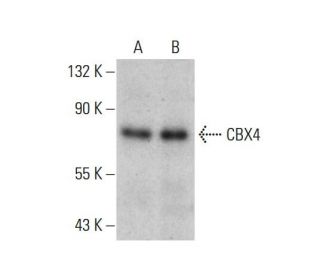

Este anticuerpo policlonal ha dejado de fabricarse. Consulta nuestro anticuerpo monoclonal recomendado CBX4 (6C5G3) (se muestran datos de muestra).
CBX4 Anticuerpo (T-20): sc-19299
- CBX4 Anticuerpo T-20 es un policlonal de cabra IgG proporcionado como 200 µg/ml
- epítopo localizado en una región interna de CBX4 de origen human
- Anticuerpo policlonal discontinuado

Información sobre pedidos
CBX4 (6C5G3): sc-517216 [ Monoclonal recomendado como alternativa a CBX4 (T-20) ]
| Nombre del producto | Número de catálogo | UNIDAD | Precio | CANTIDAD | Favoritos | |
CBX4 Anticuerpo (6C5G3) | sc-517216 | 100 µg/ml | $322.00 | |||
Paquete de CBX4 (6C5G3): m-IgG Fc BP-HRP | sc-541097 | 100 µg Ab; 10 µg BP | $361.00 | |||
Paquete de CBX4 (6C5G3): m-IgG1 BP-HRP | sc-542578 | 100 µg Ab; 20 µg BP | $361.00 |