
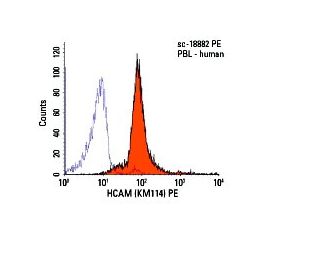


CD44 Anticorpo (KM114): sc-18882
- CD44 Anticorpo KM114é um anticorpo monoclonal produzido em rato IgG1, citado em 3 publicações, fornecido em 200 µg/ml
- recomendado para a detecção de HCAM de mouse, rat e human origem em
- disponível o conjugado para ficoeritrina para IF, IHC(P) e FCM
- também fornecido sem azida para bloquear a adesão de um hibridoma de células B, sc-18882 L, 200 µg/0,1 ml
- See CD44 (DF1485): sc-7297 for additional antibody conjugates, including AC, HRP, FITC, PE, Alexa Fluor® 488, 594, 647, 680 and 790.
- Atualmente, ainda não concluímos a identificação do(s) reagente(s) de deteção secundário(s) preferido(s) para CD44 Anticorpo (KM114). Este trabalho está em curso.

LINKS RÁPIDOS
VEJA TAMBÉM
As moléculas de adesão celular (CAMs) são uma família de glicoproteínas de superfície celular intimamente relacionadas que estão envolvidas nas interações célula-célula e que se acredita desempenharem um papel importante na embriogênese e no desenvolvimento. A HCAM, também conhecida como CD44, LHR, MDU2, MDU3, MIC4, Pgp1, HCELL, MUTCH-I ou ECMR-III, é uma proteína de membrana tipo I de passagem única de 742 aminoácidos que está envolvida na hematopoiese, na ativação de linfócitos e na metástase tumoral. Funcionando como um receptor para o ácido hialurônico (HA) e interagindo com fixadores como a osteopontina (OPN), o HCAM medeia as interações célula-célula e célula-matriz, desempenhando assim um papel essencial na adesão e migração celular. A HCAM contém um domínio Link e, devido a eventos de emenda alternativa, é expressa em várias isoformas, algumas das quais são designadas CD44R, CDw44, CD44S, CD44H (hematopoiética) e CD44E (epitelial). Embora a maioria das variantes de emenda do HCAM seja expressa em tecidos de todo o corpo, uma isoforma específica, a CD44H, é expressa em altos níveis no tecido do câncer, sugerindo uma função importante para a variante de emenda CD44H na progressão do tumor.
Informacoes sobre ordens
| Nome do Produto | Numero de Catalogo | UNID | Preco | Qde | FAVORITOS | |
CD44 Anticorpo (KM114) | sc-18882 | 200 µg/ml | $322.00 | |||
CD44 Anticorpo (KM114) L | sc-18882 L | 200 µg/0.1 ml | $322.00 | |||
CD44 Anticorpo (KM114) PE | sc-18882 PE | 200 µg/ml | $349.00 |