epitope corresponding to phosphorylated Ser 65 of 4E-BP1 of human origin
recommended for detection of Ser 65 phosphorylated 4E-BP1 of mouse, rat and human origin by WB, IP, IF and ELISA; also reactive with additional species, including porcine
4E-BP1 Background Information The multisubunit eukaryotic translation initiation factor (eIF) 4F recruits 40S ribosomal subunits to the 5' end of mRNA (1). The eIF4F subunit eIF4E interacts directly with the mRNA 5' cap structure (1). Assembly of the eIF4F complex is inhibited by a family of repressor polypeptides, the eIF4E-binding proteins (4E-BPs) (1–3). 4E-BP1 (also known as PHAS-1) normally binds eIF4E, inhibiting cap-dependent translation. Hyperphosphorylation of 4E-BP1 disrupts this binding, activating cap-dependent translation (1). The PI3-kinase/Akt pathway and the FRAP/mTOR kinase regulate 4E-BP1 (2,3). 4E-BP1 is phosphorylated in vivo on multiple residues and phosphorylation by FRAP/mTOR on Threonine 37 and Threonine 46 of human 4E-BP1 may prime it for sub-sequent phosphorylation at sites including Serine 65 and Threonine 70 (4,5). The corresponding rat residues include Threonine 36, Threonine 45, Serine 64 and Threonine 69. In vitro, 4E-BP1 is also phosphorylated by ataxia telangiectasia (ATM) at human Serine 112 (rat Serine 111) in response to an increase in insulin levels (6).
p-4E-BP1 (Ser 65)-R Product Citations
See how others have used p-4E-BP1 (Ser 65)-R: sc-18091-R antibody and or p-4E-BP1 (Ser 65)-R antibody conjugates.
2 total citations
Loading citations.
p-4E-BP1 (Ser 65)-R
Click on image to enlarge
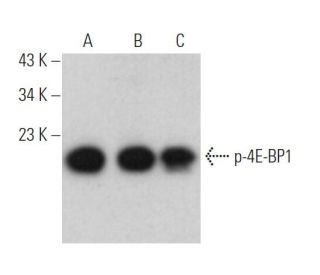
p-4E-BP1 (Ser 65)-R: sc-18091-R. Western blot analysis of 4E-BP1 phosphorylation in non-transfected: sc-117752 (A) and human 4E-BP1 transfected: sc-116590 (B) 293T whole cell lysates.
p-4E-BP1 (Ser 65): sc-18091. Western blot analysis of 4E-BP1 phosphorylation in non-transfected: sc-117752 (A) and mouse 4E-BP1 transfected: sc-118030 (B) 293T whole cell lysates.