
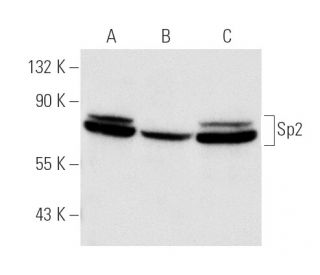

Sp2 Anticorpo (A-8): sc-17814
- Sp2 Anticorpo A-8é um anticorpo monoclonal produzido em camundongo IgG1 κ Sp2 anticorpo, citado em 4 publicações, fornecido em 200 µg/ml
- Produzido contra aminoácidos 154-435 de Sp2 de human origem
- Sp2 Anticorpo (A-8) é recomendado para a detecção de Sp2 de mouse, rat e human origem em WB, IP, IF e ELISA
- Anticorpo anti-Sp2 O anticorpo anti-Sp2 (A-8) está disponível conjugado com agarose para IP; HRP para WB, IHC(P) e ELISA; e com fioeritrina ou FITC para IF, IHC(P) e FCM
- também disponível conjugado com Alexa Fluor® 488, Alexa Fluor® 546, Alexa Fluor® 594 ou Alexa Fluor® 647 para WB (RGB), IF, IHC(P) e FCM, e para utilização com sistemas de imagiologia fluorescente RGB, tais como iBright™ FL1000, FluorChem™, Typhoon, Azure e outros sistemas comparáveis
- também disponível conjugado com Alexa Fluor® 680 ou Alexa Fluor® 790 para WB (NIR), IF e FCM; para utilização com sistemas de deteção de infravermelhos próximos (NIR), tais como LI-COR®Odyssey®, iBright™ FL1000, FluorChem™, Typhoon, Azure e outros sistemas comparáveis
- disponível como reagente TransCruz para ensaios de Gel Supershift e uso em ChIP (sc-17814 X, 200 µg/0.1 ml)
- m-IgG Fc BP-HRP e m-IgG1 BP-HRP são os reagentes de deteção secundários preferidos para Sp2 Antibody (A-8) for WB applications. Estes reagentes são agora oferecidos em conjuntos com Sp2 Antibody (A-8)(ver informações de encomenda abaixo).

LINKS RÁPIDOS
VEJA TAMBÉM
O anticorpo Sp2 (A-8) é um anticorpo monoclonal de cadeia leve IgG1 kappa de ratinho que detecta a proteína Sp2 de origem de camundongo, rato e humana por western blotting (WB), imunoprecipitação (IP), imunofluorescência (IF) e ensaio imunoenzimático (ELISA). O anticorpo Sp2 (A-8) está disponível em formas não conjugadas e em várias formas conjugadas, incluindo agarose, peroxidase de rábano (HRP), ficoeritrina (PE), isotiocianato de fluoresceína (FITC) e vários conjugados Alexa Fluor®. A proteína Sp2, um membro da família de factores de transcrição Sp, desempenha um papel crucial na regulação da expressão genética através da ligação a sequências de ADN específicas conhecidas como caixas GC, embora a Sp2 exiba uma afinidade mais fraca para as caixas GT em comparação com os seus homólogos da família. Esta ligação diferencial é significativa, uma vez que o Sp2 influencia a atividade transcricional de genes envolvidos em vários processos celulares, incluindo o crescimento e a diferenciação celular. Os factores de transcrição Sp, que também incluem Sp1, Sp3 e Sp4, partilham um domínio conservado de ligação ao ADN caracterizado por três dedos de zinco no terminal C, mas cada um desempenha funções distintas na célula. Enquanto Sp1, Sp3 e Sp4 são expressos de forma ubíqua, a expressão de Sp2 é mais restrita, o que pode contribuir para papéis reguladores únicos em tecidos específicos. O gene que codifica a Sp2 humana está localizado no cromossoma 17p32.3, o que realça a importância genética da Sp2 no contexto da saúde e da doença humanas.
Alexa Fluor® é uma marca comercial da Molecular Probes Inc., OR., EUA
LI-COR® e Odyssey® são marcas registadas da LI-COR Biosciences
Referencias do Sp2 Anticorpo (A-8):
- Clonagem de proteínas de ligação à caixa GT: uma nova família multigénica Sp1 que regula a expressão do gene do recetor de células T. | Kingsley, C. and Winoto, A. 1992. Mol Cell Biol. 12: 4251-61. PMID: 1341900
- Clonagem por rastreio de sítios de reconhecimento de duas novas proteínas de ligação à caixa GT: uma família de genes relacionados com Sp1. | Hagen, G., et al. 1992. Nucleic Acids Res. 20: 5519-25. PMID: 1454515
- Identificação de Sp2 como repressor transcricional da molécula de adesão celular 1 relacionada com o antigénio carcinoembrionário na tumorigénese. | Phan, D., et al. 2004. Cancer Res. 64: 3072-8. PMID: 15126343
- Sp2 localiza-se em focos subnucleares associados à matriz nuclear. | Moorefield, KS., et al. 2006. Mol Biol Cell. 17: 1711-22. PMID: 16467376
- A Sp2 promove a invasão e a metástase do carcinoma hepatocelular através da ativação da proteína TRIB3. | Zhu, Y., et al. 2020. Cancer Med. 9: 3592-3603. PMID: 32160655
- O fator de transcrição Sp2 promove a diferenciação osteogénica de células intersticiais mediada por TGFB em válvulas aórticas bicúspides através de uma via dependente de SMAD. | Zheng, R., et al. 2022. Exp Cell Res. 411: 112972. PMID: 34914964
- Reacções de Aminação Csp2-H Mediadas por Espécies de Aryl-CoIII-nitreno Mascaradas Pseudo-Oh Metastáveis. | Capdevila, L., et al. 2022. Inorg Chem. 61: 14075-14085. PMID: 35997604
- Aminação Organocatalítica Csp2-O de Quinolin-4(1H)-onas com 3-Alquil-3-hidroxiisoindolinonas. | Huang, T., et al. 2024. J Org Chem. 89: 9086-9091. PMID: 38815157
- Análises funcionais do fator de transcrição Sp4 revelam propriedades distintas de Sp1 e Sp3. | Hagen, G., et al. 1995. J Biol Chem. 270: 24989-94. PMID: 7559627
- A ativação transcricional mediada por Sp1 é reprimida por Sp3. | Hagen, G., et al. 1994. EMBO J. 13: 3843-51. PMID: 8070411
- Sp1 e Sp3 regulam a expressão do gene da subunidade beta4 do recetor nicotínico de acetilcolina neuronal. | Bigger, CB., et al. 1997. J Biol Chem. 272: 25976-82. PMID: 9325332
Informacoes sobre ordens
| Nome do Produto | Numero de Catalogo | UNID | Preco | Qde | FAVORITOS | |
Sp2 Anticorpo (A-8) | sc-17814 | 200 µg/ml | $322.00 | |||
Pacote do Sp2 (A-8): m-IgG Fc BP-HRP | sc-526574 | 200 µg Ab; 10 µg BP | $361.00 | |||
Pacote do Sp2 (A-8): m-IgG1 BP-HRP | sc-531947 | 200 µg Ab; 20 µg BP | $361.00 | |||
Sp2 Anticorpo (A-8) X | sc-17814 X | 200 µg/0.1 ml | $322.00 | |||
Sp2 Anticorpo (A-8) AC | sc-17814 AC | 500 µg/ml, 25% agarose | $424.00 | |||
Sp2 Anticorpo (A-8) HRP | sc-17814 HRP | 200 µg/ml | $322.00 | |||
Sp2 Anticorpo (A-8) FITC | sc-17814 FITC | 200 µg/ml | $336.00 | |||
Sp2 Anticorpo (A-8) PE | sc-17814 PE | 200 µg/ml | $349.00 | |||
Sp2 Anticorpo (A-8) Alexa Fluor® 488 | sc-17814 AF488 | 200 µg/ml | $364.00 | |||
Sp2 Anticorpo (A-8) Alexa Fluor® 546 | sc-17814 AF546 | 200 µg/ml | $364.00 | |||
Sp2 Anticorpo (A-8) Alexa Fluor® 594 | sc-17814 AF594 | 200 µg/ml | $364.00 | |||
Sp2 Anticorpo (A-8) Alexa Fluor® 647 | sc-17814 AF647 | 200 µg/ml | $364.00 | |||
Sp2 Anticorpo (A-8) Alexa Fluor® 680 | sc-17814 AF680 | 200 µg/ml | $364.00 | |||
Sp2 Anticorpo (A-8) Alexa Fluor® 790 | sc-17814 AF790 | 200 µg/ml | $364.00 |