
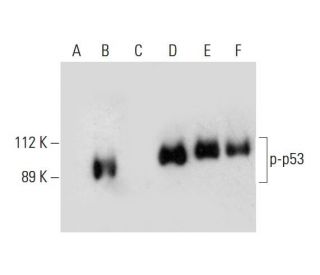
goat polyclonal IgG, 200 µg/ml; also available as rabbit IgG, 200 µg/ml, sc-17105-R
epitope corresponding to a short amino acid sequence containing phosphorylated Thr 155 of p53 of human origin
recommended for detection of Thr 155 phosphorylated p53 of h origin by WB, IF and ELISA; also reactive with additional species, including equine, bovine, porcine and avian
p53 Background Information p53 is a DNA-binding, oligomerization domain- and transcription activation domain-containing tumor suppressor that upregulates growth arrest and apoptosis-related genes in response to stress signals, thereby influencing programmed cell death, cell differentiation and cell cycle control mechanisms. p53 localizes to the nucleus yet can be chaperoned to the cytoplasm by the negative regulator MDM2, an E3 ubiquitin ligase that is upregulated in the presence of active p53, where MDM2 polyubiquitinates p53 for proteasome targeting. p53 can assemble into tetramers in the absence of DNA, fluctuates between latent and active (DNA-binding) conformations, and is differentially activated through posttranslational modifications including phosphorylation and acetylation. Mutations in the DNA-binding domain (DBD) (amino acids 110-286) of p53 can compromise energetically favorable association with cis elements and are implicated in several human cancers. Phosphorylation of p53 at residue Thr 155 is mediated by the COP9 signalosome (CSN) and targets p53 to ubiquitin-26S Proteasome-dependent degradation.
p-p53 (Thr 155) Product Citations
See how others have used p-p53 (Thr 155): sc-17105 antibody and or p-p53 (Thr 155) antibody conjugates.
