
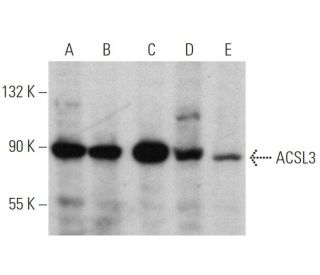
ACSL3 항체 (H-9): sc-166374
- ACSL3 항체 H-9 는 마우스 monoclonal IgG2b κ ACSL3 항체, 12간행물에 인용, 이며 200 µg/ml으로 제공합니다.
- 항원결정부는 human origin의 ACSL3의 내부에 위치한 645-672의 아미노산에 해당됩니다.
- ACSL3 항체 (H-9)는 WB, IP, IF, IHC(P) and ELISA으로 mouse, rat and human유래의 ACSL3 를 감지하는 데에 추천한다.; 이외에, equine, canine, bovine and porcine등 species와 반응할수 있습니다
- 항-ACSL3 항체(H-9)는 IP용 agarose와 결합되어 이용 가능하며, WB, IHC(P), ELISA용 HRP와 결합되어 이용 가능하며, IF, IHC(P), FCM용 phycoerythrin 또는 FITC와 결합되어 이용 가능합니다.
- WB (RGB), IF, IHC(P) 와FCM, RGB fluorescent imaging systems, such as iBright™ FL1000, FluorChem™, Typhoon, Azure and other comparable systems에 사용가능한 Alexa Fluor® 488, Alexa Fluor® 546, Alexa Fluor® 594 or Alexa Fluor® 647결합제품도 있습니다.
- WB (NIR), IF와FCM,Near-Infrared (NIR) detection systems, such as LI-COR®Odyssey®, iBright™ FL1000, FluorChem™, Typhoon, Azure and other comparable systems에 사용가능한 Alexa Fluor® 680 or Alexa Fluor® 790 결합제품도 있습니다.
- 2b BP-HRP">m-IgG2b BP-HRP 및 m-IgGκ BP-HRP는 ACSL3 항체 (H-9) WB 및 IHC(P) 애플리케이션용입니다. 이 시약은 이제 ACSL3 항체 (H-9)와 함께 번들로 제공됩니다(아래 주문 정보 참조).

ACSL3 항체(H-9)는 마우스, 쥐 및 인간 유래의 ACSL3 단백질을 WB, IP, IF, IHC(P) 및 ELISA로 검출하는 IgG2b κ 마우스 모노클로날 ACSL3 항체입니다. ACSL3 항체(H-9)는 비접합 항체 형태뿐만 아니라 아가로스, HRP, PE, FITC 및 여러 Alexa Fluor® 접합체를 포함한 여러 접합 형태의 항체로도 제공됩니다. 장쇄 지방산 CoA 합성 효소(ACSL) 또는 팔미토일-CoA 리가제라고도 하는 아실-CoA 합성 효소에는 미토콘드리온, 마이크로솜 또는 퍼옥시좀에 국한되는 단일 통과 막 단백질인 ACSL1-6이 포함됩니다. ACSL 단백질은 세포 지질 합성과 β-산화 분해에 중요한 역할을 합니다. 특히, ACSL 단백질은 장쇄 지방산을 아실-CoA로 활성화하는 촉매 역할을 하며, 이는 대사되어 CO2, 트리아실글리세롤(TAG), 인지질(PL) 및 콜레스테롤 에스테르(CE)를 형성할 수 있습니다. ACSL3는 포화 및 불포화 장쇄 지방산 중 라우레이트, 미리스테이트, 아라키도네이트, 에이코사펜타에노에이트를 우선적으로 활용합니다. ACSL3는 뇌, 심장, 태반, 전립선, 골격근, 고환, 흉선 등 다양한 조직에서 두 가지 이소형으로 발현됩니다. ACSL4는 아라키도네이트를 우선적으로 활용하며 스테로이드 생성 조직에 풍부합니다. ACSL4는 여성의 생식 능력과 자궁 프로스타글란딘 생성을 조절할 수 있습니다.
Alexa Fluor®는 미국 오리건주 Molecular Probes Inc.의 상표입니다.
LI-COR®와 Odyssey®는 LI-COR Biosciences의 등록 상표입니다.
ACSL3 항체 (H-9) 참고문헌:
- 스테로이드 생성 조직에서 발현되는 아라키도네이트 선호 효소인 아실-CoA 합성 효소 4의 발현을 부신피질 자극 호르몬과 아라키도네이트에 의해 조절합니다. | Cho, YY., et al. 2000. Biochem Biophys Res Commun. 274: 741-5. PMID: 10924347
- 간에서 기능적으로 전달되는 아실-CoA: 아실-CoA 합성효소의 잠재적 역할. | Muoio, DM., et al. 2000. Am J Physiol Endocrinol Metab. 279: E1366-73. PMID: 11093925
- 아실-CoA 합성효소 4 결핍 이형 접합 마우스에서 다낭종, 자궁 프로스타글란딘 축적 및 생식력 감소를 동반한 비정상적인 자궁. | Cho, YY., et al. 2001. Biochem Biophys Res Commun. 284: 993-7. PMID: 11409893
- 인간 아실-CoA 합성효소 4 유전자의 엑손/인트론 조직 및 전사 단위. | Minekura, H., et al. 2001. Biochem Biophys Res Commun. 286: 80-6. PMID: 11485311
- 인간 아실-CoA 합성 효소 3 유전자의 게놈 조직 및 전사 단위. | Minekura, H., et al. 2001. Gene. 278: 185-92. PMID: 11707336
- 장쇄 아실-CoA 합성효소는 합성 경로와 분해 경로로 지방산 유입을 조절할까요? | Coleman, RA., et al. 2002. J Nutr. 132: 2123-6. PMID: 12163649
- Baicalein은 GPX4/ACSL4/ACSL3 축을 조절하여 ferroptosis를 억제함으로써 대뇌 허혈-재관류 손상을 개선합니다. | Li, M., et al. 2022. Chem Biol Interact. 366: 110137. PMID: 36055377
- ACSL3는 투명 세포 신장 세포 암종에서 지질 방울 생성과 페로셉토시스 민감성을 조절합니다. | Klasson, TD., et al. 2022. Cancer Metab. 10: 14. PMID: 36192773
- ACSL3와 ACSL4, 철분증과 암에서 뚜렷한 역할. | Yang, Y., et al. 2022. Cancers (Basel). 14: PMID: 36497375
- ANKRD1은 TRIM25 매개 유비퀴틴화를 촉진하여 신장 허혈-재관류 손상을 악화시킵니다. | Han, S., et al. 2024. Clin Transl Med. 14: e70024. PMID: 39285846
- 쥐 아실-CoA 합성 효소 3의 분자 특성 및 발현. | Fujino, T., et al. 1996. J Biol Chem. 271: 16748-52. PMID: 8663269
- 대체 번역 개시는 이질적인 아미노 말단을 가진 아실-CoA 합성 효소 3 동형체를 생성합니다. | Fujino, T., et al. 1997. J Biochem. 122: 212-6. PMID: 9276691
주문정보
| 제품명 | 카탈로그 번호 | 단위 | 가격 | 수량 | 관심품목 | |
ACSL3 항체 (H-9) | sc-166374 | 200 µg/ml | $322.00 | |||
ACSL3 (H-9): m-IgGκ BP-HRP 번들 | sc-521581 | 200 µg Ab, 40 µg BP | $361.00 | |||
ACSL3 (H-9): m-IgG2b BP-HRP 번들 | sc-548931 | 200 µg Ab; 10 µg BP | $361.00 | |||
ACSL3 항체 (H-9) AC | sc-166374 AC | 500 µg/ml, 25% agarose | $424.00 | |||
ACSL3 항체 (H-9) HRP | sc-166374 HRP | 200 µg/ml | $322.00 | |||
ACSL3 항체 (H-9) FITC | sc-166374 FITC | 200 µg/ml | $336.00 | |||
ACSL3 항체 (H-9) PE | sc-166374 PE | 200 µg/ml | $349.00 | |||
ACSL3 항체 (H-9) Alexa Fluor® 488 | sc-166374 AF488 | 200 µg/ml | $364.00 | |||
ACSL3 항체 (H-9) Alexa Fluor® 546 | sc-166374 AF546 | 200 µg/ml | $364.00 | |||
ACSL3 항체 (H-9) Alexa Fluor® 594 | sc-166374 AF594 | 200 µg/ml | $364.00 | |||
ACSL3 항체 (H-9) Alexa Fluor® 647 | sc-166374 AF647 | 200 µg/ml | $364.00 | |||
ACSL3 항체 (H-9) Alexa Fluor® 680 | sc-166374 AF680 | 200 µg/ml | $364.00 | |||
ACSL3 항체 (H-9) Alexa Fluor® 790 | sc-166374 AF790 | 200 µg/ml | $364.00 | |||
ACSL3 (H-9) 중화펩타이드 | sc-166374 P | 100 µg/0.5 ml | $69.00 |