
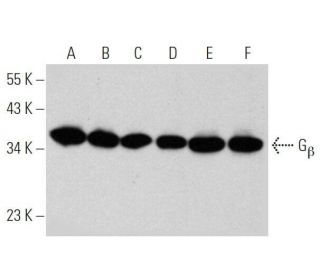
Gβ Anticuerpo (A-4): sc-166250
- Gβ Anticuerpo (A-4) es un monoclonal de ratón IgG1 κ, ver las 1 publicaciones, proporcionado como 200 µg/ml
- planteada frente a los aminoácidos 1-300 que corresponden al N-terminus de Gβ 2 de human origen
- recomendado para detectarGβ 1, Gβ 2, Gβ 3 and Gβ 4 de mouse, rat y human origen, mediante WB, IP, IF y ELISA
- m-IgG Fc BP-HRP y m-IgG1 BP-HRP son los reactivos de detección secundarios preferidos para Gβ Anticuerpo (A-4) for WB applications. Estos reactivos se ofrecen ahora en paquetes con Gβ Anticuerpo (A-4)(véase la información de pedido más abajo).

ENLACES RÁPIDOS
Las proteínas G heterotriméricas funcionan para transmitir información desde los receptores de la superficie celular a los efectores intracelulares. Cada uno de una amplia gama de receptores detecta específicamente un estímulo extracelular (es decir, un fotón, feromona, olor, hormona o neurotransmisor), mientras que los efectores (por ejemplo, la adenil ciclasa), que actúan para generar uno o más mensajeros intracelulares, son menos numerosos. Cada subunidad del complejo de proteínas G está codificada por un miembro de una de las tres familias de genes correspondientes (α, β, γ). En mamíferos, hay cinco miembros diferentes de la familia de la subunidad β. Las subunidades β de las proteínas G son reguladores importantes de las subunidades α de las proteínas G, así como de ciertos receptores de transducción de señales y efectores. En contraste con G β1-4, que son al menos 83% homólogos, G β5 es solo 50% homólogo a las otras subunidades β. La G β5 humana se expresa en niveles altos en el cerebro, páncreas, riñón y corazón.
Alexa Fluor® es una marca registrada de Molecular Probes Inc., OR., USA
REIVEW LI-COR® y Odyssey® son marcas registradas de LI-COR Biosciences.
Gβ Anticuerpo (A-4) Referencias:
- Identificación de residuos en el extremo N de alfa1B críticos para la inhibición del canal de calcio dependiente de voltaje por Gbeta gamma. | Cantí, C., et al. 1999. J Neurosci. 19: 6855-64. PMID: 10436043
- Activación del factor nuclear Kappa B por el receptor H(1) de la histamina: funciones de las subunidades G beta gamma y G alfa(q/11) en la señalización constitutiva y mediada por agonistas. | Bakker, RA., et al. 2001. Mol Pharmacol. 60: 1133-42. PMID: 11641442
- Contribución gradual de los dominios de unión gamma Gbeta a la activación del canal GIRK. | Sadja, R., et al. 2002. Proc Natl Acad Sci U S A. 99: 10783-8. PMID: 12124401
- La proteína Galpha Gpa2 controla la diferenciación de la levadura interactuando con proteínas de repetición kelch que imitan a las subunidades Gbeta. | Harashima, T. and Heitman, J. 2002. Mol Cell. 10: 163-73. PMID: 12150916
- Roles de G beta gamma en el reclutamiento de membrana y la activación de p110 gamma/p101 fosfoinositida 3-quinasa gamma. | Brock, C., et al. 2003. J Cell Biol. 160: 89-99. PMID: 12507995
- La subunidad p101 de PI3Kγ restaura la activación por mutantes Gβ deficientes en p110γ estimulante. | Shymanets, A., et al. 2012. Biochem J. 441: 851-8. PMID: 22054284
- Disección de la transducción de señales Gβ de Arabidopsis en la superficie de la proteína. | Jiang, K., et al. 2012. Plant Physiol. 159: 975-83. PMID: 22570469
- Análisis Proteómico Cuantitativo de Monitorización de Reacciones Múltiples de las Subunidades Gβ y Gγ en Sinaptosomas Cerebrales de C57Bl6/J. | Yim, YY., et al. 2017. Biochemistry. 56: 5405-5416. PMID: 28880079
- Localización de G alfa 0 en conos de crecimiento de células PC12: papel de la asociación de G alfa 0 con receptores y G beta gamma. | Nüsse, O. and Neer, EJ. 1996. J Cell Sci. 109 (Pt 1): 221-8. PMID: 8834806
- Señalización celular selectivamente aumentada por las proteínas Gi en la hipertensión esencial. G alfa i2, G alfa i3, G beta 1 y G beta 2 no están mutadas. | Pietruck, F., et al. 1996. Circ Res. 79: 974-83. PMID: 8888689
Información sobre pedidos
| Nombre del producto | Número de catálogo | UNIDAD | Precio | CANTIDAD | Favoritos | |
Gβ Anticuerpo (A-4) | sc-166250 | 200 µg/ml | $322.00 | |||
Paquete de Gβ (A-4): m-IgG Fc BP-HRP | sc-540058 | 200 µg Ab; 10 µg BP | $361.00 | |||
Paquete de Gβ (A-4): m-IgG1 BP-HRP | sc-541878 | 200 µg Ab; 20 µg BP | $361.00 |