
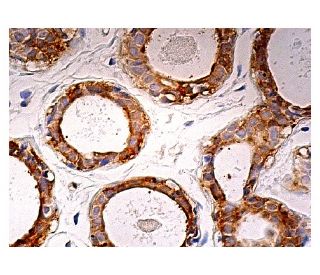
ThrRS Antibody (C-3): sc-166146
- ThrRS Antibody (C-3) is a mouse monoclonal IgG1 κ ThrRS antibody, cited in 2 publications, provided at 200 µg/ml
- raised against amino acids 1-98 mapping at the N-terminus of ThrRS of human origin
- ThrRS Antibody (C-3) is recommended for detection of ThrRS of mouse, rat and human origin by WB, IP, IF, IHC(P) and ELISA
- Anti-ThrRS Antibody (C-3) is available conjugated to agarose for IP; HRP for WB, IHC(P) and ELISA; and to either phycoerythrin or FITC for IF, IHC(P) and FCM
- also available conjugated to Alexa Fluor® 488, Alexa Fluor® 546, Alexa Fluor® 594 or Alexa Fluor® 647 for WB (RGB), IF, IHC(P) and FCM, and for use with RGB fluorescent imaging systems, such as iBright™ FL1000, FluorChem™, Typhoon, Azure and other comparable systems
- also available conjugated to Alexa Fluor® 680 or Alexa Fluor® 790 for WB (NIR), IF and FCM; for use with Near-Infrared (NIR) detection systems, such as LI-COR®Odyssey®, iBright™ FL1000, FluorChem™, Typhoon, Azure and other comparable systems
- m-IgG Fc BP-HRP, m-IgG1 BP-HRP and m-IgGκ BP-HRP are the preferred secondary detection reagents for ThrRS Antibody (C-3) for WB and IHC(P) applications. These reagents are now offered in bundles with ThrRS Antibody (C-3) (see ordering information below).

QUICK LINKS
SEE ALSO...
ThrRS Antibody (C-3) is a mouse monoclonal IgG1 kappa light chain antibody that detects ThrRS protein of mouse, rat, and human origin by western blotting (WB), immunoprecipitation (IP), immunofluorescence (IF), immunohistochemistry, and enzyme-linked immunosorbent assay (ELISA). ThrRS (C-3) antibody is available in both non-conjugated and various conjugated forms, including agarose, horseradish peroxidase (HRP), phycoerythrin (PE), fluorescein isothiocyanate (FITC), and multiple Alexa Fluor® conjugates. ThrRS protein, also known as threonyl-tRNA synthetase, plays a crucial role in protein synthesis by catalyzing the attachment of threonine to corresponding tRNA, a process essential for accurate translation of genetic information into functional proteins. This enzyme is localized in the cytoplasm and is a member of the class-II aminoacyl-tRNA synthetase family, consisting of 723 amino acids. The structure includes a zinc-binding catalytic domain, a C-terminal tRNA-binding domain, and an N-terminal editing domain, which are vital for function. ThrRS features four mobile regions that facilitate conformational changes during catalysis, enhancing the efficiency of the tRNA-amino acid reaction. The dynamic nature of these regions, particularly the key residues that shift conformation, underscores the importance of structural integrity in catalytic activity, ultimately influencing the fidelity of protein synthesis in cells.
Alexa Fluor® is a trademark of Molecular Probes Inc., OR., USA
LI-COR® and Odyssey® are registered trademarks of LI-COR Biosciences
ThrRS Antibody (C-3) References:
- The structure of threonyl-tRNA synthetase-tRNA(Thr) complex enlightens its repressor activity and reveals an essential zinc ion in the active site. | Sankaranarayanan, R., et al. 1999. Cell. 97: 371-81. PMID: 10319817
- Conformational movements and cooperativity upon amino acid, ATP and tRNA binding in threonyl-tRNA synthetase. | Torres-Larios, A., et al. 2003. J Mol Biol. 331: 201-11. PMID: 12875846
- Unusually high frequency of autoantibodies to PL-7 associated with milder muscle disease in Japanese patients with polymyositis/dermatomyositis. | Yamasaki, Y., et al. 2006. Arthritis Rheum. 54: 2004-9. PMID: 16732549
- Post-transfer editing mechanism of a D-aminoacyl-tRNA deacylase-like domain in threonyl-tRNA synthetase from archaea. | Hussain, T., et al. 2006. EMBO J. 25: 4152-62. PMID: 16902403
- Antisynthetase syndrome associated with sarcoidosis. | Asanuma, Y., et al. 2006. Intern Med. 45: 1065-8. PMID: 17043379
- Mechanism of tRNA-dependent editing in translational quality control. | Ling, J., et al. 2007. Proc Natl Acad Sci U S A. 104: 72-7. PMID: 17185419
- N-terminal domains of native multidomain proteins have the potential to assist de novo folding of their downstream domains in vivo by acting as solubility enhancers. | Kim, CW., et al. 2007. Protein Sci. 16: 635-43. PMID: 17384228
- Threonyl-tRNA synthetase of archaea: importance of the discriminator base in the aminoacylation of threonine tRNA. | Ishikura, H., et al. 2000. Nucleic Acids Symp Ser. 83-4. PMID: 12903279
- A unique hydrophobic cluster near the active site contributes to differences in borrelidin inhibition among threonyl-tRNA synthetases. | Ruan, B., et al. 2005. J Biol Chem. 280: 571-7. PMID: 15507440
Ordering Information
| Product Name | Catalog # | UNIT | Price | Qty | FAVORITES | |
ThrRS Antibody (C-3) | sc-166146 | 200 µg/ml | $322.00 | |||
ThrRS Antibody (C-3): m-IgG Fc BP-HRP Bundle | sc-528915 | 200 µg Ab; 10 µg BP | $361.00 | |||
ThrRS Antibody (C-3): m-IgGκ BP-HRP Bundle | sc-521522 | 200 µg Ab, 40 µg BP | $361.00 | |||
ThrRS Antibody (C-3): m-IgG1 BP-HRP Bundle | sc-543208 | 200 µg Ab; 20 µg BP | $361.00 | |||
ThrRS Antibody (C-3) AC | sc-166146 AC | 500 µg/ml, 25% agarose | $424.00 | |||
ThrRS Antibody (C-3) HRP | sc-166146 HRP | 200 µg/ml | $322.00 | |||
ThrRS Antibody (C-3) FITC | sc-166146 FITC | 200 µg/ml | $336.00 | |||
ThrRS Antibody (C-3) PE | sc-166146 PE | 200 µg/ml | $349.00 | |||
ThrRS Antibody (C-3) Alexa Fluor® 488 | sc-166146 AF488 | 200 µg/ml | $364.00 | |||
ThrRS Antibody (C-3) Alexa Fluor® 546 | sc-166146 AF546 | 200 µg/ml | $364.00 | |||
ThrRS Antibody (C-3) Alexa Fluor® 594 | sc-166146 AF594 | 200 µg/ml | $364.00 | |||
ThrRS Antibody (C-3) Alexa Fluor® 647 | sc-166146 AF647 | 200 µg/ml | $364.00 | |||
ThrRS Antibody (C-3) Alexa Fluor® 680 | sc-166146 AF680 | 200 µg/ml | $364.00 | |||
ThrRS Antibody (C-3) Alexa Fluor® 790 | sc-166146 AF790 | 200 µg/ml | $364.00 |