
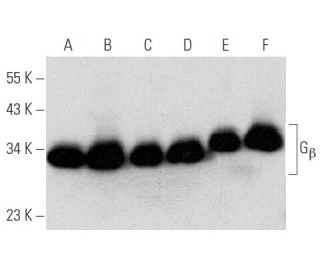
Gβ Antibody (H-1): sc-166123
- Gβ Antibody (H-1) is a mouse monoclonal IgG1 κ, cited in 13 publications, provided at 200 µg/ml
- specific for an epitope mapping between amino acids 302-340 at the C-terminus of Gβ of mouse origin
- G beta Antibody (H-1) is recommended for detection of Gβ1, Gβ2, Gβ3 and Gβ4 of mouse, rat, human and origin by WB, IP, IF, IHC(P) and ELISA; also reactive with additional species, including and equine, canine, bovine, porcine and avian
- Anti-G beta Antibody (H-1) is available conjugated to agarose for IP; HRP for WB, IHC(P) and ELISA; and to either phycoerythrin or FITC for IF, IHC(P) and FCM
- also available conjugated to Alexa Fluor® 488, Alexa Fluor® 546, Alexa Fluor® 594 or Alexa Fluor® 647 for WB (RGB), IF, IHC(P) and FCM, and for use with RGB fluorescent imaging systems, such as iBright™ FL1000, FluorChem™, Typhoon, Azure and other comparable systems
- also available conjugated to Alexa Fluor® 680 or Alexa Fluor® 790 for WB (NIR), IF and FCM; for use with Near-Infrared (NIR) detection systems, such as LI-COR®Odyssey®, iBright™ FL1000, FluorChem™, Typhoon, Azure and other comparable systems
- m-IgG1 BP-HRP and m-IgGκ BP-HRP are the preferred secondary detection reagents for Gβ Antibody (H-1) for WB and IHC(P) applications. These reagents are now offered in bundles with Gβ Antibody (H-1) (see ordering information below).

Gβ Antibody (H-1) is a mouse monoclonal IgG1 kappa light chain antibody that detects Gβ protein of mouse, rat, and human origin by western blotting (WB), immunoprecipitation (IP), immunofluorescence (IF), immunohistochemistry, and enzyme-linked immunosorbent assay (ELISA). Gβ (H-1) antibody is available in both non-conjugated and various conjugated forms, including agarose, horseradish peroxidase (HRP), phycoerythrin (PE), fluorescein isothiocyanate (FITC), and multiple Alexa Fluor® conjugates. Gβ protein plays a crucial role in cellular signaling as part of heterotrimeric G proteins, which are essential for transmitting signals from cell surface receptors to intracellular effectors. These receptors are responsible for detecting a wide array of extracellular stimuli, such as hormones and neurotransmitters, while Gβ subunits help regulate the activity of G protein alpha subunits and certain signal transduction pathways. Notably, Gβ subunit family consists of five members in mammals, with Gβ1-4 sharing at least 83% homology, whereas Gβ5 exhibits only 50% homology to the others. Gβ5 is particularly significant as Gβ5 is highly expressed in the brain, pancreas, kidney, and heart, indicating potential involvement in various physiological processes. Gβ proteins′ ability to modulate signaling pathways underscores their importance in maintaining cellular communication and response to external stimuli, making Gβ (H-1) monoclonal antibody a valuable tool for researchers studying these critical mechanisms.
Alexa Fluor® is a trademark of Molecular Probes Inc., OR., USA
LI-COR® and Odyssey® are registered trademarks of LI-COR Biosciences
Gβ Antibody (H-1) References:
- Different beta-subunits determine G-protein interaction with transmembrane receptors. | Kleuss, C., et al. 1992. Nature. 358: 424-6. PMID: 1322501
- Activation of cytosolic phosphoinositide phospholipase C by G-protein beta gamma subunits. | Blank, JL., et al. 1992. J Biol Chem. 267: 23069-75. PMID: 1331076
- Selective tissue distribution of G protein gamma subunits, including a new form of the gamma subunits identified by cDNA cloning. | Cali, JJ., et al. 1992. J Biol Chem. 267: 24023-7. PMID: 1385432
- G protein beta gamma subunits synthesized in Sf9 cells. Functional characterization and the significance of prenylation of gamma. | Iñiguez-Lluhi, JA., et al. 1992. J Biol Chem. 267: 23409-17. PMID: 1429682
- Diversity among the beta subunits of heterotrimeric GTP-binding proteins: characterization of a novel beta-subunit cDNA. | von Weizsäcker, E., et al. 1992. Biochem Biophys Res Commun. 183: 350-6. PMID: 1543505
- Diversity of G proteins in signal transduction. | Simon, MI., et al. 1991. Science. 252: 802-8. PMID: 1902986
- G protein diversity is increased by associations with a variety of gamma subunits. | Gautam, N., et al. 1990. Proc Natl Acad Sci U S A. 87: 7973-7. PMID: 2122451
- Inter-relationships between the heterotrimeric Gβ subunit AGB1, the receptor-like kinase FERONIA, and RALF1 in salinity response. | Yu, Y. and Assmann, SM. 2018. Plant Cell Environ. 41: 2475-2489. PMID: 29907954
- Structural mechanism of calcium-mediated hormone recognition and Gβ interaction by the human melanocortin-1 receptor. | Ma, S., et al. 2021. Cell Res. 31: 1061-1071. PMID: 34453129
- Alcohol self-administration and nicotine withdrawal alter biomarkers of stress and inflammation and prefrontal cortex changes in Gβ subunits. | Cruz, B., et al. 2023. Am J Drug Alcohol Abuse. 49: 321-332. PMID: 36206520
- Selectivity in signal transduction determined by gamma subunits of heterotrimeric G proteins. | Kleuss, C., et al. 1993. Science. 259: 832-4. PMID: 8094261
- Structural elements of G alpha subunits that interact with G beta gamma, receptors, and effectors. | Conklin, BR. and Bourne, HR. 1993. Cell. 73: 631-41. PMID: 8388779
Ordering Information
| Product Name | Catalog # | UNIT | Price | Qty | FAVORITES | |
Gβ Antibody (H-1) | sc-166123 | 200 µg/ml | $322.00 | |||
Gβ Antibody (H-1): m-IgGκ BP-HRP Bundle | sc-521516 | 200 µg Ab, 40 µg BP | $361.00 | |||
Gβ Antibody (H-1): m-IgG1 BP-HRP Bundle | sc-533495 | 200 µg Ab; 20 µg BP | $361.00 | |||
Gβ Antibody (H-1) AC | sc-166123 AC | 500 µg/ml, 25% agarose | $424.00 | |||
Gβ Antibody (H-1) HRP | sc-166123 HRP | 200 µg/ml | $322.00 | |||
Gβ Antibody (H-1) FITC | sc-166123 FITC | 200 µg/ml | $336.00 | |||
Gβ Antibody (H-1) PE | sc-166123 PE | 200 µg/ml | $349.00 | |||
Gβ Antibody (H-1) Alexa Fluor® 488 | sc-166123 AF488 | 200 µg/ml | $364.00 | |||
Gβ Antibody (H-1) Alexa Fluor® 546 | sc-166123 AF546 | 200 µg/ml | $364.00 | |||
Gβ Antibody (H-1) Alexa Fluor® 594 | sc-166123 AF594 | 200 µg/ml | $364.00 | |||
Gβ Antibody (H-1) Alexa Fluor® 647 | sc-166123 AF647 | 200 µg/ml | $364.00 | |||
Gβ Antibody (H-1) Alexa Fluor® 680 | sc-166123 AF680 | 200 µg/ml | $364.00 | |||
Gβ Antibody (H-1) Alexa Fluor® 790 | sc-166123 AF790 | 200 µg/ml | $364.00 | |||
Gβ (H-1) Neutralizing Peptide | sc-166123 P | 100 µg/0.5 ml | $69.00 |