
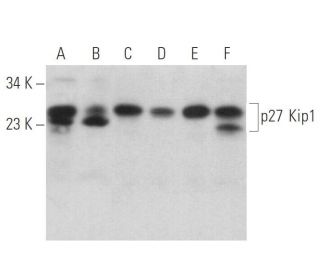
CDKN1B/Kip1 p27 Anticuerpo (F-8): sc-1641
- CDKN1B/Kip1 p27 Anticuerpo F-8 es un monoclonal de ratón IgG1 κ CDKN1B/Kip1 p27 Anticuerpo, ver las 673 publicaciones, proporcionado como 200 µg/ml
- producido contra los amino ácidos 1-197 representando la proteína completa p27 Kip1 de origen mouse
- CDKN1B/Kip1 p27 Anticuerpo (F-8) es recomendado para detectar p27 Kip1 de mouse, rat y human origen, mediante WB, IP, IF, IHC(P), FCM y ELISA
- CDKN1B/Kip1 p27 Anticuerpo (F-8) es disponible conjugado a agarosa para IP; HRP para WB, IHC(P) y ELISA; y tanto a phycoerythrin como a FITC para IF, IHC(P) y FCM
- también disponible conjugado a Alexa Fluor® 488, Alexa Fluor® 546, Alexa Fluor® 594 o Alexa Fluor® 647 para WB (RGB), IF, IHC (P) y FCM
- también disponible conjugado a Alexa Fluor® 680 o Alexa Fluor® 790 para WB (NIR), IF y FCM
- disponible conjugado tanto a TRITC como a Alexa Fluor® 405 para IF, IHC(P) y FCM
- m-IgG Fc BP-HRP y m-IgG1 BP-HRP son los reactivos de detección secundarios preferidos para CDKN1B/Kip1 p27 Anticuerpo (F-8) for WB and IHC(P) applications. Estos reactivos se ofrecen ahora en paquetes con CDKN1B/Kip1 p27 Anticuerpo (F-8)(véase la información de pedido más abajo).

ENLACES RÁPIDOS
VER TAMBIÉN ....
El anticuerpo p27 Kip1 (F-8) es un anticuerpo monoclonal IgG1 de ratón de cadena ligera kappa que detecta p27 Kip1 de origen de ratón, rata y humano a través de diversas aplicaciones, como la inmunotransferencia (WB), la inmunoprecipitación (IP), la inmunofluorescencia (IF), la inmunohistoquímica (IHC), la citometría de flujo (FCM) y el ensayo inmunoenzimático (ELISA). El anticuerpo p27 Kip1 (F-8) se ofrece tanto en forma no conjugada como en múltiples formas conjugadas, como agarosa, peroxidasa de rábano picante, ficoeritrina, isotiocianato de fluoresceína y diversos conjugados Alexa Fluor®. El p27 Kip1 desempeña un papel crucial en la regulación de la progresión del ciclo celular al actuar como regulador negativo de la transición a la fase G1, que es esencial para mantener una función celular adecuada y evitar la proliferación celular descontrolada. Se observan niveles elevados de p27 Kip1 en respuesta a daños en el ADN, en particular de forma dependiente de p53, lo que subraya su importancia en las respuestas al estrés celular. p27 Kip1 interactúa con las ciclinas de tipo D y la quinasa dependiente de ciclina 4, así como, en menor medida, con la ciclina E y la quinasa dependiente de ciclina 2, influyendo así en la actividad de estos reguladores clave en el ciclo celular. La modulación por p27 Kip1 de la dinámica del ciclo celular subraya su importancia en la biología del cáncer y en las estrategias terapéuticas dirigidas a la proliferación celular.
Alexa Fluor® es una marca registrada de Molecular Probes Inc., OR., USA
REIVEW LI-COR® y Odyssey® son marcas registradas de LI-COR Biosciences.
CDKN1B/Kip1 p27 Anticuerpo (F-8) Referencias:
- Señalización p27(Kip1): Regulación transcripcional y post-traduccional. | Hnit, SS., et al. 2015. Int J Biochem Cell Biol. 68: 9-14. PMID: 26279144
- p27kip1 como regulador clave de la endometriosis. | Gonçalves, GA. 2018. Eur J Obstet Gynecol Reprod Biol. 221: 1-4. PMID: 29216564
- p27Kip1 regula la expresión de la alfa-sinucleína. | Gallastegui, E., et al. 2018. Oncotarget. 9: 16368-16379. PMID: 29662651
- Clonación de p27Kip1, un inhibidor de la cinasa dependiente de ciclina y potencial mediador de señales antimitogénicas extracelulares. | Polyak, K., et al. 1994. Cell. 78: 59-66. PMID: 8033212
- p27, un nuevo inhibidor de la actividad G1 de la proteína cinasa ciclina-Cdk, está relacionado con p21. | Toyoshima, H. and Hunter, T. 1994. Cell. 78: 67-74. PMID: 8033213
- p15INK4B es un efector potencial de la detención del ciclo celular inducida por TGF-beta. | Hannon, GJ. and Beach, D. 1994. Nature. 371: 257-61. PMID: 8078588
- Un inhibidor de las cinasas dependientes de ciclinas regulado por el ciclo celular. | Hengst, L., et al. 1994. Proc Natl Acad Sci U S A. 91: 5291-5. PMID: 8202483
- WAF1, un mediador potencial de la supresión tumoral de p53. | el-Deiry, WS., et al. 1993. Cell. 75: 817-25. PMID: 8242752
- La p21 es un inhibidor universal de las ciclina quinasas. | Xiong, Y., et al. 1993. Nature. 366: 701-4. PMID: 8259214
- Un nuevo motivo regulador en el control del ciclo celular que causa la inhibición específica de la ciclina D/CDK4. | Serrano, M., et al. 1993. Nature. 366: 704-7. PMID: 8259215
- p27Kip1, un inhibidor de ciclina-Cdk, vincula el factor de crecimiento transformante-beta y la inhibición del contacto con la detención del ciclo celular. | Polyak, K., et al. 1994. Genes Dev. 8: 9-22. PMID: 8288131
- Ciclinas G1 de mamíferos. | Sherr, CJ. 1993. Cell. 73: 1059-65. PMID: 8513492
Información sobre pedidos
| Nombre del producto | Número de catálogo | UNIDAD | Precio | CANTIDAD | Favoritos | |
CDKN1B/Kip1 p27 Anticuerpo (F-8) | sc-1641 | 200 µg/ml | $322.00 | |||
Paquete de CDKN1B/Kip1 p27 (F-8): m-IgG Fc BP-HRP | sc-526469 | 200 µg Ab; 10 µg BP | $361.00 | |||
Paquete de CDKN1B/Kip1 p27 (F-8): m-IgG1 BP-HRP | sc-531842 | 200 µg Ab; 20 µg BP | $361.00 | |||
CDKN1B/Kip1 p27 Anticuerpo (F-8) AC | sc-1641 AC | 500 µg/ml, 25% agarose | $424.00 | |||
CDKN1B/Kip1 p27 Anticuerpo (F-8) HRP | sc-1641 HRP | 200 µg/ml | $322.00 | |||
CDKN1B/Kip1 p27 Anticuerpo (F-8) FITC | sc-1641 FITC | 200 µg/ml | $336.00 | |||
CDKN1B/Kip1 p27 Anticuerpo (F-8) PE | sc-1641 PE | 200 µg/ml | $349.00 | |||
CDKN1B/Kip1 p27 Anticuerpo (F-8) Alexa Fluor® 488 | sc-1641 AF488 | 200 µg/ml | $364.00 | |||
CDKN1B/Kip1 p27 Anticuerpo (F-8) Alexa Fluor® 546 | sc-1641 AF546 | 200 µg/ml | $364.00 | |||
CDKN1B/Kip1 p27 Anticuerpo (F-8) Alexa Fluor® 594 | sc-1641 AF594 | 200 µg/ml | $364.00 | |||
CDKN1B/Kip1 p27 Anticuerpo (F-8) Alexa Fluor® 647 | sc-1641 AF647 | 200 µg/ml | $364.00 | |||
CDKN1B/Kip1 p27 Anticuerpo (F-8) Alexa Fluor® 680 | sc-1641 AF680 | 200 µg/ml | $364.00 | |||
CDKN1B/Kip1 p27 Anticuerpo (F-8) Alexa Fluor® 790 | sc-1641 AF790 | 200 µg/ml | $364.00 | |||
CDKN1B/Kip1 p27 Anticuerpo (F-8) TRITC | sc-1641 TRITC | 200 µg/ml | $326.00 | |||
CDKN1B/Kip1 p27 Anticuerpo (F-8) Alexa Fluor® 405 | sc-1641 AF405 | 200 µg/ml | $364.00 |