
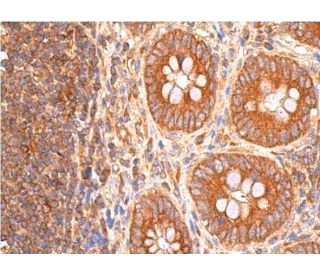

Cet anticorps polyclonal n'est plus commercialisé. Voir l'anticorps monoclonal CTLA-4 (F-8) que nous recommandons (données d'échantillonnage indiquées).
Anticorps CTLA-4 (C-19): sc-1628
- L'anticorps CTLA-4 C-19 est un polyclonal IgG de chèvre fourni en 200 µg/ml
- épitope situé au niveau C-terminus de CTLA-4 d'origine human
- Anticorps polyclonal arrêté

Pour la Recherche Uniquement. Non destiné à un usage diagnostique ou thérapeutique.
Alexa Fluor® est une marque déposée de Molecular Probes Inc., OR., USA
Informations pour la commande
CTLA-4 (F-8): sc-376016 [ Monoclonal recommandé en remplacement de CTLA-4 (C-19) ]
| Nom du produit | Ref. Catalogue | COND. | Prix HT | QTÉ | Favoris | |
Anticorps CTLA-4 (F-8) | sc-376016 | 200 µg/ml | $322.00 | |||
CTLA-4 (F-8): m-IgG Fc BP-HRP Kit | sc-529801 | 200 µg Ab; 10 µg BP | $361.00 | |||
CTLA-4 (F-8): m-IgGκ BP-HRP Kit | sc-522818 | 200 µg Ab, 40 µg BP | $361.00 | |||
CTLA-4 (F-8): m-IgG1 BP-HRP Kit | sc-543694 | 200 µg Ab; 20 µg BP | $361.00 | |||
Anticorps CTLA-4 (F-8) AC | sc-376016 AC | 500 µg/ml, 25% agarose | $424.00 | |||
Anticorps CTLA-4 (F-8) HRP | sc-376016 HRP | 200 µg/ml | $322.00 | |||
Anticorps CTLA-4 (F-8) FITC | sc-376016 FITC | 200 µg/ml | $336.00 | |||
Anticorps CTLA-4 (F-8) PE | sc-376016 PE | 200 µg/ml | $349.00 | |||
Anticorps CTLA-4 (F-8) Alexa Fluor® 488 | sc-376016 AF488 | 200 µg/ml | $364.00 | |||
Anticorps CTLA-4 (F-8) Alexa Fluor® 546 | sc-376016 AF546 | 200 µg/ml | $364.00 | |||
Anticorps CTLA-4 (F-8) Alexa Fluor® 594 | sc-376016 AF594 | 200 µg/ml | $364.00 | |||
Anticorps CTLA-4 (F-8) Alexa Fluor® 647 | sc-376016 AF647 | 200 µg/ml | $364.00 | |||
Anticorps CTLA-4 (F-8) Alexa Fluor® 680 | sc-376016 AF680 | 200 µg/ml | $364.00 | |||
Anticorps CTLA-4 (F-8) Alexa Fluor® 790 | sc-376016 AF790 | 200 µg/ml | $364.00 | |||
CTLA-4 (F-8) peptide neutralisant | sc-376016 P | 100 µg/0.5 ml | $69.00 |