
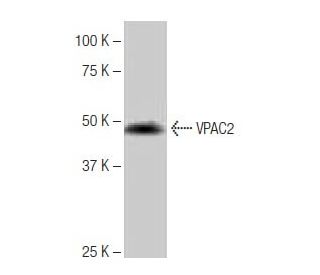
epitope mapping within an internal region of VPAC2 of human origin
recommended for detection of VPAC2 of mouse, rat and human origin by WB, IF and ELISA; also reactive with additional species, including equine, canine, bovine, porcine and avian
VPAC2 Background Information The vasoactive intestinal peptide (VIP) and pituitary adenylate cylase-activating polypeptide (PACAP) belong to a superfamily of peptide hormones that include glucagon, secretin and growth hormone releasing hormone (1,2). The effects of VIP and PACAP are mediated by three G-protein coupled receptors, VPAC1, VPAC2 and the PACAP receptor (also designated PAC1-R) (1,2). The VPAC receptors have equal affinities for VIP and PACAP, which stimulate the activation of adenylyl cyclase (1,3). Both VPAC1 and VPAC2 are abundantly expressed in brain and T cells, where they modulate neuronal differentiation and T cell activation, respectively (1,4-6). The PACAP receptor is a seven transmembrane protein that produces at least eight isoforms by alternative splicing (2). Each isoform is associated with a specific signaling pathway and a specific expression pattern (2). The PACAP receptor, which is thought to play an integral role in brain development, preferentially binds PACAP in order to stimulate a cAMP-protein kinase A signaling pathway (2,7).
VPAC2 (K-15) Product Citations
See how others have used VPAC2 (K-15): sc-15960 antibody and or VPAC2 (K-15) antibody conjugates.
